

What is WSG Singapore all about?
In 2026, career conversations in Singapore sound very different from how they did even five years ago. Fewer people talk about “climbing the ladder” in one company. More talk about staying relevant, learning new tools, and being able to move when roles change or disappear.
That shift is exactly why Workforce Singapore (WSG Singapore) Career Conversion Programmes, or CCPs, continue to attract attention. They were created to help mid-career individuals move into new roles while giving employers some support to train them. But with the rise of short, practical courses in AI, digital tools, business systems, and communication, many learners are now asking a fair question:
If I’m already upgrading my skills, are CCPs still worth it in 2026?
The answer isn’t a simple yes or no. It depends on how CCPs are used — and how well a person prepares before entering one.
Why CCPs Are Changing Skillsets?
One common misunderstanding about CCPs is that they are only for people making drastic career switches. In reality, many CCPs today support role evolution rather than a complete change.
For example:
– Someone with administrative experience may move into a more digitally driven operations role.
– A customer-facing professional might transition into business support or coordination functions.
– Someone with basic accounting exposure could step into system-based finance or reporting roles.
What employers are really looking for in 2026 is not a perfect background match, but evidence that a person can learn quickly, use modern tools, and function effectively in a changing work environment. This is where CCPs intersect very clearly with skills-based learning.
Why Short, Practical Courses Matter for CCP Readiness?
Talk to employers who participate in CCPs and a pattern becomes clear. They are far more confident hiring CCP candidates who already show some level of practical capability.
That doesn’t mean advanced technical mastery. It means things like:
- Understanding how generative AI tools such as ChatGPT or Copilot can be used at work
- Being comfortable with digital documents, collaboration platforms, and productivity tools
- Basic awareness of how businesses operate, from simple accounting flows to HR or admin systems
- Communicating clearly, asking the right questions, and working well with different teams
This is why many learners now take short courses such as AI Course for Beginners, Generative AI Course, Leadership Course, or Essential Office Skills Course before or alongside a CCP. These courses don’t replace the CCP. They make them more effective.
From an employer’s point of view, a candidate who already understands digital tools requires less guidance and settles into the role faster. That reduces risk, which is exactly what CCPs are meant to do.
Why WSG Singapore’s CCPs Are Not Limited to One Industry?
Another important point often missed is that CCPs are not tied to one sector. While they are sometimes associated with HR or administrative roles, CCPs span across technology, finance, operations, services, and more.
What connects these roles is not the industry, but the type of skills required. Across sectors, employers increasingly value:
- Digital literacy
- Process understanding
- System-based working
- Clear workplace communication
This explains why courses in basic accounting, HRMS exposure, or business communication remain relevant even for learners who don’t plan to work strictly in HR or finance. These are transferable capabilities that support CCP placements in many different roles.
For learners, this means one thing: building broadly useful skills gives you more CCP options, not fewer.
Why Communication Skills Are Important In WSG Singapore?
Technical and digital skills get most of the attention, but in practice, many CCP challenges come down to communication.
CCP participants are learning while working. They need to ask questions, accept feedback, clarify expectations, and adapt to new environments. Employers regularly share that candidates who struggle tend to struggle not because they lack intelligence, but because they find it hard to communicate confidently and professionally.
Courses focused on workplace communication, negotiation, and leadership courses play a quiet but important role here. They help learners navigate real work situations — team discussions, reporting lines, misunderstandings — which directly affects CCP outcomes.
In 2026, being able to work well with others is not a “soft” skill. It is a survival skill.
Are WSG Singapore CCPs Still Worth It in 2026?
They are — but not as a shortcut.
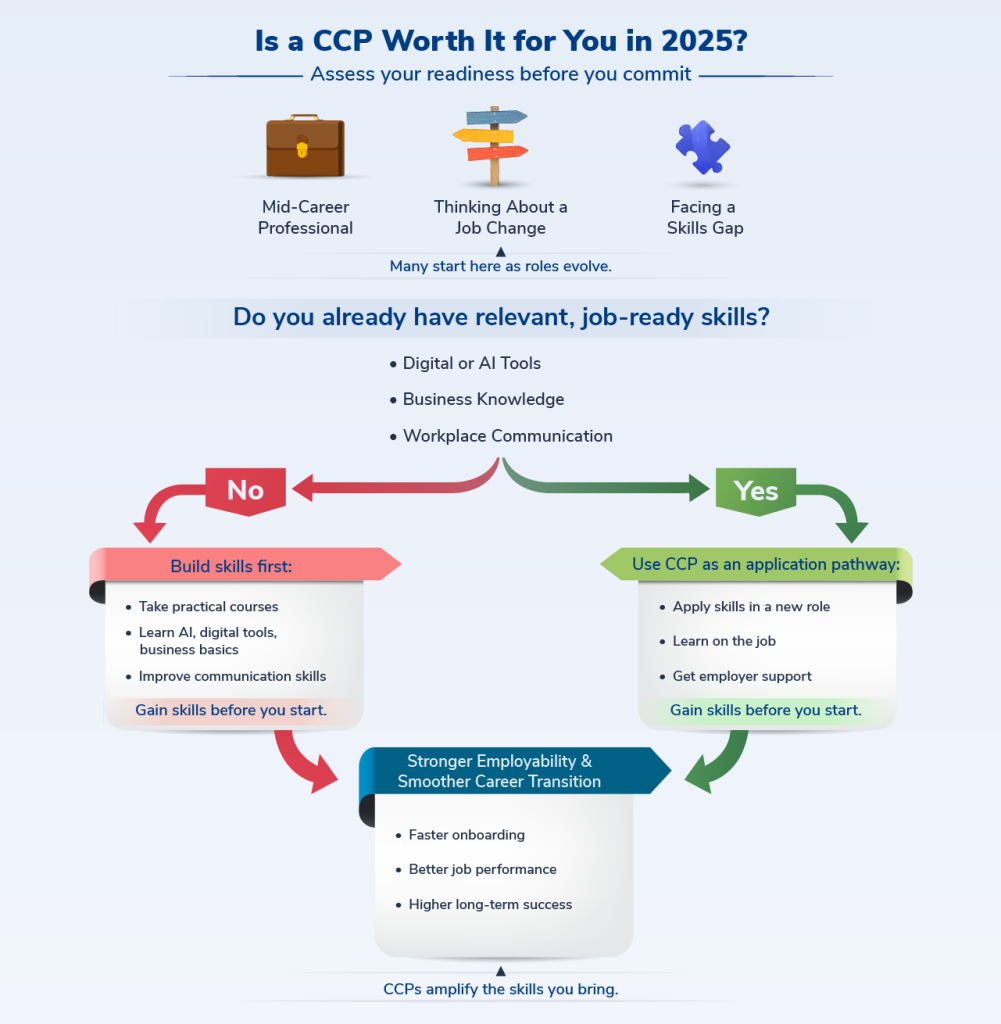
CCPs work best when learners see them as application pathways, not rescue plans. The most successful participants are those who:
- Build relevant skills before joining
- Use the CCP to apply and deepen those skills
- Treat the programme as a learning commitment, not just a job opportunity
For learners who expect the CCP alone to do all the work, results are often disappointing. For those who prepare properly, CCPs can be a powerful bridge into new roles and industries.
How Learners Should Think About CCPs Going Forward?
In today’s market, a practical mindset works best.
Instead of asking, “Which CCP should I join?”, it’s more useful to ask:
- What skills are employers hiring for right now?
- Which tools or systems do I need to understand?
- Where can I realistically add value in the next role?
Once those questions are answered, CCPs become easier to evaluate. They stop being abstract programmes and start becoming structured opportunities to apply what you already know — and to learn what you don’t.
Final Thoughts
WSG Singapore Career Conversion Programmes are still relevant in 2026, but their role has changed. They no longer stand alone. They sit alongside short, focused courses in AI, digital tools, business fundamentals, and communication — courses that prepare learners for real work, not just certificates.
For learners willing to invest in skills first, CCPs can open doors.
For those hoping for an easy reset, they rarely deliver.
As with most things in today’s job market, preparation matters more than participation.
Get In Touch With Info-Tech Academy For Expert Guidance and WSQ approved certifications!
WSG Singapore FAQs
What are WSG Singapore Career Conversion Programmes?
They are programmes that help mid-career individuals transition into new roles through structured on-the-job training with employer participation and government support.
Are CCPs useful if I already have skills?
Yes. CCPs are more effective when learners already possess relevant digital, AI, or business skills that reduce training time and increase productivity.
Do CCPs apply to all industries?
Yes. CCPs span multiple sectors including technology, finance, operations, administration, and services—not just HR roles.
Should I take courses before joining a CCP?
Yes. Skills-based courses significantly improve CCP readiness, interview success, and on-the-job performance.

I’ve always been drawn to the power of writing! As a content writer, I love the challenge of finding the right words to capture the essence of HR, payroll, and accounting software. I enjoy breaking down complex concepts, making technical information easy to understand, and helping businesses see the real impact of the right tools.