

In 2026, Singapore’s workforce is undergoing a clear shift. Hiring decisions are no longer driven solely by years of experience or job titles, but by a combination of recognised qualifications, applied skills, and long-term adaptability. For working professionals, this has made part-time degree programmes more relevant than ever.
As businesses respond to digitalisation, tighter compliance requirements, and evolving job roles, many professionals are discovering that experience alone is no longer sufficient to unlock promotions, leadership opportunities, or career transitions. In this environment, part-time degree in Singapore have become a strategic tool, allowing individuals to upgrade academically while remaining economically active.
What is the Workforce Reality in Singapore?
Singapore’s labour market in 2026 is shaped by three dominant forces: skills-based hiring, credential thresholds, and lifelong learning expectations.
Employers increasingly screen candidates using formal qualification benchmarks, especially for mid-level and senior roles. At the same time, government-linked organisations and regulated industries continue to require recognised degrees for progression. This has created a situation where capable professionals may plateau without academic upgrading.
Part-time degree programmes directly address this gap. They allow professionals to meet qualification requirements while continuing to build experience, making them particularly valuable in a workforce that rewards both credentials and practical competence.
What Defines a Modern Part-Time Degree In Singapore?
Part-time degrees in Singapore today are very different from those offered a decade ago. They are designed around adult learners and employability, not traditional campus life.
Flexible and blended learning models are now standard. Evening classes, weekend schedules, and online components allow professionals to study without compromising work performance.
Recognition of prior learning (RPL) plays a larger role than ever. Diploma holders and experienced professionals may receive exemptions, reducing time-to-completion and lowering overall costs.
Industry relevance and applied assessment have become core design principles. Assignments increasingly mirror workplace scenarios, ensuring that learning outcomes align with current job demands rather than purely academic theory.
Why Part-Time Degrees In Singapore Are a Smart Career Move?
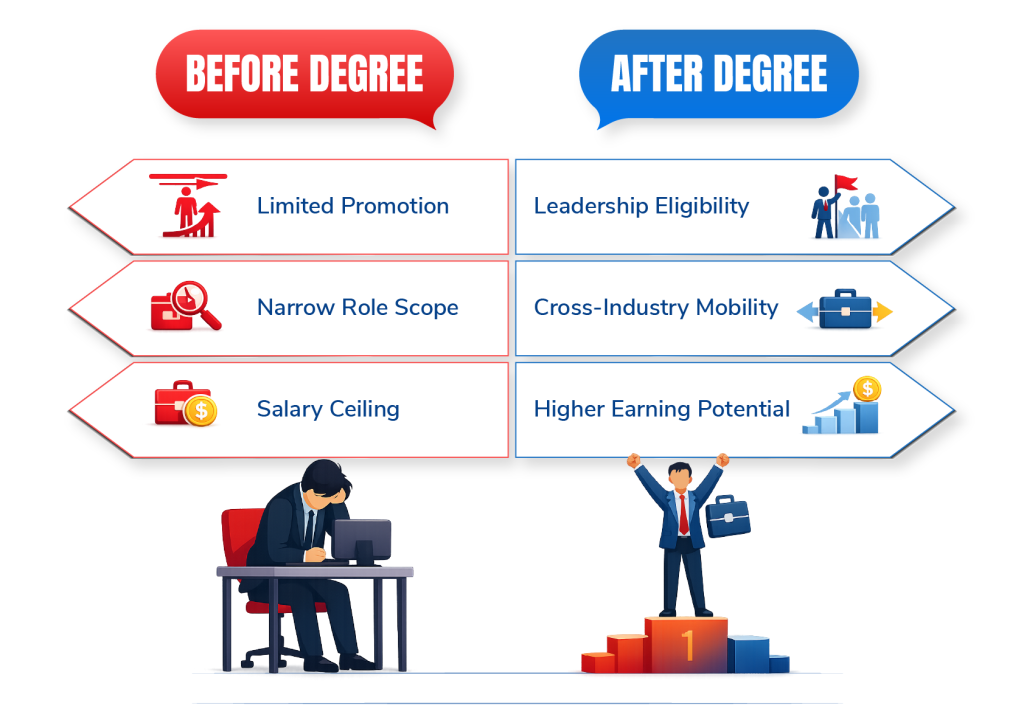
In the 2026 job market, part-time degrees are no longer just about “having a degree.” They are about career resilience.
Professionals who upgrade while working benefit from:
- Continued income stability in a high-cost environment
- Immediate application of new skills at work
- Stronger promotion and mobility prospects
- Higher employability during economic uncertainty
Many employers value the commitment shown by professionals who balance work and part-time study, especially when the degree is from a recognised institution and the learning is applied on the job. Part-time study can signal discipline and capacity for learning, but employer preference varies by industry, qualification prestige, and specific role requirements.
What Are the High-Demand Fields For Part-Time Degree in Singapore?
Not all degrees offers equal returns. Certain fields align more closely with Singapore’s workforce priorities and hiring demand.
1. Business and Management Degrees in a Leadership-Constrained Market
Business and management degrees remain highly relevant, but expectations have changed. Employers are no longer looking for general managers alone; they want leaders who understand operations, data, people management, and compliance.
Modern part-time business degrees emphasise strategic thinking, organisational leadership, financial awareness, and people management. These programmes are especially valuable for professionals moving from individual contributor roles into supervisory or management positions.
Graduates commonly progress into team lead, operations manager, HR manager, or department head roles, particularly in SMEs, MNCs, and government-linked organisations.
2. Accountancy and Finance Degrees in a Compliance-Driven Economy
Singapore’s regulatory environment continues to tighten, making formally qualified finance professionals indispensable.
Part-time degrees in accountancy and finance are strongly aligned with 2026 workforce needs, especially in areas such as financial reporting, taxation, audit readiness, and corporate governance. Employers increasingly expect degree-level knowledge even for mid-tier finance roles.
These degrees are particularly impactful for professionals working in accounting support, payroll, or finance operations who need academic credentials to move into senior, managerial, or specialist positions.
3. Information Technology Degrees for Digital and AI-Enabled Roles
Digitalisation remains one of Singapore’s strongest workforce drivers. However, the focus has shifted from general IT skills to applied digital competence.
Part-time IT and computing degrees in 2026 emphasise:
- Software and systems development
- Data analytics and data-driven decision-making
- Cybersecurity fundamentals
- Cloud and enterprise systems
These programmes support both career advancement for existing tech professionals and structured career transitions for non-technical professionals moving into digital roles. In a market increasingly influenced by AI and automation, formal IT qualifications provide long-term relevance rather than short-term skills.
4. Engineering Degrees for Regulated and Technical Progression
Engineering remains a qualification-sensitive field. In 2026, degree requirements continue to shape eligibility for senior technical, project management, and regulatory-facing roles.
Part-time engineering degrees are especially valuable for diploma holders who already possess hands-on experience but face advancement limitations. These programmes blend theory with application, ensuring graduates meet both technical and formal expectations.
Graduates often progress into senior engineer, project lead, or supervisory roles across construction, manufacturing, facilities management, and infrastructure sectors.
5. Psychology, Education, and People-Centric Degrees in a Human-Focused Workplace
As organisations place greater emphasis on well-being, learning, and organisational culture, people-centric degrees have gained renewed relevance.
Part-time degrees in psychology, education, and related disciplines support professionals working in HR, training, education, and social services. While not all graduates pursue specialist practice, many use these qualifications to strengthen leadership capability, employee development expertise, and people management effectiveness.
In a workforce increasingly focused on sustainability and human capital, these degrees align well with long-term organisational needs.
What are the Entry Pathways for Learning Policies?
Singapore’s education system in 2026 strongly supports lifelong learning, and this is reflected in part-time degree entry pathways.
- Diploma holders remain the primary intake group and often receive academic exemptions.
- A-Level or equivalent holders benefit from early workforce entry while upgrading academically.
- Mature professionals with substantial experience may qualify through alternative admissions that assess industry relevance rather than traditional academic routes.
This flexibility ensures that capable professionals are not excluded due to outdated entry criteria.
What are the Workload Expectations in a High-Performance Economy?
Part-time degrees in Singapore require discipline, especially in Singapore’s demanding work culture.
Most programmes involve two to three classes per week, typically in the evenings or on weekends. Additional time is required for assignments, group projects, and assessments, particularly during peak academic periods.
Successful professionals plan realistically, maintain consistent study routines, and align their academic commitments with long-term career objectives rather than short-term convenience.
Employer Recognition
Employer perception of part-time degrees in Singapore is clear: recognition and relevance matter more than study mode.
When a degree is obtained from a recognised institution and aligned with job requirements, it is widely accepted across private sector, public sector, and regulated industries. In many cases, employers value part-time graduates for their maturity, applied learning, and demonstrated commitment.
Are Part-Time Degrees In Singapore Still Worth It in 2026?
In Singapore’s current workforce climate, a part-time degree is not optional for many professionals, it is strategic.
It removes qualification ceilings, strengthens employability, and creates career flexibility in an economy shaped by automation, regulation, and rapid skills evolution. For professionals planning long-term careers rather than short-term roles, the return on investment remains strong.
Conclusion
Choosing part-time degrees in Singapore in 2026 is no longer just about picking a programme—it is about aligning education with workforce trends, employer expectations, and personal sustainability.
In a labour market where clarity matters as much as credentials, the right guidance can turn education into a strategic advantage rather than a costly experiment. For upskilling with WSQ approved courses, visit Info-Tech Academy.
Check Our Latest AI Course for Beginners & AI Course At Our Info-tech Academy Now!
Part-Time Degrees FAQs
Are part-time degrees recognised in Singapore?
Yes, part-time degrees are recognised in Singapore as long as they are awarded by recognised local universities or approved private institutions with accredited overseas university partners. Employers generally evaluate the institution and accreditation, not whether the degree was completed part-time or full-time. In fact, many employers value part-time graduates because they bring both formal education and continuous work experience. For public sector roles and regulated industries, recognition depends on whether the qualification meets official eligibility criteria.
Is a part-time degree worth it in Singapore?
In 2026, a part-time degree is worth it for many working professionals in Singapore, especially those facing qualification ceilings. As hiring standards become more structured, a recognised degree often determines eligibility for promotions, leadership roles, and career transitions. A part-time degree allows professionals to retain income, gain experience, and meet credential requirements simultaneously, making it a high-return long-term investment rather than a short-term academic pursuit.
Does NUS offer part-time degrees?
Yes, the National University of Singapore (NUS) offers part-time undergraduate programmes, primarily designed for adult learners and working professionals. These programmes are typically structured with evening, weekend, or blended learning formats and are subject to specific admission criteria. Availability depends on the faculty and programme, and applicants are usually expected to have relevant academic qualifications or work experience. As with all NUS programmes, part-time degrees follow rigorous academic standards.
Can I take a part-time degree during National Service (NS)?
In general, full-time National Servicemen (NSFs) are not permitted to pursue part-time degree programmes during active full-time NS due to operational and training commitments. However, once NSFs transition to Operationally Ready National Service (NSmen), pursuing a part-time degree is allowed. Some individuals may take short courses or preparatory programmes during NS, but enrolling in a formal part-time degree usually requires completion of full-time NS.

I’ve always been drawn to the power of writing! As a content writer, I love the challenge of finding the right words to capture the essence of HR, payroll, and accounting software. I enjoy breaking down complex concepts, making technical information easy to understand, and helping businesses see the real impact of the right tools.