


What is a Win-Win Leadership With Negotiation Skills?
A win-win leadership is a leadership style where the goal is – creating outcomes that benefit the employees, teams, customers, and the organisation involved. A win-win leader, instead of relying on one-sided decision and short-term targets, understands and brings together different interests to a common ground.
Practically, if an organisation needs to adapt to a new process, a win-win leader will not directly apply the change. They will listen to concerns of the employees, explain the business needs, and work toward the solution such that it is manageable for the team. The end result would support both employee confidence as well as productivity.
This kind of leadership is especially important in modern workspaces where leaders deal with diversified teams and changing expectations. In this kind of environment, success not only depends on instruction giving, but also on goal alignment and agreement building. This is the reason why win-win leadership is connected to empathy, conflict resolution, and negotiation.
How Leadership Shifts From Control to Collaboration?
Workplaces no longer respond effectively to rigid management alone. While leaders were expected to give repeated instructions, perform close monitoring in the past, today’s environment depends hugely on teamwork, shared ability, and problem-solving. Collaboration-focused environment very well understands that employees want to be heard and trusted. Instead of micro-managing, today’s leaders encourage ideas and give space for innovations.
While this is the ongoing trend, it does not mean that leaders are giving up their authority. It simply means that they are using their power in such a way that it builds cooperation among the members. This shift has enabled businesses to operate in faster, people-driven environments. In these settings, collaboration results in better communication, trust, and more practical solutions.
Dive Deeper Into Our Leadership Course Today!
Why Great Leaders Listen Before They Decide?
Decision through authority alone rarely makes good decisions. Listening to employees and clients will enable leaders to understand their thoughts, needs, and challenges. This will in turn explain them what kind of impact a decision can have on the team. Listening will also gather perspectives; giving a clear picture of the situation and helping the leader notice risks and concerns they might have missed.
Listening builds trust. When employees feel that they are heard, they will mostly respect the decision of the leader, even if it is not exactly what they wanted to happen. This is because people generally support the decision when they are convinced that their views are fairly and honestly considered.
How Negotiation Skills Turn Problems Into Solutions?
Every workplace faces pressure, disagreements, and unexpected challenges. A strong leader cannot completely get rid of the problems but will know how to handle it in a way that it results in progress instead of confusion. They do not get stuck or react emotionally to problems, but they focus on possible solutions and try to understand the root cause of the issue.
An efficient leader knows that most of the issues involve more than one perspective, and that addressing the communication gap clearly can turn situations into opportunities for better teamwork and coordination. Teams work best when leaders find common grounds and work for results that would benefit everyone.
How Leaders Influence Without Forcing Outcomes?
Modern leaders guide through trust, understanding, and clarity rather than with authority or pressure. Instead of only giving importance to their own view, leaders now listen to others’ opinion and respect their involvement. When people feel heard, they eventually get a feeling that they are actually respected.
When a leader explains the purpose behind a decision, how it would be beneficial for the organisation, it will make people feel like they are being involved in the decision too and are not blindly obeying the instructions of the leader.
Leaders must handle disagreements calmly by understanding the concern clearly and clarifying the doubts. This will encourage agreement between the leader and the members, rather than forecefully making them quiet or demanding to comply to their decision.
What Are the Skills Behind Win-Win Results?
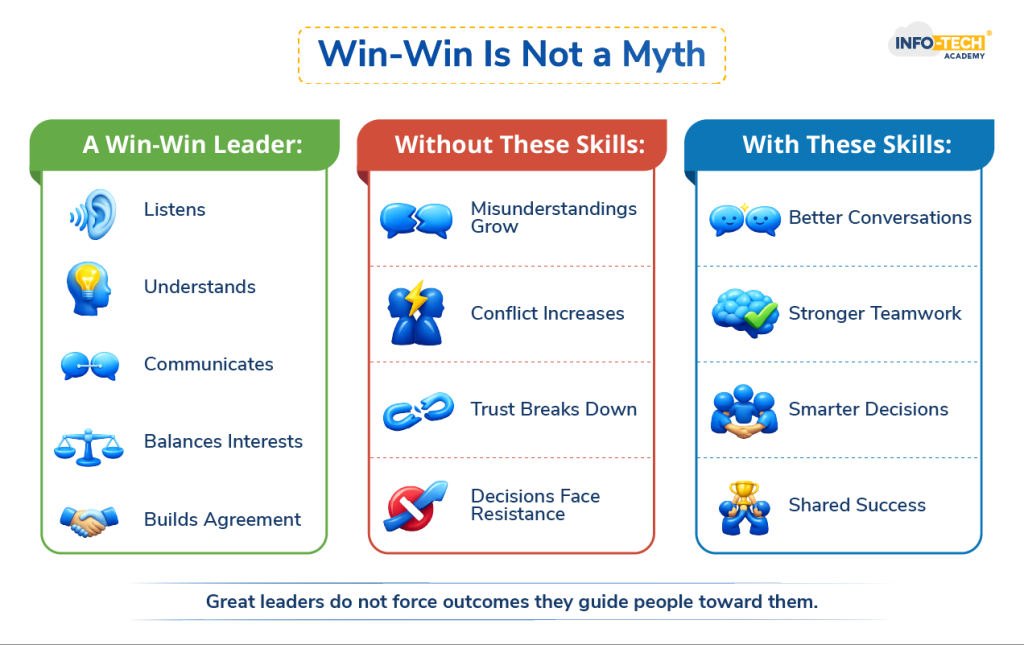
The skills involved for acheiving mutually beneficial results are beyond just good intentions. It generally cannot be achieved by chance, but by combination of certain essential skills.
- Active listening
- Clear communication skills
- Empathy
- Problem solving
- Agreement building
All these abilities come under one umbrella term; negotiation skills. Acquiring this skill requires proper learning and practice. It can be developed through an effective course for negotiation skills. This course can develop confidence and clarity that will support career growth. Info-Tech academy provides you WSQ courses with SkillsFuture subsidies. Get a free consultation today!
Negotiation Skills FAQs
Why are negotiation skills necessary?
Negotiation skills help people handle differences, communicate effectively, and decide on solutions that benefit everyone without creating unnecessary conflict.
What are the 5 C’s of negotiation?
The 5 C’s of negotiation are Communication, Collaboration, Compromise, Creativity, and Commitment.
Why are negotiation skills important in business?
Negotiation skills are important in business as they help professionals build stronger relationships, make better deals, and reach outcomes that support long-term cooperation.
Why is negotiation important in leadership?
Negotiation is important in leadership as it helps leaders manage conflicts, align with different interests, and take decisions that protect the organisational goals.

Transforming thoughts and concepts into clear, compelling words is a powerful tool that connects people. While writing boosts my creativity, reading broadens my perspective and sharpens my understanding of language and narration.