

What “WDA Singapore Recognised” Means for an AI Course?
When learners or employers search for WDA Singapore recognition, they are not looking for a logo or a marketing label. In practical terms, recognition means that the AI course has been reviewed and accepted under Workforce Singapore (WSG) frameworks and aligns with national Skills Frameworks used to guide workforce development in Singapore.
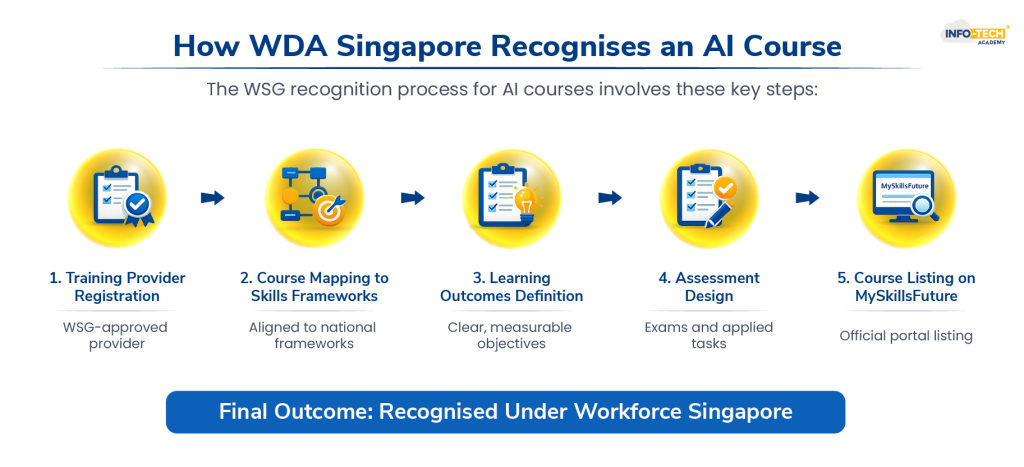
A recognised AI course must meet several baseline expectations. The training provider needs to be officially registered, the course content must map to defined competencies under a relevant Skills Framework, and learning outcomes must be assessable rather than purely attendance-based. This structure ensures that AI training contributes to measurable skills development rather than general awareness.
This distinction is particularly important in 2026. AI courses are increasingly influencing SkillsFuture claims, employer training audits, and workforce capability reporting. Courses that fall outside WDA Singapore recognition may still offer knowledge, but they do not carry the same formal standing within Singapore’s workforce ecosystem.
| A WDA Singapore recognised AI course is officially listed on MySkillsFuture and aligned with national Skills Frameworks under Workforce Singapore. If an AI course does not appear on MySkillsFuture, it is not recognised by WDA Singapore, regardless of certification claims. |
How Workforce Singapore Evaluates AI Courses?
Workforce Singapore does not recognise AI courses based on trendiness or tool popularity. Instead, recognition is determined by how well a course supports Singapore’s broader workforce transformation objectives.
AI courses are assessed on whether they develop applied capabilities relevant to job roles, rather than surface-level familiarity with tools. For example, courses that focus on how Generative AI improves business productivity, HR operations, or decision-making are more likely to align with current Skills Framework priorities than those that only demonstrate prompts or automation shortcuts.
This is why many organisations now prefer AI programmes that integrate real business use cases. InfoTech Academy has explored this shift in detail in its analysis of Generative AI adoption for business productivity. This explains why applied AI capability has become a priority area in Singapore’s training landscape.
Read: Why You Should Take Up A Generative AI Course In 2026
How to Check If an AI Course Is Officially WDA Singapore Recognised?
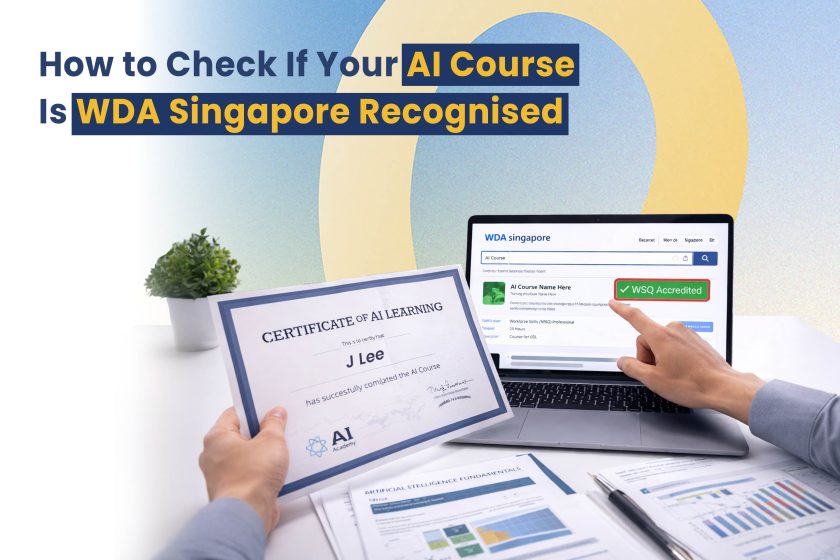
The most reliable way to verify recognition is through the MySkillsFuture portal. It serves as the authoritative listing for recognised courses in Singapore. If an AI course does not appear on MySkillsFuture, it should be treated as non-recognised, regardless of how it is marketed.
Beyond simply confirming the course listing, learners and employers should also review how the course is categorised. Recognised AI courses are typically aligned with Skills Frameworks such as Infocomm Technology, Business Management, or Human Resource. This alignment is not incidental—it determines whether the training supports national workforce objectives and whether it can be referenced during SkillsFuture claims or employer audits.
It is also important to verify the training provider itself. WDA Singapore recognition applies to approved providers, not just individual courses. Providers that consistently deliver recognised programmes usually maintain transparent documentation around framework alignment, assessment structure, and trainer credentials.
The table below summarises the key differences between WDA Singapore recognised AI courses and non-recognised programmes. This is based on Workforce Singapore and SkillsFuture requirements.
| Evaluation Area | WDA Singapore Recognised AI Course | Non-Recognised AI Course |
| Official Listing | Listed on the MySkillsFuture portal under Workforce Singapore | Not listed on MySkillsFuture |
| Training Provider | Delivered by a WSG-approved training provider | Provider approval unclear or not stated |
| Skills Framework Alignment | Aligned to national Skills Frameworks (ICT, HR, Business) | No formal framework alignment |
| SkillsFuture Eligibility | May be eligible for SkillsFuture funding (subject to criteria) | Not eligible for SkillsFuture funding |
| Learning Outcomes | Structured outcomes with assessments | Attendance-based or tool demonstrations |
| Employer Acceptance | Suitable for employer training claims and audits | May not meet employer compliance needs |
| Workforce Credibility | Recognised within Singapore’s workforce development ecosystem | Recognition limited to private certification |
Why Skills Framework Alignment Matters More Than the AI Tool Taught?
One of the most common misconceptions is that WDA Singapore recognition depends on which AI tool is covered. In reality, the tool matters far less than the capability being developed.
A course teaching ChatGPT, Microsoft Copilot, or Google Gemini may or may not be recognised depending on how those tools are applied. Courses that demonstrate how AI supports HR planning, payroll processes, accounting workflows, or business decision-making are more likely to meet framework requirements. They map directly to job-role competencies.
This is especially relevant for HR and finance professionals. InfoTech Academy’s coverage on AI-driven HR transformation explains how AI training is increasingly evaluated based on its impact on workforce processes rather than technical novelty.
Read: AI In HR: How Beginners Can Use AI To Work Smarter
What Employers and HR Teams Need to Consider Before Approving AI Training?
From an employer’s perspective, WDA Singapore recognition is closely tied to accountability. Training approvals are no longer assessed only on perceived usefulness, but on whether they can withstand internal reviews, SkillsFuture claims validation, and audit checks.
Recognised AI course provide employers with documented learning outcomes, framework alignment, and traceability. This makes it easier to justify training investments, report workforce development progress, and ensure compliance with national training guidelines.
As AI becomes embedded into HRMS platforms, payroll systems, and financial operations, employers are also looking for training that integrates with real workplace systems. This connection between AI learning and enterprise tools has been discussed in InfoTech Academy’s insights on HRMS integration and digital workforce productivity.
Why Many AI Courses Fail WDA Singapore Recognition Checks?
A significant number of AI courses fail recognition checks not because they lack content, but because they lack structure. Courses that rely solely on demonstrations, webinars, or unassessed workshops often fall outside WSG’s expectations.
WDA Singapore prioritises courses that define what a learner can do after completion, not just what they have seen. This includes clear outcomes, structured learning paths, and assessment mechanisms that demonstrate applied understanding.
For learners, this distinction explains why some AI certificates are not recognised despite appearing credible. For employers, it reinforces the importance of verifying recognition before approving training budgets.
How InfoTech Academy Designs AI Courses Around WSG Expectations?
InfoTech Academy structures its AI and digital courses around Skills Framework requirements and WSQ approval rather than short-term trends. This approach ensures that training remains aligned with WDA Singapore expectations and evolving workforce priorities.
Courses are designed to support practical application in HR, accounting, business management, and digital operations. By focusing on real job roles and measurable outcomes, the programmes remain relevant to both individual learners and organisations managing structured workforce development initiatives.
This approach also reflects the broader shift in Singapore’s training ecosystem—from exploratory AI learning to capability-driven upskilling.
Key Takeaway for Learners and Employers
If an AI course is genuinely WDA Singapore recognised, it will appear on MySkillsFuture. It will clearly state its Skills Framework alignment, and be delivered by an approved provider with structured assessments. If any of these elements are missing, the course should be treated as non-recognised, regardless of branding or certificates offered.
Get in touch with Info-Tech Academy For Expert Guidance!
WDA Singapore FAQs
How do I check if an AI course is WDA Singapore recognised?
You can check if an AI course is WDA Singapore recognised by searching the course or training provider on the MySkillsFuture portal. If the course appears with Skills Framework alignment and provider details, it is officially recognised under Workforce Singapore.
What does WDA Singapore recognition mean for AI courses?
WDA Singapore recognition means the AI course meets Workforce Singapore standards, aligns with national Skills Frameworks, and is delivered by an approved training provider. Recognised courses support SkillsFuture funding eligibility and employer training compliance.
Are all AI courses in Singapore SkillsFuture eligible?
No, not all AI courses in Singapore are SkillsFuture eligible. Only AI courses recognised under WDA Singapore and listed on the MySkillsFuture portal may qualify for SkillsFuture funding, subject to individual eligibility criteria.
Can online AI courses be recognised by WDA Singapore?
Yes, online AI courses can be WDA Singapore recognised if they meet required standards, including framework alignment, structured assessments, and approved trainers. Delivery mode alone does not determine recognition.

I’ve always been drawn to the power of writing! As a content writer, I love the challenge of finding the right words to capture the essence of HR, payroll, and accounting software. I enjoy breaking down complex concepts, making technical information easy to understand, and helping businesses see the real impact of the right tools.