

Growing Gap Between Degrees and Job Readiness
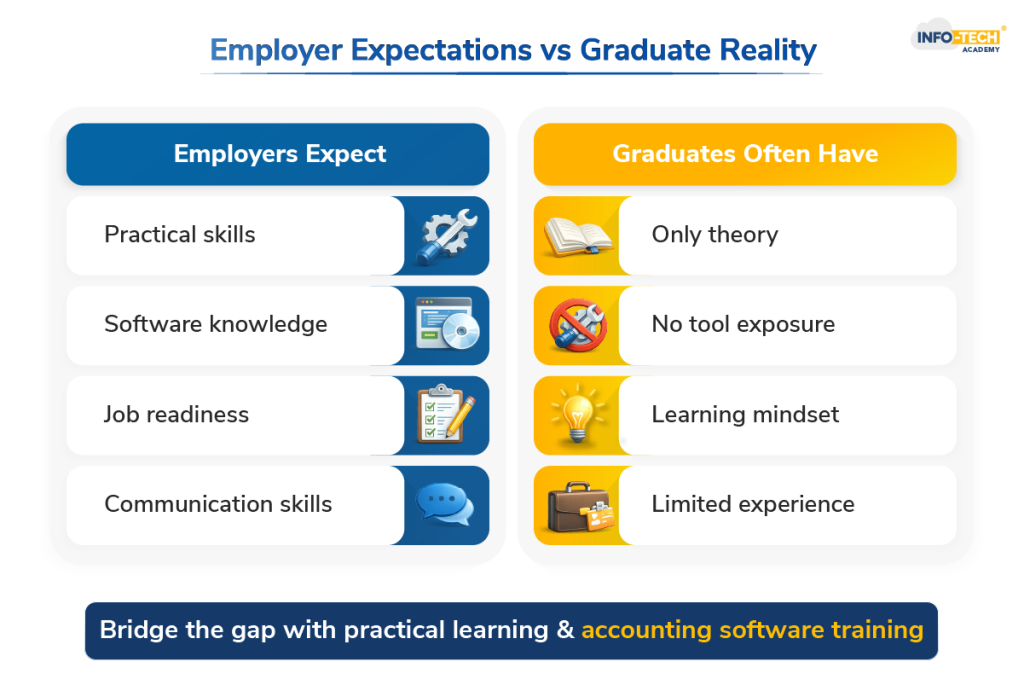
Having an accounting degree alone does not guarantee you to fetch an accounting career anymore. In today’s competitive market, graduates struggle when applying accounting concepts like taxation, auditing, and financial principles to the real-world scenarios. This is largely due to the presence of only theoretical knowledge and no practical knowledge. This gap has largely disconnected academic qualification and actual accounting career.
On contrast, employers look for candidates who can perform well and implement their learning to the job from the first day of work. Familiarity with modern accounting tools and industry practices is no more a plus, but an essential skill. To stand out in the process of hiring, candidates must possess and express strong practical skills aligning to the market expectations.
What Employers Really Expect from Accounting Graduates
Apart from the already said practical knowledge in accounting domain, employers also focus on some more skills from potential candidates. The foremost and biggest one would be accuracy and attention to detail. Even a minor mistake in accounting can lead to bigger financial issues and cost the company much. So, having attention and accuracy in calculation is key.
Strong analytical skills, communication, and familiarity with technology are some other essential skills. With growing reliability on modern tools such as cloud platforms and digital software, possessing knowledge on its use is an additional advantage. Candidates who have taken accounting course often appear more job-ready, as they can adapt to workplace systems and processes faster.
Role of Technology in Modern Accounting Career
Technology has significantly transformed the accounting jobs, changing them from a process focused mainly on manual record-keeping to one that depends on speed, accuracy, and real-time financial management. In modern workplaces, accountants are no longer expected to spend most of their time on repetitive data entry. Instead, they are expected to use digital tools to
- Manage accounts efficiently
- Analyze financial information
- Support better business decisions
Today, businesses rely on accounting software to handle essential tasks such as bookkeeping, payroll, invoicing, tax calculations, financial reporting, and expense tracking. This has made technology a core part of almost every accounting role. Employers now prefer candidates who are comfortable working with such systems because it helps reduce training time and improves productivity from the start of employment. For accounting graduates, this means that being familiar with digital tools is becoming just as important as understanding basic accounting principles.
Another major impact of technology is automation. By using automated software, many routine accounting tasks that were once done manually can now be completed faster and with fewer or no errors. As a result, accountants are increasingly expected to focus on higher-value responsibilities such as
- interpreting reports,
- identifying trends,
- ensuring compliance, and
- advising management.
This shift shows that the role of an accountant is becoming more strategic and less administrative.
Cloud-based accounting systems have also changed how accounting teams work. Financial data can now be accessed securely from anywhere, making collaboration easier between teams, clients, and businesses. This has increased the demand for professionals who can adapt to digital work environments and use software confidently in everyday operations.
Because of these changes, practical exposure to technology has become essential for career growth in accounting. This is where an accounting course plays an important role. It helps graduates move beyond theory and develop the hands-on skills needed in real workplaces. In today’s job market, a strong understanding of technology can make accounting graduates more employable, efficient, and better prepared for modern job demands.
Common Mistakes Fresh Accounting Graduates Make
Graduates often overlook the importance of internships and projects that actually provide them with practical learning opportunities. This hands-on experience develops workplace readiness and increases the rate of getting a career in accounting. Candidates must ensure that they add these learnings and skills to their resume and project the skills to the one interviewing them. This will not only help the employers to build trust in the candidate’s capabilities but also increase the rate of them getting hired for the role.
Keeping up with changing industry’s expectations by knowing more than just number crunching and valuing other commonly expected skills. Communication skills, problem-solving ability, adaptability, and familiarity with technology are also important for today’s job market.
Conclusion: From Graduate to Job-Ready Professional
The gap between education and employment is true but is bridgeable too. With the development of practical expertise, transition from just possessing theoretical skill to application of their learnings and familiarity with the related tools is clearly possible. Ultimately, becoming job-ready is about combining knowledge with action. By focusing on skill development, practical exposure, and continuous learning, accounting graduates can move beyond the struggle and position themselves as valuable, employable professionals in a competitive market.
WDA Singapore FAQs:
How do I check if an AI course is WDA Singapore recognised?
You can check if an AI course is WDA Singapore recognised by searching the course or training provider on the MySkillsFuture portal. If the course appears with Skills Framework alignment and provider details, it is officially recognised under Workforce Singapore.
What does WDA Singapore recognition mean for AI courses?
WDA Singapore recognition means the AI course meets Workforce Singapore standards, aligns with national Skills Frameworks, and is delivered by an approved training provider. Recognised courses support SkillsFuture funding eligibility and employer training compliance.
Are all AI courses in Singapore SkillsFuture eligible?
No, not all AI courses in Singapore are SkillsFuture eligible. Only AI courses recognised under WDA Singapore and listed on the MySkillsFuture portal may qualify for SkillsFuture funding, subject to individual eligibility criteria.
Can online AI courses be recognised by WDA Singapore?
Yes, online AI courses can be WDA Singapore recognised if they meet required standards, including framework alignment, structured assessments, and approved trainers. Delivery mode alone does not determine recognition.
How do I check if an AI course is WDA Singapore recognised?
You can check if an AI course is WDA Singapore recognised by searching the course or training provider on the MySkillsFuture portal. If the course appears with Skills Framework alignment and provider details, it is officially recognised under Workforce Singapore.

Transforming thoughts and concepts into clear, compelling words is a powerful tool that connects people. While writing boosts my creativity, reading broadens my perspective and sharpens my understanding of language and narration.