

Artificial intelligence is no longer limited to research labs or tech startups. By 2026, AI tools are embedded across banking, healthcare, logistics, cybersecurity, education, and public services. As organisations integrate machine learning and generative AI into daily workflows, professionals are increasingly seeking formal AI certification to remain relevant.
But “best” can be tricky. There’s no universal AI certification. It hinges on your background, career goals, and whether you plan to build AI systems or apply AI within business operations
This full guide tells you all you need to know.
Why AI Certification Is So Important in 2026
AI has moved from experimental to operational use. Companies don’t just “look into AI” anymore, they now use AI systems that create content, streamline work, predict trends, and blend AI into customer interactions.
As adoption increases, employers are assessing whether candidates:
- Understand AI fundamentals
- Can apply AI tools responsibly
- Are familiar with generative AI and large language models
- Recognise ethical and governance considerations
An AI certification signals structured learning and exposure to recognised frameworks. When combined with practical experience, it can strengthen professional credibility.
What Makes an AI Certification Valuable?
Not all AI certifications carry equal weight. In 2026, a strong AI programme should demonstrate three qualities.
First, the curriculum must be up to date. Artificial intelligence changes quickly, particularly in areas such as generative AI and large language models. Any credible certification today should cover foundational machine learning concepts, neural networks, and model evaluation, while also addressing generative AI applications, prompt design principles, and governance considerations.
Second, practical exposure matters. Employers are less concerned with theoretical familiarity and more interested in whether candidates can apply AI concepts. Technical tracks should include coding exercises and model-building components. Non-technical tracks should incorporate business case discussions and applied implementation frameworks.
Finally, institutional credibility still plays a role. Certifications issued by recognised universities, major online learning platforms, or established technology companies tend to carry stronger professional weight. However, relevance and demonstrated competence remain more important than branding alone.
Choosing the Right AI Certification Based on Your Profile
| Certification | Best For | Technical Level | Key Focus | Ideal Career Outcome |
| AI For Everyone | Managers, HR, business leaders | Beginner | AI strategy, business understanding | AI Project Lead |
| Machine Learning Specialization | Developers | Intermediate | Algorithms, ML models | ML Engineer |
| IBM AI Engineering Professional Certificate | Software professionals | Intermediate–Advanced | Deep learning, neural networks | AI Engineer |
| Deep Learning Specialization | Technical AI builders | Advanced | CNNs, RNNs, sequence models | Deep Learning Engineer |
| Generative AI Certifications | Cross-industry professionals | Beginner–Advanced | LLMs, prompt engineering | AI Automation Specialist |
Which Is the Best Certification for AI?
No single certification suits everyone.
Your goal determines the best AI certification.
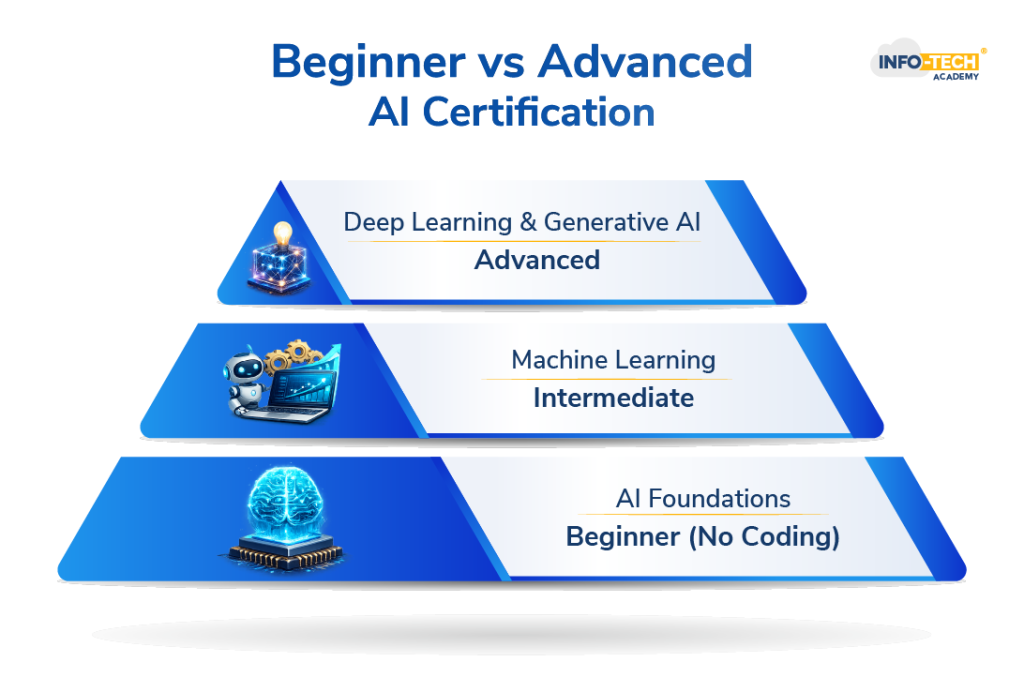
If You Are New to AI (Non-Technical)
You should get AI basics certifications that cover:
- What AI is
- How AI impacts business
- Where AI creates value
- AI implementation strategy
These programs suit:
- HR managers
- Marketing professionals
- Business owners
- Operations heads
They don’t need coding and focus on strategy.
If You Want to Become an AI Engineer
You need certifications that cover:
- Python coding
- Machine learning methods
- Model training and testing
- Neural networks
- Deep learning frameworks
These programs are technical and need strong logic skills.
If You Want to Specialize in Generative AI
Generative AI certifications cover:
- Prompt engineering
- Large language models
- AI content automation
- AI workflow integration
- Responsible AI usage
These skills are in high demand in 2026 because companies are rolling out generative AI on a large scale.
Do AI Certificates Have Value?
Yes, but it depends.
AI certificates are valuable when:
- They match your career goals
- They include real-world projects
- Employers recognize them
- You put the knowledge to use
AI certifications boost:
- Job prospects
- LinkedIn profile appeal
- Chances for interviews
- Salary negotiation leverage
But a certificate alone won’t cut it. You need to back it up with projects, experimentation, and building a strong portfolio.
Salary Impact of Best AI Certification
AI-certified professionals often earn higher salaries because employers trust their skills more.
| Role | Average Global Salary | With Recognized AI Certification |
| Data Analyst | $70,000 | $85,000+ |
| AI Engineer | $110,000 | $135,000+ |
| ML Engineer | $120,000 | $145,000+ |
| AI Product Manager | $115,000 | $140,000+ |
Certification boosts credibility, which has an impact on salary negotiations.
Who Are the Big 4 of AI?
In 2026, the Big 4 of AI are:
Stays ahead in AI research foundational models, and advanced AI systems.
Microsoft
Focuses on Enterprise AI integration and key AI partnerships.
Amazon
Cloud AI infrastructure and AI deployment at scale.
Meta
AI research leadership and open AI model contributions.
Understanding these ecosystems matters as many AI certifications align with tools these companies use.
Which AI Course Ranks Best in Singapore?
Singapore’s AI ecosystem is growing because of:
- Smart Nation projects
- Enterprises taking up AI
- Government AI governance frameworks
- Regional innovation hubs
The best AI course in Singapore depends on your goal.
For Beginners
AI basics and AI fundamental courses fit well.
For Mid-Career Employees:
Machine learning certificates boost job prospects.
For Technical Learners:
Deep learning and AI engineering programs offer higher technical depth.
Singapore professionals should focus on:
- Industry-aligned curriculum
- Practical projects
- Updated content on generative AI
- Certification recognition
Is There a WSQ AI Certification in Singapore?
Yes. In Singapore, AI-related courses are available under the Workforce Skills Qualifications (WSQ) framework. This framework ensures training is industry-aligned and competency-based. WSQ AI programmes focus on digital transformation, data analytics and automation. These programmes emphasize practical workplace application rather than technical theory.
A key advantage of WSQ courses is SkillsFuture funding eligibility. This makes AI upskilling more affordable for Singapore Citizens and Permanent Residents. These programmes are suitable for mid-career professionals, managers and individuals who are moving into digital roles and want structured, government-recognised credentials.
While WSQ AI certifications build strong foundational and applied skills, professionals aiming for advanced machine learning or deep learning roles may complement them with recognized AI certifications to specialize deeper in technical areas and for international mobility.
Final Thoughts:
AI is becoming a universal professional skill. Certification isn’t just about learning AI, it proves you understand it in a structured credible way.
Picking the right AI certification today can have a big impact on your career path for the next ten years.
Frequently Asked Questions
Which is the best AI course in Singapore?
The best AI certification varies based on your career aims. Beginners get value from AI fundamentals programs, while those aspiring AI engineering roles should go for machine learning or deep learning specializations. For business leaders, AI strategy certifications might be the way to go. The most useful AI certification combines theory, hands-on projects, and up-to-date generative AI material.
Are AI certificates worth it?
AI certificates have worth when industries recognize them and they focus on skills. They boost job chances, can lead to better pay, and show organized AI knowledge. But using what you’ve learned in real life and building a portfolio of projects makes them much more valuable for your career.
Who are the Big 4 of AI?
Google, Microsoft, Amazon, and Meta make up the Big 4 of AI. These companies are at the forefront of global AI research, cloud AI infrastructure generative AI development, and enterprise AI deployment.
Which is the best AI course in Singapore?
Your experience level determines the best AI course in Singapore. New learners should start with AI basics, while tech professionals should go for machine learning or deep learning certifications. Courses that line up with Singapore’s digital transformation plans have more local relevance.

I’ve always been drawn to the power of writing! As a content writer, I love the challenge of finding the right words to capture the essence of HR, payroll, and accounting software. I enjoy breaking down complex concepts, making technical information easy to understand, and helping businesses see the real impact of the right tools.