

Artificial Intelligence in 2026 drives enterprise copilots, autonomous AI agents, real-time fraud detection systems, HR analytics engines predictive healthcare diagnostics smart robotics multimodal generative AI platforms, and large-scale cloud-native automation systems. As AI spreads worldwide, one question keeps popping up on search engines:
What programming language do people use for AI in 2026?
The quick answer is Python is still the top programming language for AI development in 2026, but the full story has more layers. Today’s AI ecosystems use many languages. While Python leads in creating and testing models, languages like C++, Java, R, Julia, Rust, Go, and JavaScript play key roles in performance, optimization, deploying AI to work in big companies, infrastructure and web integration.
This complete guide looks at every major language driving AI in 2026, why people use them, where they come in handy, and how they fit into the growing AI tech world.
The State of AI Development in 2026
AI systems in 2026 are much more complex than the machine learning models we saw before. Today’s AI applications:
- Multimodal (text, voice, video, image processing combined)
- Agent-driven (autonomous decision-making systems)
- Real-time and edge-deployable
- Cloud-native and microservice-based
- Enterprise-integrated
- Privacy-aware and regulation-compliant
AI systems now work across many areas. These include training pipelines, deployment environments, web interfaces, embedded hardware, and distributed cloud systems spread. Because of this, one programming language can’t handle everything in the best way. The language you pick depends on what you want to focus on. This could be research, speed, scalability, security, infrastructure, or integration.
1. Python – The Undisputed Leader of AI in 2026
Python still leads AI development in 2026 because it’s easy to use, has tons of tools, and everyone in the industry uses it. It’s the go-to choice for machine learning, deep learning, and generative AI work in startups, research labs, and enterprises.
Python’s popularity comes from how easy it is to learn and use. It’s clear and simple code lets developers and researchers spend more time on algorithms and trying out models instead of dealing with complicated system details. Also, pretty much every big AI breakthrough in the past ten years has relied on frameworks built with Python.
Why Python Stays on Top in 2026
Python’s collection of tools is unbeatable. It’s the base for:
- Machine learning pipelines
- Deep learning frameworks
- Natural language processing (NLP)
- Computer vision
- Generative AI systems
- AI agent frameworks
- MLOps tools
Major AI Libraries in Python (2026)
- TensorFlow
- PyTorch
- Keras
- Scikit-learn
- Hugging Face Transformers
- LangChain
- OpenCV
- Pandas
- NumPy
Python isn’t the fastest language when it comes to raw execution speed. However, many key components that need high performance are written in C++ behind the scenes. This gives developers the best of both worlds: it’s easy to develop in Python, but you still get optimized performance.
Where Python Is Most Used
- LLM creation
- AI new companies
- Science centers
- Big company machine learning groups
- Data expert jobs
- Tools for doing things
Python will keep its top spot in 2026.
2. C++ – High-Performance AI and Systems Optimization
Python is great for experimentation, but C++ is key for AI systems that need to work fast. Many core AI engines use C++ to run calculations and use memory well.
C++ is important in places where speed and being efficient matter, like in robotics, embedded computer systems, AI for games, and self-driving cars.
Why C++ Is Needed in AI
C++ gives you:
- Direct control of memory
- Fast computation
- Tweaking low-level hardware
- Smart use of resources
C++ AI Apps You Often See
- Robot systems
- Self-driving car software
- AI engines that work in real time
- Tools for computer vision
- High frequency trading AI systems
Often, teams use Python to train models and C++ to run them in real world.
3. Java – Enterprise AI Infrastructure
Java is still a big deal in 2026 because it’s everywhere in big companies. Major firms rely on Java for their backend systems, so it makes sense to use Java when adding AI to legacy enterprise architecture.
Companies pick Java when they need AI to work across huge systems like those in banks, insurance firms, or telecom companies.
Why Big Companies Still Pick Java
- Scales up well
- Top-notch security for businesses
- Solid frameworks
- Many big firms use it
- Easy to keep running for years
How Companies Use Java for AI
- Fraud Detection
- Figuring out risks
- Financial AI modelling
- Backend AI services
- Large-scale AI production systems
Java isn’t the go-to for AI research, but it’s great for getting AI up and running in big companies.
4. R – Statistical and Data-Heavy AI Applications
R is still a big deal in statistical computing and AI research. While it’s not the main player in deep learning tech, it shines in AI that’s all about analysis.
R is a top pick for:
Here’s my rephrasing of the given text:
- Academic studies
- Biostatistics
- Financial analytics
- Healthcare modeling
- Data visualization
Its power comes from statistical modeling and in-depth data exploration.
5. Julia – High-Speed Scientific Computing
Julia keeps gaining ground in scientific AI uses. It combines Python-like simpliity with speed close to C making it appealing for AI projects that need lots of computing power.
Julia works well for:
- Physics simulations
- Climate modeling
- Mathematical optimization
- Scientific research AI
While it has fewer tools than Python, its toolkit grows in 2026.
6. JavaScript – AI in Web and Frontend Applications
AI is now a big part of SaaS products and web apps. JavaScript helps integrate everything. New AI tools need interactive interfaces, dashboards, and browser-based processing.
JavaScript makes possible:
- Web apps with AI features
- Chat interfaces that work
- Browser- based AI tools
- AI dashboards
Tools like TensorFlow.js let AI models work right in web browsers.
7. Rust – Secure and Efficient AI Systems
Rust is getting noticed for AI infrastructure because it’s safe with memory and works fast. As AI systems need more security, Rust offers strong guarantees against memory problems and vulnerabilities.
People use Rust more and more in:
- Tools for AI infrastructure
- AI services that need high performance
- Backend systems with strong security
- Blockchain and AI Integration
Rust isn’t the top choice for AI model training, but it’s getting more popular in infrastructure.
8. Go (Golang) – AI Deployment and Microservices
Go sees heavy use in cloud-native settings and has a big part to play in AI deployment pipelines. While it is rarely used for training models, it is ideal for building scalable AI APIs and distributed systems.
People often use Go for:
- AI microservices
- Containerized AI systems
- API backends
- AI orchestration layers
Its simple nature and concurrency model to handle many tasks at once make it a hit with DevOps and MLOps teams.
AI Programming Language Comparison
| Language | Primary Strength | Best For | Speed | Ecosystem Strength | Enterprise Usage |
| Python | Ecosystem & Simplicity | ML, DL, GenAI | Moderate | Extremely Strong | Very High |
| C++ | Performance | Robotics, Real-Time AI | Very High | Strong | High |
| Java | Scalability | Enterprise AI | High | Medium | Very High |
| R | Statistics | Data Science | Moderate | Strong | Medium |
| Julia | Scientific Computing | Research AI | Very High | Growing | Growing |
| JavaScript | Web AI | Frontend AI | Moderate | Moderate | High |
| Rust | Security & Safety | AI Infrastructure | Very High | Emerging | Growing |
| Go | Deployment | Cloud AI Systems | High | Emerging | Growing |
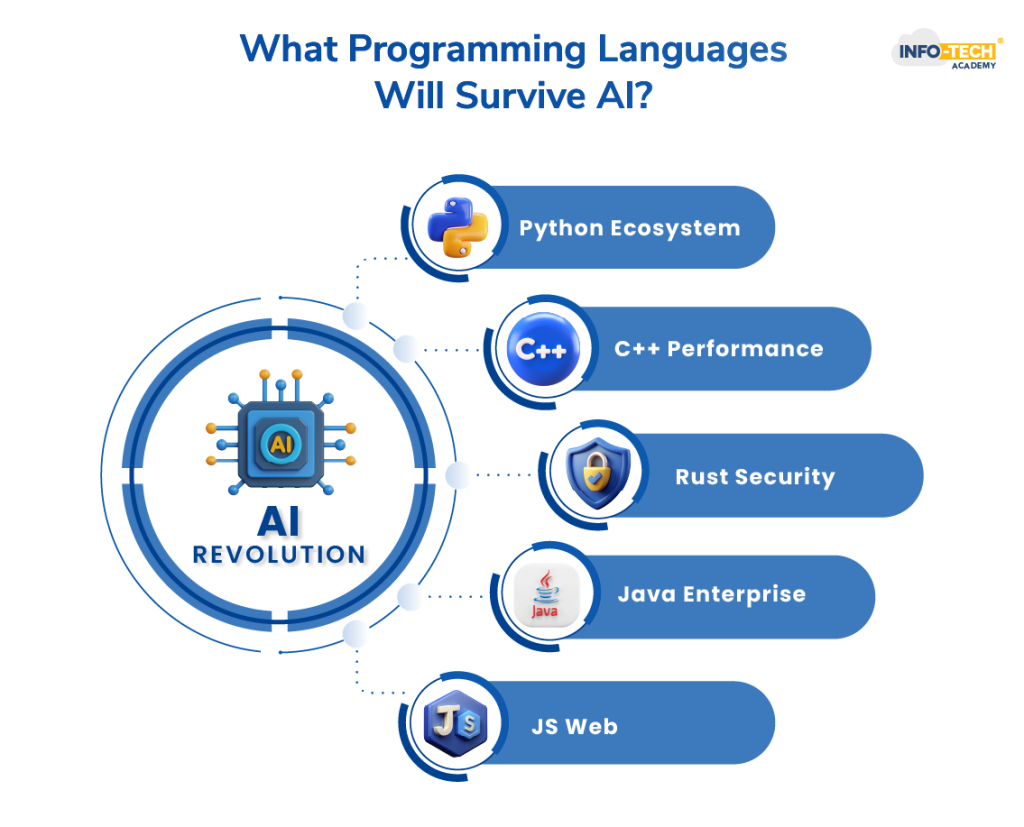
Which Programming Language Will Survive AI?
AI doesn’t get rid of programming languages — it makes them more important. Languages that work well with AI tools, scale across systems, and keep strong communities will stay relevant.
Languages likely to do well in the long run:
- Python (AI ecosystem dominance)
- C++ (performance-critical systems)
- Java (enterprise infrastructure)
- Rust (secure infrastructure)
- JavaScript (web ecosystem)
The future belongs to flexible languages that work with AI.
What’s the Top AI for Coding in January 2026?
AI coding helpers in 2026 boost how much developers can do. The best AI coding tools help with many languages and offer:
- Code generation
- Error detection
- Refactoring suggestions
- Documentation automation
- Unit test generation
These tools help developers, but they don’t take their place. Grasping basic programming concepts is still key.
In Summary:
If you want the direct answer:
Python is the top programming language for AI in 2026.
If you want the full answer:
Today’s AI systems use many languages together. Python leads the way in development. C++ makes sure things run fast. Java backs up big company systems. Rust and Go power the behind-the-scenes stuff. JavaScript makes AI work on the web.
The future of AI isn’t about picking just one language — it’s about knowing how these languages team up.
Frequently Asked Questions (FAQs)
What programming language will be used in 2026?
Python remains the primary programming language used for AI development in 2026 due to its powerful ecosystem and ease of use. However, C++, Java, Rust, Go, and JavaScript are also widely used depending on whether the focus is performance, enterprise integration, or web-based AI applications
Which programming language will survive AI?
Programming languages that integrate well with AI tools and support scalable systems will survive. Python, C++, Java, Rust, and JavaScript are expected to remain highly relevant because they power AI development, infrastructure, enterprise systems, and web applications.
Which programming language is considered the most popular for AI development in 2025?
Python is considered the most popular programming language for AI development in 2025 and continues leading into 2026. Its dominance comes from frameworks like TensorFlow and PyTorch and its widespread use in machine learning and generative AI.
What is the best AI for coding January 2026?
As of January 2026, advanced AI coding assistants such as GPT-powered copilots and integrated IDE AI tools are among the best for coding. They support multiple programming languages and significantly improve productivity, though developers still require foundational programming knowledge.

I’ve always been drawn to the power of writing! As a content writer, I love the challenge of finding the right words to capture the essence of HR, payroll, and accounting software. I enjoy breaking down complex concepts, making technical information easy to understand, and helping businesses see the real impact of the right tools.