

Shaping a career for oneself is not an easy task in today’s fast-paced world – it takes more than just technical skills and subject matter expertise. While these skills are essential for performing everyday tasks to perfection, there are also other essential aspects that require a different approach of understanding.
Growing digital transformation initiatives in Singapore has put workforce upskilling like soft skills training at spotlight. Companies now look for the certain skills in a candidate, such as:
- Clear communication
- Adaptability
- Critical thinking
- Effective collaborative work
- Leadership
- Emotional intelligence
- Problem-solving ability
Many deserving individuals lose their job opportunities or promotions due to their struggle with communication, leadership qualities, or presentation skills. In this guide, we will unearth the top soft skill training courses in Singapore, how to choose the right course and in what ways it can boost one’s career.
Why Soft Skills Training Is Essential in Singapore’s Competitive Job Market
The job market in Singapore is widely known for its high competitiveness, global connection, and performance. Technical skills may fetch you a job at hand in Singapore, but soft skills are the deciding factors of your progress, be it in any field of work. High performers are often related to the ability to present ideas confidently, manage workplace relationships, handle feedback constructively, and lead teams under pressure which every employee does not necessarily possess.
Diverse workplace in Singapore has resulted in teams consisting of employees from many cultural and professional backgrounds. Hence, the need for strong, clear communication and teamwork would result in a boost of the team’s overall performance. These abilities are not merely “personality traits,” but critical workplace competencies that drive success in a collaborative environment.
Top Soft Skills Employers in Singapore Look For
Soft skills are no longer optional; they are essential for professional growth. Developing these skills can boost your performance and improve your employability.
1. Communication
Clear communication helps present ideas professionally, draft formal emails, build strong relationships with clients, and participate confidently in meetings.
2. Conflict Resolution
Differences in opinions or expectations can often lead to misunderstandings, resulting in reduced team morale. Managing these disagreements calmly, listening to all perspectives, and finding mutually beneficial solutions demonstrate efficient leadership, emotional maturity, and professionalism.
3. Business Negotiation
Effective negotiation with clients, vendors, partners, and even internal stakeholders require strong interpersonal skills, adequate preparation, and confidence; all of which can be achieved by proper soft skills training. Professionals with the ability to negotiate can help with strong business relationships and achieve cost savings.
4. Adaptability
Change is constant in all workplaces. Adapting to this change quickly without resistance can create a positive environment and better professional outcomes.
Who Should Attend Soft Skills Training
Soft skills training is not limited to any particular job role or industry but is an essential strength for every professional. Individuals at every stage of their career can greatly benefit from building up a strong interpersonal skill – whether you’re hunting for a job, just beginning your career, or managing a team.
Business owners and founders require rigid negotiation skills and persuasive communication to secure clients and forming professional partners. Likewise, organisations that invest in soft skills training for their employees benefit from improved overall productivity.
Online vs Classroom Soft Skills Training
With growing demands for soft skills training in Singapore, professionals can choose between the modes of learning available to equip those skills:
- Online mode
- Offline mode (Classroom)
- Blended mode
Online mode
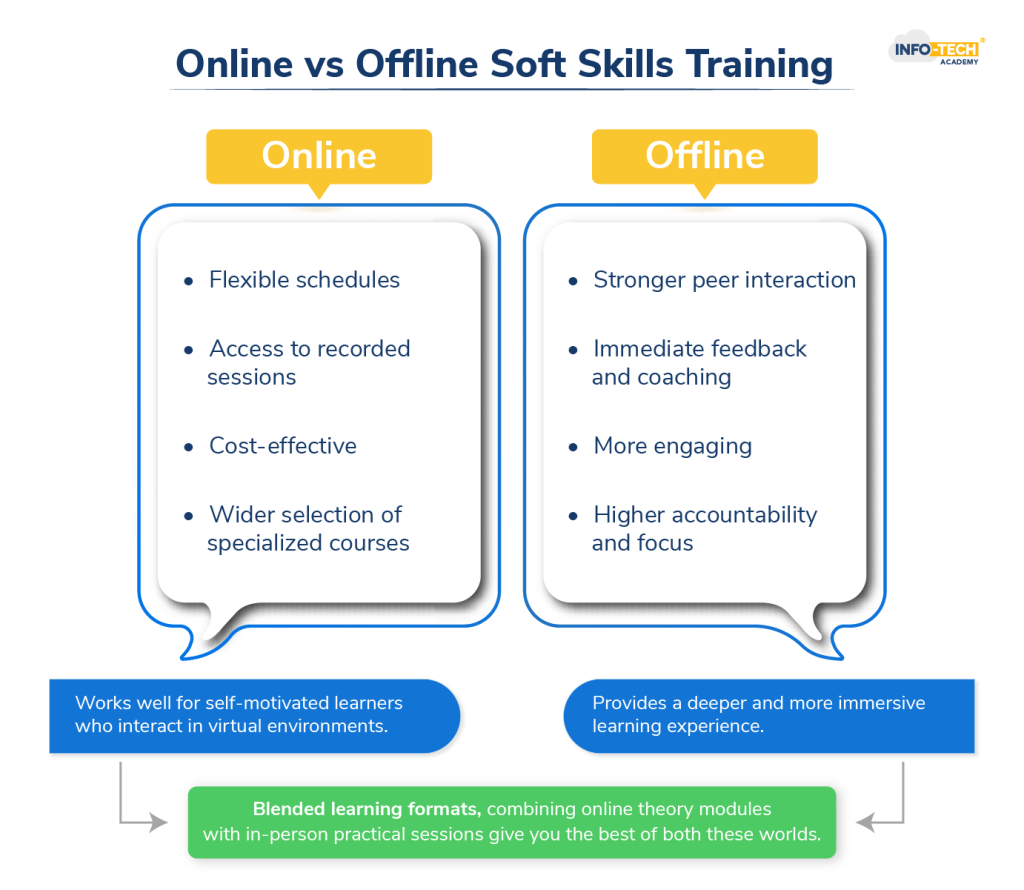
Amongst the evolving need for learning soft skills for working professionals, online training can support them in balancing their busy work schedules. Virtual access to these trainings allows learners to save commuting time and offers greater flexibility. This is a cost-effective option available with wider options to select the course based on the learner’s choice. It is the best option for learners who are self-motivated and comfortably engage in virtual platforms.
Classroom Mode (Offline)
Face-to-face learning provides hands-on access to group activities and exercises such as role-plays – these play a crucial role in mastering soft skills. Comparatively, learning at an offline setting sets up for higher focus and gives immediate opportunity for coaching and feedback by the trainer. Overall, in-person classes provide an immersive experience in learning.
Blended Mode
The combination of online theory classes along with in-person practical lessons can provide the best of both the worlds, just like the WSQ-approved courses offered by Info-Tech Academy.
Conclusion: Invest in Soft Skills for Long-Term Career Success
Effective qualities such as communication, leadership, emotional intelligence, adaptability, and negotiation are no longer optional qualities. They are considered career assets that are required for long-term professional success. Your career growth depends not only on what you know, but also on how you convey it and how you behave in a professional setting. Invest in reaping this skill today – ring us at +65 6668 7222 or visit Info-Tech Academy to register for a course of your choice.
Read More About Soft Skills Here: Soft Skills Explained: Definition, Examples, and Importance in 2026
Frequently Asked Questions
Do Employers in Singapore Really Value Soft Skills?
Yes, employers in Singapore consider soft skills just as important as technical skills.
What is the Difference Between Hard Skills and Soft Skills?
Hard Skills are technical abilities that are usually learnt through formal education such as coding, designing, and accounting. Soft Skills are interpersonal abilities that influence interaction and teamwork, such as leadership, problem-solving, and time management.
Can Soft Skills Training Help With Promotions?
Yes, effective learning of soft skills can significantly help with promotions.
What certifications can I get from soft skills training in Singapore?
Depending on the provider and structure of the programme, WSQ (Workforce Skills Qualifications) certification and SkillsFuture funding can be claimed.

I’ve always been drawn to the power of writing! As a content writer, I love the challenge of finding the right words to capture the essence of HR, payroll, and accounting software. I enjoy breaking down complex concepts, making technical information easy to understand, and helping businesses see the real impact of the right tools.