


In Singapore’s push towards lifelong employability, training subsidies play a crucial role in helping workers stay relevant. While SWDA is widely known, the Union Training Assistance Program (UTAP) is another valuable benefit that helps eligible NTUC members reduce their training costs through UTAP CLAIM. This can be especially helpful for workers taking WSQ courses or other recognized training programs to upgrade their skills and improve their career prospects.
This article explains, in detail, who qualifies for UTAP, how much can be claimed, and how the scheme works in practice, UTAP claim status, subsidy, and balance based on current NTUC and e2i guidelines applicable for 2026.
What is UTAP Scheme in Singapore?
UTAP is a training grant administered by NTUC to support its members in upgrading their skills through structured and recognised training programmes. Unlike universal subsidies, UTAP is tied directly to union membership and is meant to complement existing government funding rather than replace it.
The scheme focuses on encouraging continuous learning among working adults by reimbursing a portion of the unfunded course fees;that is, the amount a member pays after all other subsidies have been applied. This approach ensures that NTUC members are not discouraged from pursuing job-relevant training due to cost concerns.
Who Is Eligible for UTAP Claim?
Eligibility for UTAP is determined primarily by NTUC membership status and course completion.
To qualify for UTAP, an individual must be a current NTUC member before the course start date. This includes rank-and-file workers, PMETs, freelancers, and self-employed persons who are members of NTUC-affiliated unions or associations. Membership must remain active throughout the course duration.
In addition, the claimant must be at least 18 years old and must have successfully completed the course. For courses with assessments, a pass result is required.
A key point emphasised in NTUC’s official guidance is that UTAP does not apply retroactively. Courses that begin before a member joins NTUC are not eligible.
Where UTAP Claim Does Not Apply?
There are several scenarios where UTAP claims will not be approved. Individuals who are not NTUC members, whose membership starts after course commencement, or who fail to complete the course will not qualify.
UTAP also does not cover courses that are fully sponsored, where the participant does not pay any course fees personally. Informal learning, hobby-based classes, or programmes that lack clear skills relevance are similarly excluded. The course must be structured, professionally oriented, and conducted by a recognised training provider.
How Much Can You Claim Under UTAP?
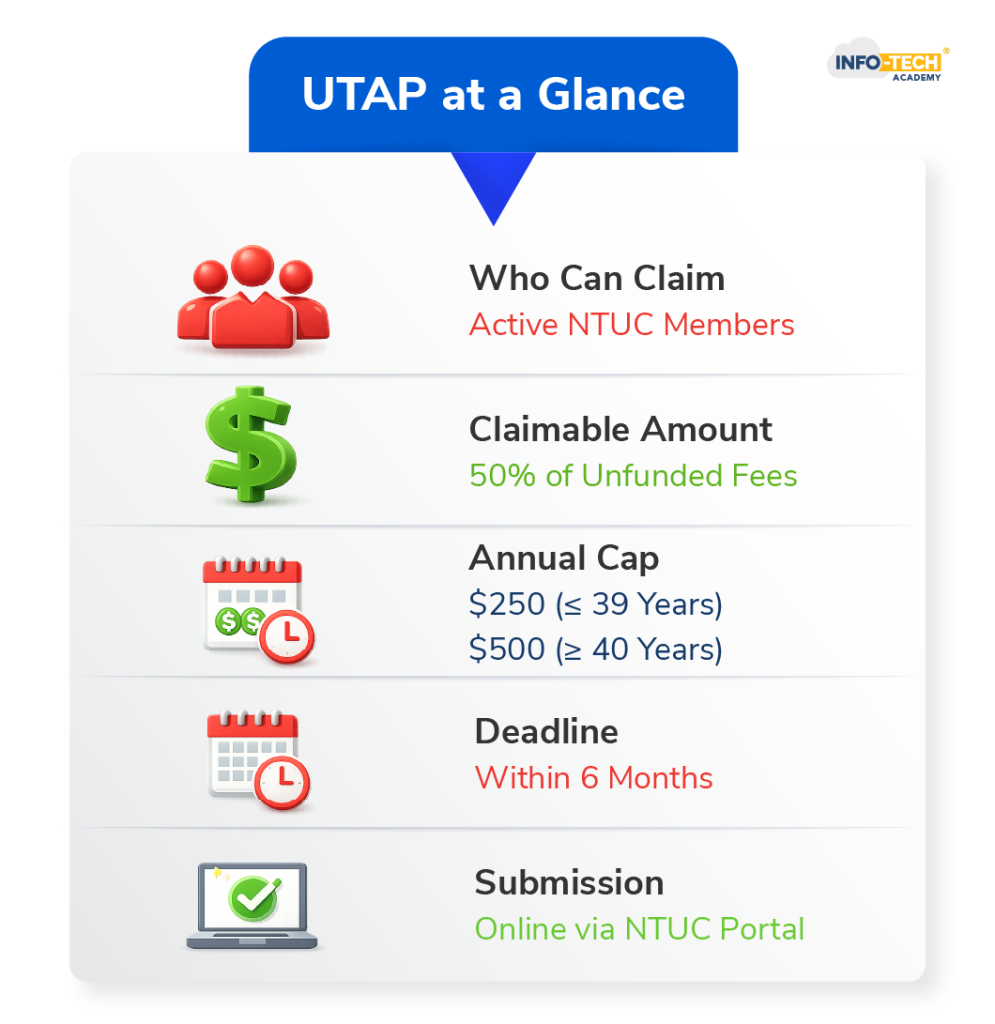
UTAP reimburses 50% of the unfunded course fee, subject to an annual cap. The maximum amount claimable depends on the member’s age.
For NTUC members aged 39 and below, the annual claim cap is SGD 250 per calendar year. Members aged 40 and above are eligible for a higher annual cap of SGD 500. This reflects the stronger emphasis on mid-career and mature worker upskilling.
The calendar-year structure means members can submit multiple claims in a year. Provided, the total amount claimed does not exceed their respective cap.
What is UTAP Claim Summary 2026?
| Item | UTAP Details |
| Who can claim | Active NTUC members |
| Claimable amount | 50% of unfunded course fees |
| Annual cap (≤ 39 years) | Up to SGD 250 |
| Annual cap (≥ 40 years) | Up to SGD 500 |
| Claim deadline | Within 6 months after course completion |
| Claim method | Online via NTUC UTAP portal |
What Are “Unfunded Course Fees”?
Unfunded Course Fees refers to the remaining amount payable by the individual after all other subsidies. Examples include SWDA funding, course fee subsidies, or employer sponsorship have been deducted.
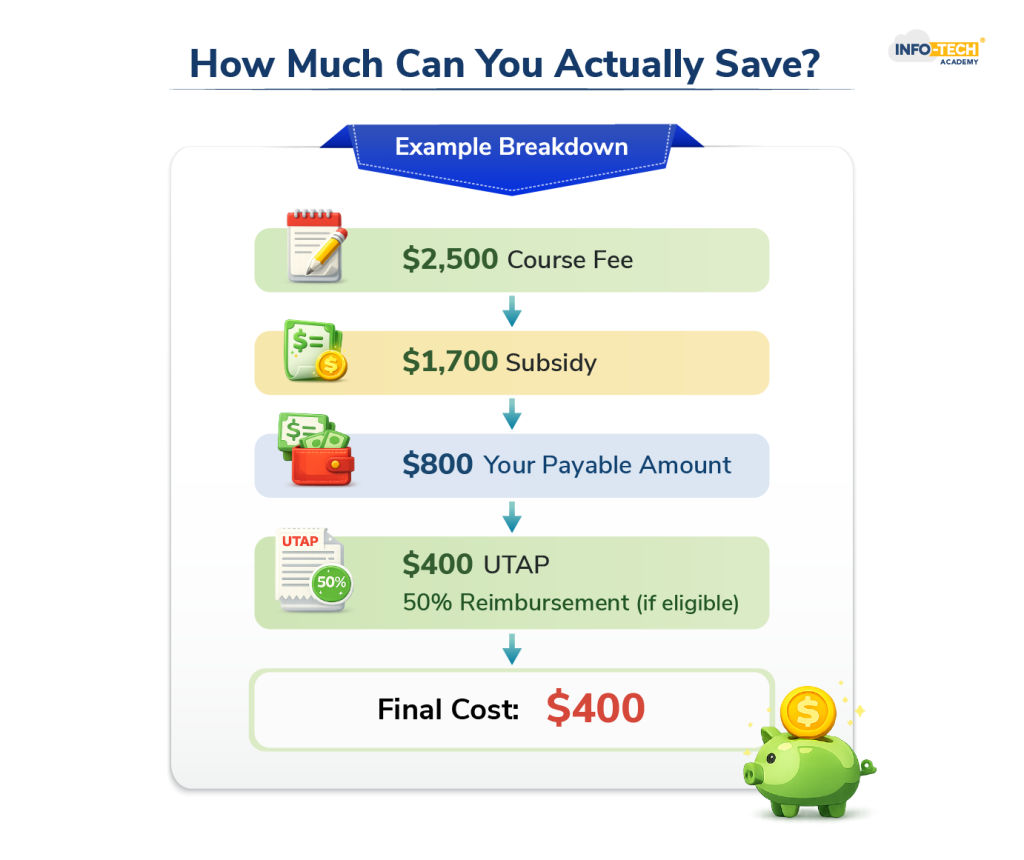
For example, if a course costs SGD 2,500 and SWDA subsidies reduce the payable amount to SGD 800, UTAP will be calculated based on that SGD 800. The member can then claim 50% of this amount, subject to their annual limit.
This layered funding structure ensures that UTAP enhances affordability without overlapping with other national funding schemes.
What Types of Courses Are Supported by UTAP?
UTAP supports a wide range of employability-focused training programmes. These include certified WSQ courses, SWDA supported programmes, and industry-recognised professional certifications. Courses commonly fall within areas such as digital skills, technology, business management, finance, HR, operations, and sector-specific technical training.
Training must be conducted by recognised providers and meet NTUC’s eligibility requirements. As training quality standards continue to tighten in 2026, priority is placed on programmes that demonstrate clear workplace relevance and measurable skill outcomes.
What is UTAP Claim Submission Timeline and Process?
UTAP claims must be submitted within six months after course completion. Claims submitted after this timeframe are not accepted. Supporting documents such as proof of payment, course completion certificates, and attendance records are required as part of the claim process.
NTUC emphasises the importance of accurate documentation, as incomplete submissions may result in delays or rejection.
How to Use UTAP Together with Other Funding Schemes?
One of UTAP’s strengths is its compatibility with other funding schemes. Members can use UTAP alongside SkillsFuture credits and course subsidies to significantly reduce their out-of-pocket expenses. This makes higher-value and longer-duration programmes more accessible, especially for working adults balancing career progression with financial commitments.
Why UTAP Matters in 2026?
As Singapore’s workforce adapts to digitalisation, automation, and evolving industry requirements, structured upskilling has become essential rather than optional. UTAP provides targeted financial support to union members who proactively invest in their own employability.
Conclusion
UTAP is a focused and valuable training subsidy that rewards NTUC members for upgrading their skills through recognised programmes. By understanding eligibility requirements, claim limits, and how unfunded course fees are calculated, members can make informed decisions and maximise the benefits available to them.
When used strategically, especially in combination with SWDA, UTAP claim can substantially lower training costs and support long-term career resilience in Singapore’s evolving job market.
Try our AI Course for Beginners in Singapore at Info-Tech Academy today! Get in touch with us.
UTAP Claim FAQs
What Is a UTAP Claim?
A UTAP claim is a reimbursement request submitted by an eligible NTUC member to recover part of the course fees paid for approved training. Under the Union Training Assistance Programme (UTAP), NTUC subsidises 50% of the unfunded course fees, meaning the amount you pay after SWDA or other subsidies have been applied.
How Do I Submit a UTAP Claim Online?
UTAP claims are submitted online through the official NTUC UTAP portal. Members must log in using their NTUC account credentials, complete the digital claim application, and upload required documents such as proof of payment, course completion certificate, and attendance records. Claims must be submitted within six months after course completion.
How Often Can I Claim UTAP and How Much Is My Claim Balance?
UTAP can be claimed multiple times within a calendar year, as long as the total amount claimed does not exceed the annual cap. Members aged 39 and below can claim up to SGD 250 per year, while members aged 40 and above can claim up to SGD 500 per year. The UTAP claim balance resets every calendar year, and any unused amount does not carry forward. Members can check their remaining claim balance by logging into the UTAP portal and viewing their claim history.
Do I Check My UTAP Claim Status or Get Help If I Can’t Log In?
After submitting a claim, members can check their UTAP claim status online by logging into the NTUC UTAP portal using their registered account. The portal shows whether a claim is under review, approved, or rejected. If members face issues such as forgotten login passwords, portal access problems, or claim errors, they can contact the NTUC UTAP hotline or visit an NTUC help centre for assistance. NTUC support teams can also help clarify claim eligibility, missing documents, and processing timelines.

I’ve always been drawn to the power of writing! As a content writer, I love the challenge of finding the right words to capture the essence of HR, payroll, and accounting software. I enjoy breaking down complex concepts, making technical information easy to understand, and helping businesses see the real impact of the right tools.