

Changing careers is something many professionals think about at some point. Sometimes it’s because an industry is evolving, sometimes because new opportunities appear elsewhere, and sometimes simply because people want to move into a field that feels more future-proof. In Singapore, the government recognises that career changes are becoming more common, especially as technology reshapes industries.
That’s where the SkillsFuture Career Transition Programme (SCTP) comes in.
Instead of expecting workers to figure everything out on their own, the programme provides a structured way for individuals to learn new skills and move into different industries. It forms part of Singapore’s wider SkillsFuture initiative, which encourages continuous learning and workforce development.
In simple terms, the SkillsFuture Career Transition Programme helps people prepare for new careers by offering training programmes designed around real industry needs.
What is SkillsFuture Career Transition Programme?
The SkillsFuture Career Transition Programme, often shortened to SCTP, was introduced by SkillsFuture Singapore (SSG) to help workers adapt to changing job markets.
Many training courses focus on a single skill. SCTP programmes work differently. They are usually built as complete training pathways, combining several modules that collectively prepare participants for a specific job role.
For example, someone who wants to move into digital marketing might learn:
- Digital campaign strategy
- Social media marketing
- Data analytics tools
- Online advertising techniques
Instead of learning just one skill, participants gain a set of abilities that employers are actively looking for.
The idea is straightforward: if workers are given the right training, transitioning into a new role becomes much more realistic.
Why Programmes Like SCTP Exist?
The workplace today looks very different compared to even a decade ago. Technology is evolving quickly, and businesses are constantly adapting to remain competitive.
As a result, certain jobs are changing or disappearing, while entirely new roles are being created.
Several major trends have influenced the creation of programmes like SCTP.
| Workplace Trend | What It Means for Workers |
| Automation | Routine tasks are increasingly automated |
| Digital transformation | More jobs require digital skills |
| Emerging industries | New career paths are being created |
| Lifelong learning | Workers must upgrade skills regularly |
Because of these shifts, career mobility is becoming more important. The SkillsFuture Career Transition Programme helps make that transition less overwhelming and more structured.
Who the Programme Is Designed For?
Although anyone interested in upgrading their skills may benefit from training, the SCTP programme mainly focuses on mid-career individuals.
These are people who may already have several years of work experience but want to move into a different industry or role.
Typical participants include:
- Professionals considering a career switch
- Workers affected by industry restructuring
- Employees who want to develop new skills
- Job seekers trying to enter growing industries
- Individuals returning to work after a career break
In many cases, participants already possess valuable soft skills such as leadership, teamwork, or project management. SCTP programmes help them combine those strengths with new technical or professional expertise.
What are the Eligibility Requirements For SCTP?
The SkillsFuture Career Transition Programme is open primarily to Singapore Citizens and Permanent Residents.
While specific requirements can vary depending on the training provider, the general eligibility guidelines look like this:
| Criteria | Details |
| Citizenship | Singapore Citizens and PRs |
| Career stage | Often targeted at mid-career workers |
| Employment status | Both employed individuals and job seekers |
| Participation | Learners must complete the programme |
Some courses may also ask for basic knowledge or prior experience related to the subject area.
How the Programme Is Structured?
Unlike short workshops or single-day seminars, SCTP programmes are usually designed as multi-module training pathways.
Participants typically go through several stages of learning.
Common components include:
- Instructor-led training sessions
- Hands-on assignments
- Case studies based on real business scenarios
- Capstone projects
- Final assessments or certifications
This combination of theory and practical learning helps participants develop skills that can be applied immediately in the workplace.
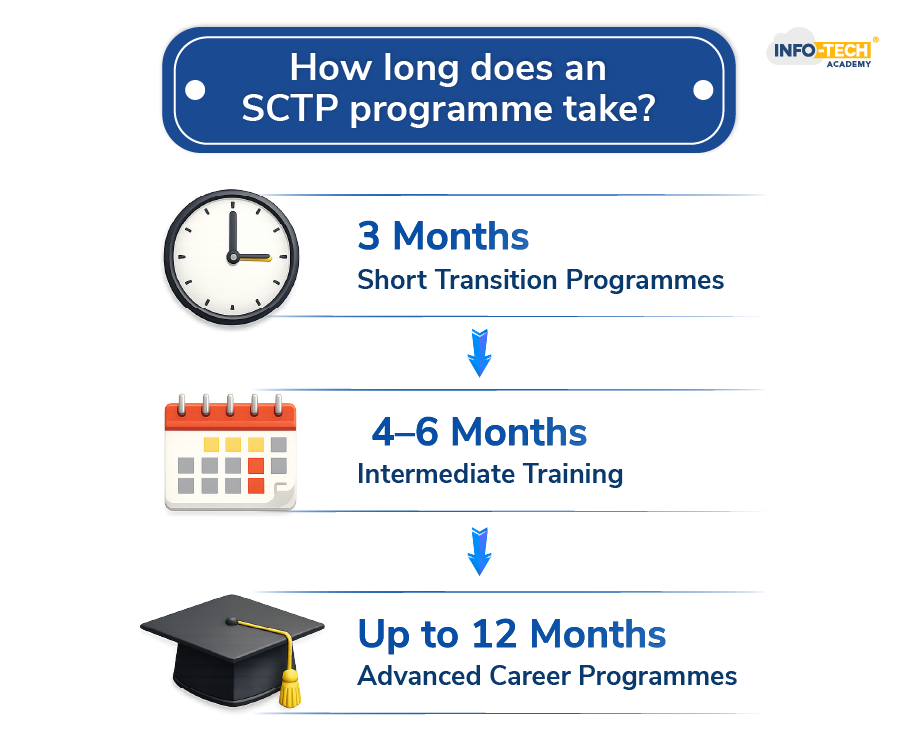
How Long SCTP Programmes Usually Take?
The duration of an SCTP programme depends on the industry and the depth of training involved.
Some programmes are relatively short, while others are more comprehensive.
| Programme Type | Typical Length |
| Short programmes | Around 3 months |
| Intermediate programmes | 4–6 months |
| Advanced programmes | Up to 12 months |
Many training providers also offer part-time schedules, making it easier for working professionals to attend classes while maintaining their jobs.
What Are the Advantages of SkillsFuture Career Transition Programme?
For individuals thinking about changing careers, the biggest challenge is often figuring out where to start. SCTP programmes help by offering a clear pathway.
Some of the key benefits include:
- Government-supported course subsidies
- Training aligned with industry demand
- Structured learning pathways for career changes
- Opportunities to explore emerging sectors
- Certifications that are recognised by employers
Because the programmes are designed in collaboration with industry stakeholders, the training tends to focus on skills that are actually needed in the job market.
Which Industries Offer SCTP Training?
The SkillsFuture Career Transition Programme usually focuses on sectors where demand for skilled professionals continues to grow.
Some examples include:
| Industry | Example Roles |
| Information Technology | Data analyst, cybersecurity specialist |
| Artificial Intelligence | Machine learning engineer |
| Digital Marketing | Digital strategist |
| Business Management | Operations manager |
| Finance and Accounting | Financial analyst |
These industries continue to expand as businesses adopt new technologies and digital solutions.
How is the Funding Support for Participants?
One of the most attractive aspects of SCTP programmes is the level of government funding available.
Depending on eligibility, participants may receive significant subsidies for their course fees.
| Participant Category | Possible Subsidy |
| Singapore Citizens | Up to 70% subsidy |
| Mid-career individuals | Up to 90% subsidy |
| Permanent Residents | Subsidy levels may vary |
Participants may also be able to use their SkillsFuture Credit to reduce their remaining course costs.
This support makes professional training far more accessible for many individuals.
How SCTP Connects with Other SkillsFuture Initiatives?
The SkillsFuture Career Transition Programme does not exist in isolation. It forms part of a much broader effort by the Singapore government to promote lifelong learning.
Other SkillsFuture initiatives include:
- SkillsFuture Credit, which provides funding for training courses
- Workforce Skills Qualifications – WSQ certifications
- SkillsFuture Mid-Career Support initiatives
- Various industry-specific upskilling programmes
Together, these initiatives encourage workers to continuously improve their capabilities throughout their careers.
How to Apply for SCTP Programme?
If someone is interested in joining a SkillsFuture Career Transition Programme, the process generally involves a few simple steps.
Most applicants start by researching the available programmes offered by approved training providers.
The usual process involves:
- Exploring available SCTP courses
- Checking eligibility requirements
- Submitting an application to a training provider
- Confirming funding eligibility
- Enrolling in the programme
Choosing a programme that aligns with long-term career goals can make a big difference.
Looking Ahead: Career Transitions in a Changing Economy
The idea of spending an entire career in one industry is becoming less common. As technology evolves, professionals are increasingly moving between roles, industries, and skill sets.
Singapore’s approach to workforce development reflects this reality. Instead of focusing only on entry-level education, the country has placed strong emphasis on continuous skill development throughout a person’s career.
The SkillsFuture Career Transition Programme is one example of how this strategy is being put into practice.
Conclusion
The SkillsFuture Career Transition Programme (SCTP) offers a practical solution for professionals who want to upgrade their skills or explore new career opportunities. By combining structured training, government subsidies, and industry-focused learning, the programme makes career transitions more achievable.
For organisations, workforce transformation also involves adopting modern systems that support employee development and operational efficiency.
When businesses combine strong workforce technologies with initiatives like SkillsFuture training programmes, they are better positioned to build adaptable teams that can thrive in an evolving economy.
SCTP Frequently Asked Questions
What is the SkillsFuture Career Transition Programme (SCTP)?
The SkillsFuture Career Transition Programme (SCTP) is a government-supported training initiative designed to help mid-career individuals acquire new skills and transition into different industries or job roles through structured training programmes.
Who is eligible for SCTP?
SCTP programmes are generally open to Singapore Citizens and Permanent Residents, particularly mid-career individuals looking to switch industries or upgrade their professional skill sets.
How long does an SCTP programme take?
Most SCTP programmes range from 3 months to 12 months, depending on the industry and the depth of training required.
Are SCTP programmes subsidised?
Yes. Eligible participants can receive government subsidies of up to 70% or 90%, depending on their eligibility and programme requirements.

I’ve always been drawn to the power of writing! As a content writer, I love the challenge of finding the right words to capture the essence of HR, payroll, and accounting software. I enjoy breaking down complex concepts, making technical information easy to understand, and helping businesses see the real impact of the right tools.