


In this article
- 1. What is this gap no one really talks about?
- 2. Why does work feel so different from what you learned?
- 3. Is the problem really a lack of skills or something else?
- 4. What does it actually mean to “apply” what you’ve learned?
- 5. Why does this gap hit fresh graduates the hardest?
- 6. Is the gap getting bigger over time?
- 7. What actually helps you bridge this gap?
- 8. What’s the takeaway most people miss
What is this gap no one really talks about?
There’s a moment that doesn’t get discussed enough. It usually happens quietly, sometime after you’ve settled into a new job. You’re no longer the “new joiner,” expectations are higher, and suddenly, something feels off. You did learn these things in school – be it through a formal university education or (… name other forms of formal education). You do know the basics.
So why does it still feel like you’re figuring everything out from scratch? This is where office skills plays a crucial role.
That’s the gap no one really prepares you for—the difference between learning something in theory and dealing with it in the reality of work.
Why does work feel so different from what you learned?
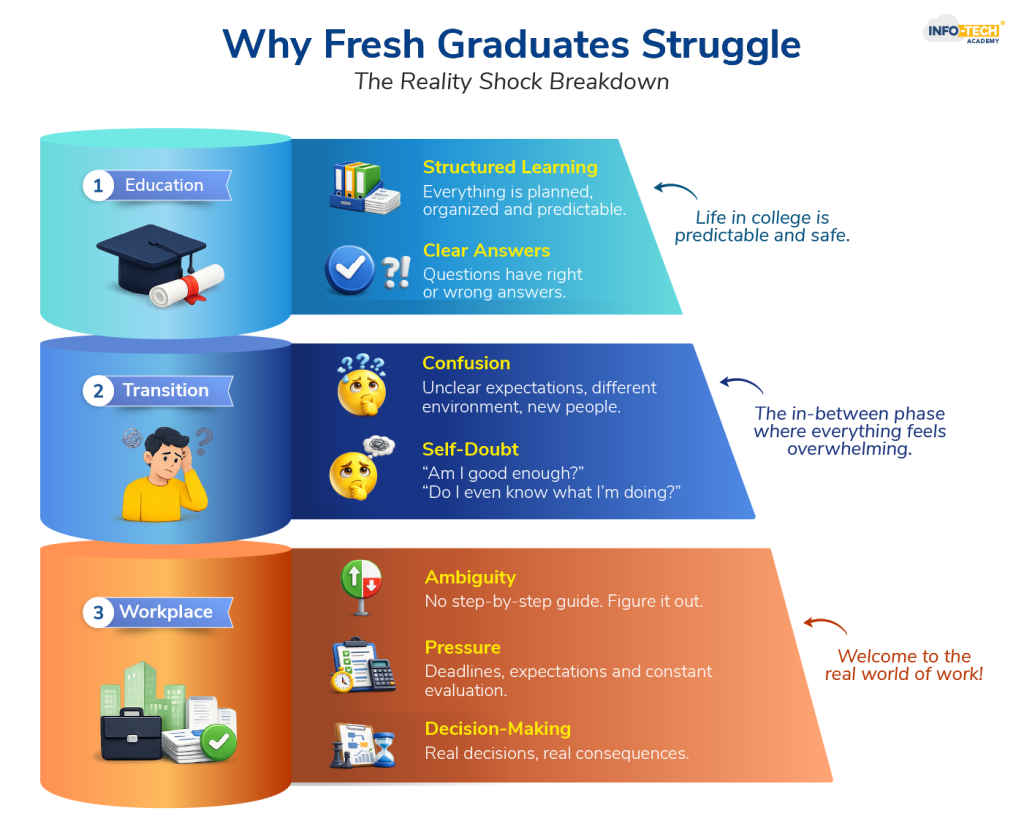
In most learning environments, everything is designed to make sense. Tasks are clear, steps are defined, and outcomes are predictable. You’re guided through the process, and more often than not, there’s a “right way” to do things.
Work doesn’t follow that script.
You might walk into a task expecting clarity, but instead you get fragments—half-explained instructions, shifting expectations, and deadlines that move without warning. You’re not just executing tasks; you’re constantly interpreting them.
That’s where the disconnect begins.
- In learning: clarity is given
- At work: clarity is often something you must create
And that shift alone is enough to make even capable people feel unprepared.
Is the problem really a lack of skills or something else?
Most people assume they’re struggling because they didn’t learn enough. But in reality, they’re struggling because they’ve never had to apply what they learned in a messy, real-world setting.
Knowing something in isolation is very different from using it under pressure.
Take a simple example. You may have learned Excel functions and formatting. But in the workplace, no one hands you a clean dataset. You’re dealing with incomplete information, inconsistencies, and expectations that aren’t clearly stated.
The same applies across the board:
- Writing emails is easy> until tone matters and stakes are high
- Creating slides is simple> until someone questions your logic mid-presentation
- Following instructions is manageable> until the instructions are unclear
Work doesn’t test your memory. It tests your judgment.
What does it actually mean to “apply” what you’ve learned?
If you strip away the job descriptions and buzzwords, what employers really value has shifted.
They assume you know the basics. What they’re watching for is how you operate when things aren’t straightforward.
They notice things like:
- How you respond when something goes wrong
- Whether you can move forward without constant direction
- How clearly you communicate when there’s confusion
- Whether you can prioritise when everything feels urgent
These aren’t skills you pick up from theory alone. They come from exposure—either through experience or through practical, applied learning.
This is where a well-structured Office Skills Course becomes relevant—not as a checklist of tools, but as a bridge between knowing and doing.
Why does this gap hit fresh graduates the hardest?
There’s a reason this feels especially overwhelming at the start of a career.
Most graduates have done everything expected of them. They studied, passed exams, and built a strong foundation. But the workplace introduces something they haven’t had much exposure to—uncertainty.
You’re no longer solving defined problems. You’re dealing with situations where:
- The problem itself isn’t fully clear
- There are multiple possible approaches
- Time is limited, and decisions matter
That shift—from structured learning to unstructured work—is where many people struggle, even if they’re capable.
Is the gap getting bigger over time?
If anything, this gap is becoming more visible in 2026.
With AI and automation handling routine tasks, the expectations from individuals have shifted upward. It’s no longer enough to “know how to do something.” What matters is how you think, decide, and adapt.
The human side of work—communication, judgment, problem-solving—is now the real differentiator.
And ironically, that’s the part traditional learning still doesn’t emphasise enough.
What actually helps you bridge this gap?
Honestly, it comes down to one thing: getting used to using the tools in real work situations.
It’s not enough to know what Excel or Word can do. What really makes a difference is when you’ve actually worked with the kind of files, formats, and tasks that show up in a real office.
Because the first time you open a spreadsheet at work, it’s rarely neat or simple. The first email you draft isn’t a practice exercise. And the first presentation you build usually has a purpose behind it—not just marks or grading.
That’s why exposure matters so much.
It could look like:
- Working on Excel sheets that feel like actual company data, not perfectly arranged examples
- Creating documents the way they’re used in offices, not just following step-by-step instructions
- Writing emails based on real workplace situations, not generic samples
- Putting together presentations that mirror what teams actually share in meetings
When you’ve done this kind of work before, even at a basic level, things don’t feel so unfamiliar anymore.
And that’s exactly where a good Digital Office Skills Course helps. Not by teaching more features, but by giving you that early exposure—so when you step into a job, you’re not seeing everything for the first time.
What’s the takeaway most people miss
The gap isn’t a reflection of your ability. It’s a reflection of how differently learning and work are structured.
Once you understand that, the focus changes.
You stop trying to learn more, and start trying to apply better.
Because at the end of the day, success at work isn’t about how much you know.
It’s about how well you can use what you know—especially when things don’t go as planned.
Office Skills Course FAQs
Why is there a gap between what we learn and what work demands?
The gap exists because learning environments are structured, while workplaces are unpredictable. In education, tasks are clearly defined with expected outcomes. At work, you deal with ambiguity, shifting priorities, and real-time decision-making. This difference makes it harder to directly apply what you’ve learned without practical exposure.
How does an Office Skills Course help bridge this gap?
A good Office Skills Course focuses on real-world application rather than just theory. It trains you to handle messy data, communicate effectively in professional situations, and manage tasks under pressure. This practical approach helps you transition from knowing concepts to confidently applying them in actual workplace scenarios.
What skills are most important in today’s workplace?
Beyond technical skills, employers value communication, adaptability, problem-solving, and time management. These skills help employees function effectively in fast-changing environments. In 2026, with AI handling routine tasks, human skills like decision-making and collaboration have become even more critical for career success.
Why do fresh graduates struggle in their first job?
Fresh graduates often struggle because they lack exposure to real-world work conditions. While they may have strong theoretical knowledge, they are not used to handling unclear instructions, tight deadlines, or workplace communication dynamics. This adjustment period is where the gap between learning and work becomes most noticeable.

I’ve always been drawn to the power of writing! As a content writer, I love the challenge of finding the right words to capture the essence of HR, payroll, and accounting software. I enjoy breaking down complex concepts, making technical information easy to understand, and helping businesses see the real impact of the right tools.