

For any organization to perform well, it is in the hands of the performance of the employees. Despite a company’s strong vision, the absence of performing employees will bring the company down and will impact the business largely. In this blog, we’ll explore what employee performance really means, why it matters, and how managers can effectively manage and improve it to build a high-performing team.
What is Employee Performance?
Employee performance is the evaluation of how well one works. It is generally defined based on the quality, quantity, and efficiency of a person’s work. Apart from this, it also depends on factors such as employee’s behavior, experience, skills, attitude, punctuality, and organizational culture.
Key indicators to evaluate employee performance are:
- Achievement of goals
- Reaching targets
- Work quality and efficiency
- Attendance
- Reliability
- Problem-solving
- Taking initiatives
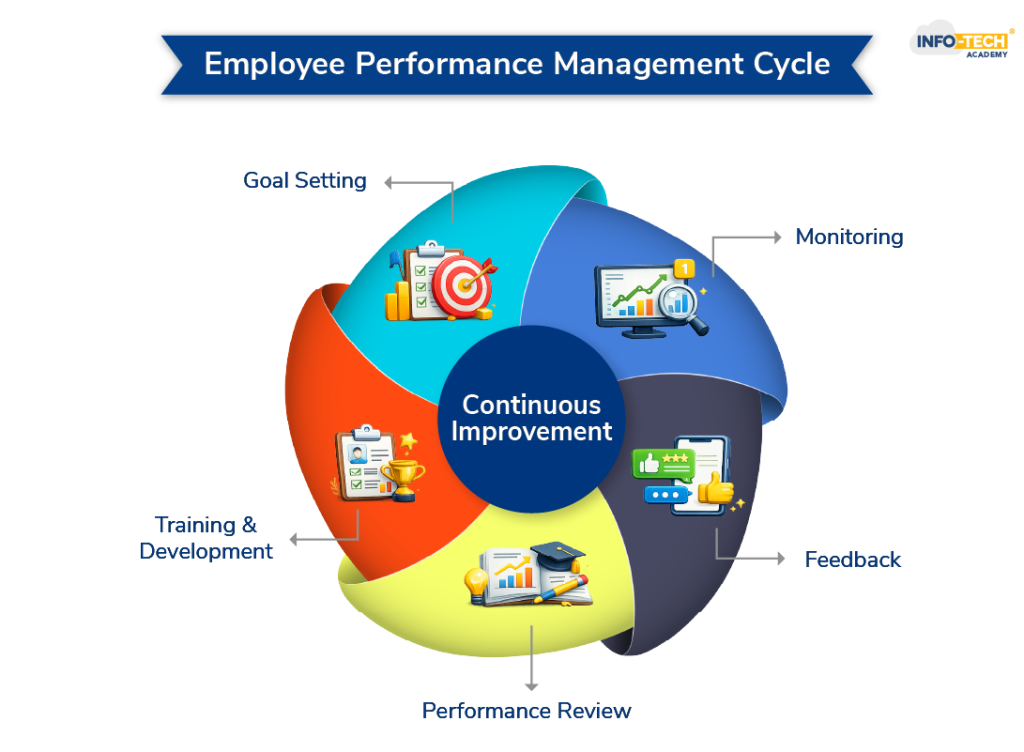
What Factors Influence Employee Performance?
Influence on an employee’s performance depends on a combination of various factors. Understanding them right can help create the right conditions for proper performance of the employees.
- Understanding Organizational Goals: Knowing one’s role and responsibility in an organization clearly will make an employee stay focused towards the goals and expectations. This will set a clear idea for them to know what and why they do the work they are assigned to.
- Relevant Skills: Having technical skills that are required for the effective performance of the role will ultimately boost their performance in the workplace.
- Motivation and Recognition: Motivation from colleagues and leaders can help perform better. Rewards for the best employees will make them feel like their constant hard work and performance did not go unnoticed.
- Management Style: Managers who effectively lead the team provide guidance, constant feedback, and teach ways for positive development.
- Work Culture: Healthy work culture can promote work-life balance and better performance at work.
- Developmental Opportunities: Growth within the organization must be made possible for the deserving employees. This will not only motivate them, but also other employees to work competitively.
- Constructive Feedback: Regular feedback can help employees know the areas where they need to develop, and work on it for better performance.
- Resources Availability: Having access to the required tools at work will make the work faster and easier.
What Employee Performance Metrics Every Manager Should Track?
Though each employee works in their own way, there are certain metrics based on which the managers will be able to assess and evaluate and analyze each one’s performance.
- Productivity Efficiency: Measuring the amount of work the employee can complete within a specific time shows how fast they can work. But that alone cannot decide if their work is proper.
- Work Quality: Even if an employee works more than the target, if the quality of work does not meet the required standards, it will be of no use. So, it is also important to have quality in mind.
- Achieving Goals: Meeting the targets consistently or exceeding them will show reliability and competency.
- Punctuality: Being to work on time on a regular basis shows professional manners and work commitment.
- Involvement and Participation: Getting involved in team activities and giving productive ideas for the team’s development indicates leadership qualities.
- Peer Reviews: Positive or negative feedback from colleagues will also create an impact on employee analysis.
- Collaborative Work: Ability of an employee to work well with the team and maintain cordial relationship with them promotes team’s success and efficiency.
- Managing Time: Prioritizing required tasks and meeting deadlines is an important indicator for good performance.
- Innovation and Suggestion: Suggesting ideas for workforce development and innovating new ways for better performance can imply better work outcomes.
- Self-Progress: Learning and developing one’s skill and knowledge over time shows adaptability and willingness to adapt.
How Training and Development Can Improve Performance?
Training and development are essential for improving employee performance. They equip individuals with the skills, knowledge, and confidence needed to perform their roles effectively. When employees receive regular training, they are better able to handle tasks efficiently, adapt to new technologies, and reduce errors in their work. This not only boosts productivity but also enhances job satisfaction and engagement, as employees feel valued and supported in their growth. Additionally, development programs help bridge skill gaps, encourage innovation, and prepare employees for future responsibilities, ultimately contributing to stronger individual performance and overall organizational success.
For corporate offices, employers can enroll their employees for corporate training to boost their overall work performance.
Employee Performance FAQs
What are 5 qualities of a good employee?
The 5 main qualities of a good employee are strong work ethics, positive attitude, good communication skills, adaptability, and teamwork.
How do you describe an employee’s performance?
Employee performance can be described as the overall effectiveness with which an employee fulfills their job responsibilities and contributes to organizational goals. It is typically evaluated based on a combination of factors such as the quality and quantity of work, consistency, reliability, and behavior in the workplace.
What are the 4 P’s of performance?
The 4 P’s of performance are Purpose, Performance, Potential, and Productivity.
What are the 5 levels of performance evaluation?
The 5 levels of performance evaluation include Outstanding, Exceeds Expectations, Meets Expectations, Needs Improvement, and Unsatisfactory.

Transforming thoughts and concepts into clear, compelling words is a powerful tool that connects people. While writing boosts my creativity, reading broadens my perspective and sharpens my understanding of language and narration.