



In this article
- 1. A National Festival That’s Often Misunderstood
- 2. What Happens Before Students Ever Step Onto The SYF Stage?
- 3. How Is The Singapore Youth Festival Evolving in 2026?
- 4. Is the pressure in SYF a problem?
- 5. Growth That Is Subtle but Lasting
- 6. Challenging the Idea That SYF Is Only for the “Talented”
- 7. Why SYF Remains Relevant in Today’s Context
- 8. Singapore Youth Festival FAQs
A National Festival That’s Often Misunderstood
On paper, the Singapore Youth Festival (SYF) sounds quite straightforward. It’s a national platform where students perform—music, dance, theatre—and schools are recognised for their efforts.
But that description feels incomplete.
Because if you’ve ever been close to it—even just watching rehearsals—you’ll realise the performance itself is only a small part of the story. What really defines SYF is everything that happens before that moment on stage.
For most students, it doesn’t feel like an “event” at all. It feels more like something they slowly grow into, without fully noticing it at first.
What Happens Before Students Ever Step Onto The SYF Stage?
What audiences see is the final version—clean, coordinated, confident.
What they don’t see is how uncertain it looks at the start.
Rehearsals can be awkward in the beginning. People miss cues, timing is off, and there’s always that slight hesitation—like everyone is still figuring out where they fit. Even students who seem confident on stage don’t always start that way.
But over time, things begin to settle.
Not all at once, and not perfectly. Just small changes. A section becomes tighter. Someone starts getting their timing right more consistently. The group begins to move with a bit more awareness of each other.
It’s gradual, almost unremarkable while it’s happening. But if you compare the beginning and the end, the difference is clear.
How The Singapore Youth Festival Is Evolving in 2026
This year feels slightly different, and people involved in SYF can sense it.
Reaching the 60-year mark has made the festival feel a bit more reflective. There’s still structure, still expectations—but the way people talk about it has shifted.
There’s less emphasis on chasing results for their own sake, and more attention on whether students actually understand what they are doing. Teachers seem more focused on helping students interpret and connect with the performance, rather than just getting it technically right.
There’s also been a quiet effort to involve students earlier, especially at the primary level. Not to push them harder, but to let them get used to expressing themselves without overthinking it.
It’s not a dramatic change. But it’s noticeable.
Is the pressure in SYF a problem?
It would be unrealistic to say SYF isn’t stressful.
Students feel it—whether it comes from expectations, from the group, or from themselves. After putting in weeks or months of effort, it’s hard not to care about how things turn out.
And lately, that pressure feels a bit more visible. Performances are sharper, and with everything being shared online, there’s a sense that more people are watching.
But the pressure isn’t entirely negative.
In many ways, it gives the experience weight. It makes students take things seriously, not just for themselves but for the people they’re performing with.
Without that sense of responsibility, the experience probably wouldn’t stay with them in the same way.
Growth That Is Subtle but Lasting
One thing about SYF is that the changes it brings aren’t always obvious while they’re happening.
There’s no clear moment where a student suddenly becomes confident or resilient. It’s usually much quieter than that.
But over time, you start to notice small shifts.
Someone who used to hesitate begins to carry themselves a bit more steadily. A student who struggled to keep up becomes more consistent. Groups that once felt disconnected start to move with a shared understanding.
These aren’t dramatic transformations. But they last longer precisely because they happen gradually.
Challenging the Idea That SYF Is Only for the “Talented”
It’s easy to assume SYF is mainly for students who are already good at performing.
The final performances can give that impression.
But if you look at the process, it tells a different story.
Many students don’t start out strong. Some take longer to find their rhythm. Others need more time to feel comfortable being seen or heard.
What makes the difference is not so much talent, but exposure and consistency.
Given enough time and the right environment, most students improve. And often, the ones who struggled at the beginning are the ones who gain the most from the experience.
Why SYF Remains Relevant in Today’s Context
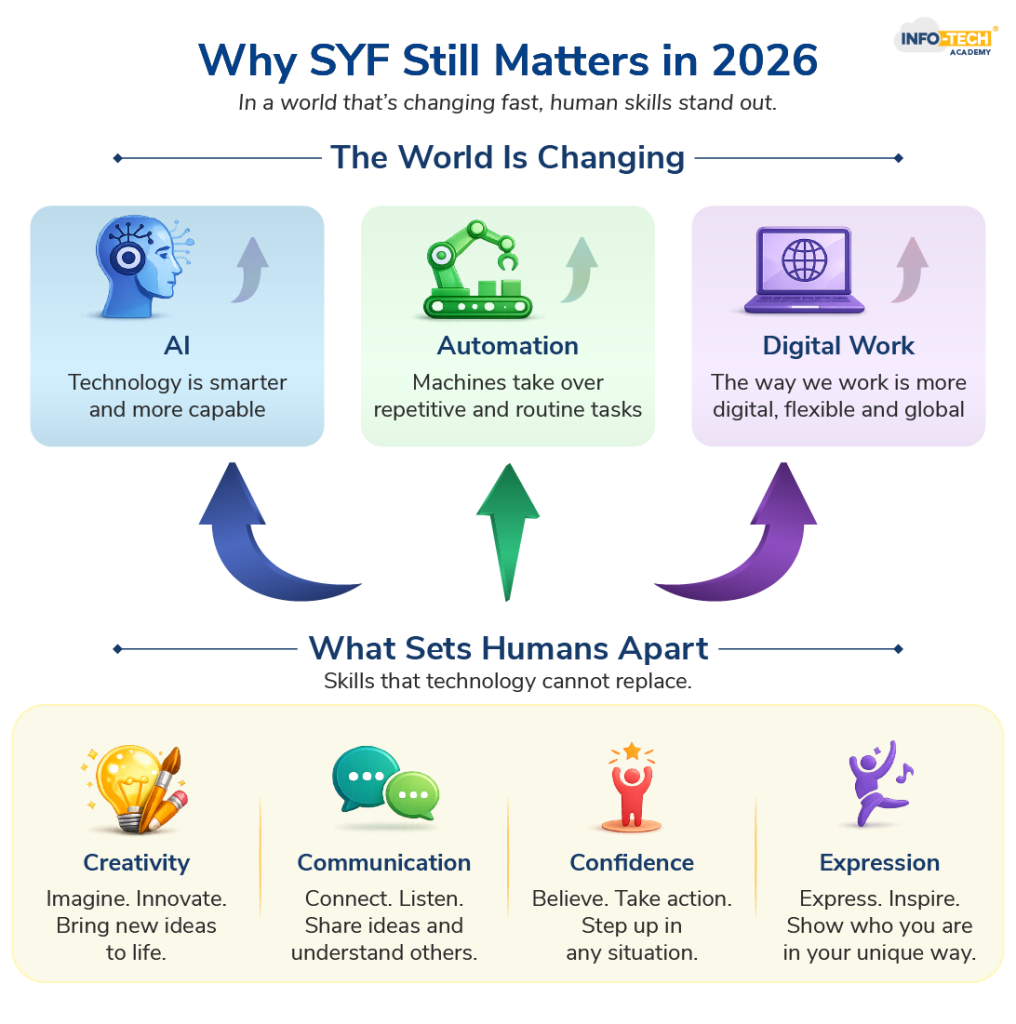
In 2026, the way people learn, and work is changing quite quickly.
A lot of tasks are becoming easier, faster, more automated. Technical knowledge is still important, but it’s no longer the only thing that matters.
What seem to stand out more now are harder to replicate—how someone communicates, how they respond under pressure, how they work with others.
SYF doesn’t teach these things directly. There’s no formal lesson for it.
But it creates situations where students must figure them out for themselves—through practice, through mistakes, and through working with a group.
That’s what keeps it relevant, even as everything else changes.
Conclusion:
The Singapore Youth Festival is often placed under the category of an arts event.
But for the students who go through it, it becomes something more than that.
It’s a space where they are asked—sometimes without realising it—to be consistent, to work with others, and to show up even when they’re unsure.
Not everything about the experience is easy. And not everything is visible from the outside.
But by the end of it, most students walk away having changed in small but meaningful ways.
And that’s what tends to stay with them long after the performance is over.
Singapore Youth Festival FAQs
What is the Singapore Youth Festival (SYF)?
The Singapore Youth Festival is a national platform where students participate in performing arts such as music, dance, and theatre, focusing on both performance and personal development.
How has SYF changed in recent years?
SYF has gradually shifted to place more emphasis on student growth and learning experiences, rather than focusing only on competition outcomes.
Is SYF only for students with artistic talent?
No. Students with different levels of ability take part, and many improve through regular practice and group work.
What skills do students gain from SYF?
Students often develop confidence, teamwork, discipline, and communication skills through the experience.

I’ve always been drawn to the power of writing! As a content writer, I love the challenge of finding the right words to capture the essence of HR, payroll, and accounting software. I enjoy breaking down complex concepts, making technical information easy to understand, and helping businesses see the real impact of the right tools.