


In this article
- 1. What Are AI Detectors and Why Are They Important?
- 2. How Do AI Detectors Work?
- 3. What Techniques Do AI Detectors Use to Identify AI Content?
- 4. Can AI Detectors Identify AI Content in Images and Videos Too?
- 5. How Accurate Are AI Detectors in Real-Life Scenarios?
- 6. What Are the Limitations of AI Detection Tools?
- 7. How Are AI Detectors Used in Education and Industry?
- 8. Are AI Detectors Better Than Plagiarism Checkers?
- 9. What Is the Future of AI Detection?
- 10. How To Learn AI Instead of Just Detecting It?
- 11. AI Detection FAQs
AI is kind of everywhere now. You see it in articles, captions, assignments and even in images and videos. And honestly, most of the time, you can’t even tell if a human made it or not. This is exactly why AI detection started becoming popular. People want to know what’s real and what’s not. But here’s the real question: do these tools actually work the way people think they do?
Let’s get to know about it in a simple way through this article.
What Are AI Detectors and Why Are They Important?
AI detectors are tools that try to figure out if something was created by AI or by a real person.
They don’t “catch” AI like some kind of lie detector. They just look at patterns and give an estimate.
Right now, they’re being used more because AI content is increasing everywhere; especially in schools, online content, and media. People want some way to check authenticity, even if it’s not perfect.
How Do AI Detectors Work?
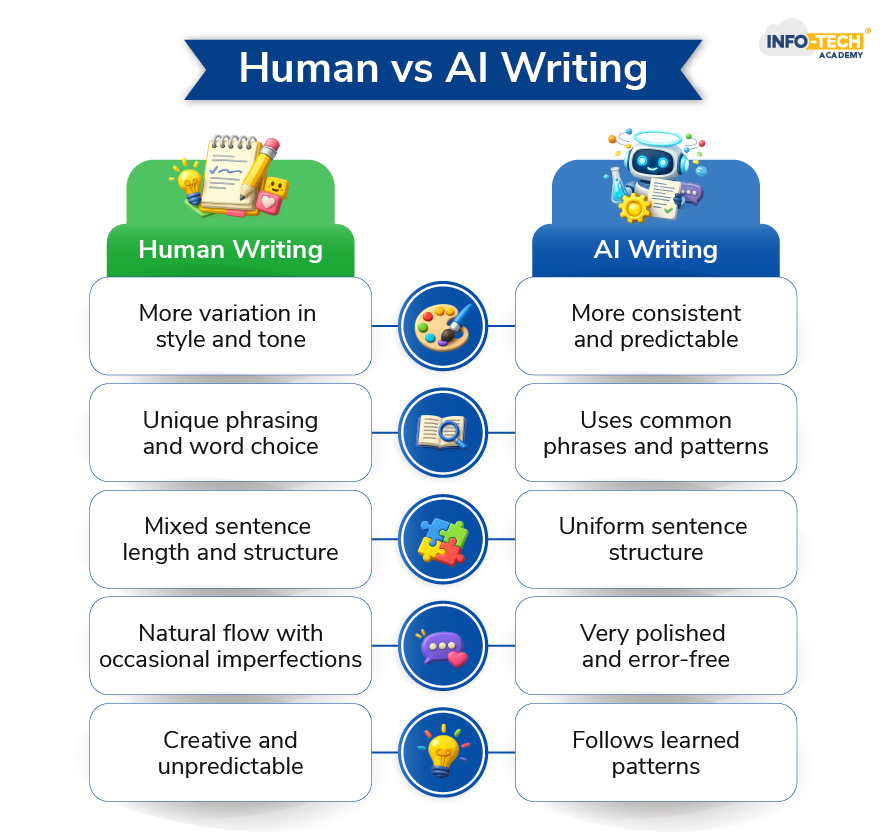
Think of it like this: these tools have seen a lot of examples. They’re trained on both human-written and AI-generated content. Over time, they learn what feels “typical” for each.
When you paste text into a detector, it doesn’t read like a human would. Instead, it checks things like:
- Is the writing too consistent?
- Are the sentences predictable?
- Does it repeat patterns?
Then it gives a score. Not a yes or no, but just a probability.
What Techniques Do AI Detectors Use to Identify AI Content?
There’s no single method. Most tools mix a few approaches.
Here’s a simple view:
| Technique | What it checks |
| Language analysis | Grammar, tone, and sentence style |
| Perplexity | How predictable the writing is |
| Burstiness | Variation in sentence lengths |
| Feature signals | Word choice and punctuation habits |
| Pattern spotting | Anything that feels “too uniform” |
One thing to note is: AI writing is often very smooth and consistent. Human writing usually isn’t. We change tone, we make small jumps, sometimes we’re a bit messy. This difference matters.
Can AI Detectors Identify AI Content in Images and Videos Too?
Yes, and this part surprises a lot of people. For images, detectors look at tiny details such as lighting, shadows, and even pixel patterns. If something feels slightly “off,” it might get flagged.
Videos are trickier, but detectors still try. They check frame consistency, audio sync, and transitions. This is especially useful when it comes to deepfakes.
How Accurate Are AI Detectors in Real-Life Scenarios?
The real answer: Mixed. Sometimes they work well. Sometimes they don’t.
A few things affect the result:
- Short text is harder to analyze
- New AI tools are harder to detect
- If a human edits AI content, it gets confusing
So even if you see a high percentage, it doesn’t prove anything. It just means the text looks similar to AI patterns.
What Are the Limitations of AI Detection Tools?
There are quite a few, actually.
- They can flag human writing as AI
- They can miss AI content completely
- Creative writing can confuse them
- They struggle to keep up with new AI tools
Because of this, most experts don’t treat them as final proof. They’re more like a hint or starting point.
How Are AI Detectors Used in Education and Industry?
They’re already being used in a lot of places.
In education, they help teachers check assignments. In media, they help verify content. On platforms, they help filter out suspicious posts.
But in all these cases, they’re used as support tools and not final judges.
Are AI Detectors Better Than Plagiarism Checkers?
Not really. They both do different things and serve different purposes.
Plagiarism tools check if something was copied.
AI detectors check how something was written.
If you want a proper check, both are useful together.
What Is the Future of AI Detection?
It’s probably going to stay constant back-and-forth. AI keeps improving. Detection tools try to catch up.
In the future, we might see better accuracy, maybe even real-time detection. But it’s unlikely that detection will ever be perfect.
At the end of the day, human judgment still matters more than any tool.
How To Learn AI Instead of Just Detecting It?
Instead of worrying about whether something is AI-generated, it might actually be more useful to understand how AI works in the first place. That’s where an AI course can help.
Info-Tech offers practical WSQ approved training in AI and digital skills that actually make sense, especially if you’re starting out or trying to build something useful for your career.
If AI is already part of your world (and it probably is), learning it properly is a smart move.
AI Detection FAQs:
Are AI detectors actually working?
AI detectors work to some extent, but they’re not fully reliable and can’t definitively tell if content is AI-generated.
Is 40% AI detection bad?
A 40% AI detection score isn’t considered bad or definitive, it simply means the content shows some characteristics that resemble AI-generated patterns, but it doesn’t prove the text was written by AI; in fact, many human-written pieces, especially those that are clear, structured, or formal, can fall into this range, so it’s generally seen as an uncertain or mixed result rather than something problematic.
How does an AI detector work exactly?
An AI detector works by analyzing patterns in writing rather than understanding meaning like a human; it uses machine learning models trained on both human and AI-generated text to look for signals such as predictability, repetition, sentence structure, and variation, then calculates a probability score based on how closely the content matches known AI patterns, instead of giving a definite yes-or-no answer.
How do I prove I didn’t use AI?
To prove you didn’t use AI, the best approach is to show your writing process rather than just the final piece. This can include drafts, notes, outlines, or version history from tools like Google Docs, along with being able to clearly explain your ideas and how you developed them; since AI detectors aren’t fully reliable, demonstrating your thought process and understanding is much stronger evidence of genuine work.

Transforming thoughts and concepts into clear, compelling words is a powerful tool that connects people. While writing boosts my creativity, reading broadens my perspective and sharpens my understanding of language and narration.