



In this article
- 1. What Are Presentation Skills?
- 2. Why Does Presentation Skills Matter In Singapore’s Workplace?
- 3. Why Do People Struggle With Presentations?
- 4. How Can Presentation Skills Help Your Career?
- 5. What Makes a Presentation Easier To Follow?
- 6. Do Voice and Body Language Make A Difference?
- 7. Can Introverts Present Well?
- 8. What Happens in Presentation Skills Training Singapore?
- 9. Presentation Skills Training FAQs
We would have come across many people at work who know their job well, but still find it hard to speak up when it matters. Someone prepares a good report, but during the meeting, the explanation comes out rushed. Another person has a useful suggestion, but says it so softly that the room moves on. A manager can have a clear plan in mind, yet the team might walk away unsure of what to do next. It is not always a knowledge problem. Quite often, it is a presentation problem. Presentation skills are not only needed when someone stands on a stage with a microphone. In real working life, presentations happen in smaller ways too. A project update is a presentation. A client call is a presentation. An interview answer is also a presentation. Even explaining your idea to your boss in five minutes needs the same skill: making people understand you without making them work too hard.
That is why presentation skills training has become useful for many working professionals in Singapore. People are not only trying to “speak better”. They want to sound clearer, calmer, and more convincing in the moments that affect their career.
What Are Presentation Skills?
Presentation skills are often linked with confidence and speech, but confidence alone is not enough. A person can sound confident and still confuse everyone in the room.
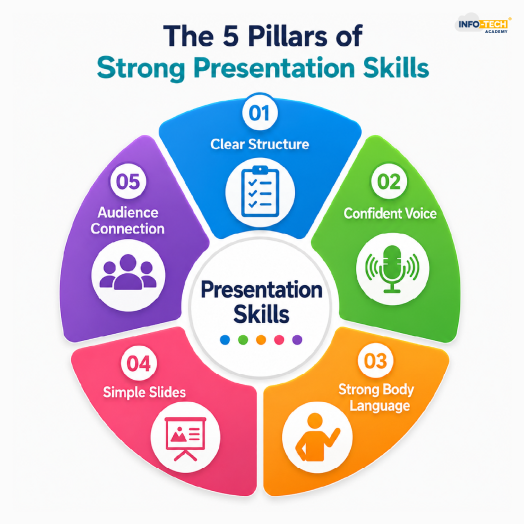
Real presentation skill is the ability to clearly deliver what is exactly in your head and make it understandable to someone else. That means knowing what to say first, how to put it, what details to keep, what to remove, and how to bring your audience to the main point of your speech.
It also includes your voice, your body language, your slides, your examples, and the way you answer questions posed by the listeners. But these things only work when the message itself is clearly delivered firsthand.
A good presenter never tries to impress people by dumping them with too much information. They help people see the point.
Why Does Presentation Skills Matter In Singapore’s Workplace?
Singapore workplaces are usually fast-moving. Meetings are short. Clients expect clear answers. Managers want updates that do not go back and forth. Teams often work with different departments, cultures, and job roles, so communication has to be simple enough for different people to follow.
This is where many capable professionals seem to get stuck.
A data analyst may show five charts but forget to actually explain clearly what the business should do next. An IT professional may explain a problem using technical terms that the client does not really understand. A fresh graduate may know the right answer to the questions in an interview but sound unsure because the response is not organized.
In these situations, the person may be capable. The idea may even be strong. But if the message is unclear, people may not really see its value.
That is the quiet yet effective power of presentation skills. They affect how others judge your readiness, confidence, and professionalism.
Why Do People Struggle With Presentations?
Most people are directly asked to present long before they are actually taught how to present.
So they do what feels safe: put all the information on the slides, read from the screen, speak quickly because they want to finish and use formal phrases that sound unnatural. By the end, the presentation may be complete, but the audience may not remember or understand much.
Nervousness also plays a part. Some people worry about forgetting their words, while some fear difficult questions. Some are simply uncomfortable with people looking at them.
The truth is, feeling nervous while presenting is normal. Even experienced speakers feel the same. The only difference is that trained speakers know how to manage it. They know where and how to pause, breathe, return to their main point, and continue without openly looking lost. A good presentation skills course that professionals attend should help with exactly that. It should not make people sound fake or overly rehearsed. It should help them speak in a way that still feels like themselves.
How Can Presentation Skills Training Help Your Career in Singapore?
At the early stage of your career, people may only notice how well you complete your tasks. Later, they eventually start noticing how well you explain your work.
Can you present your idea clearly? Update senior management without rambling? Can you speak to clients in a way that builds trust? Can you lead a discussion when the room is quiet or confused?
These things begin to matter more as your responsibilities grow.
Good presentation skills can help you ease your job during meetings, interviews, sales pitches, project reviews, leadership discussions, and client presentations. They also help you build a stronger professional image. People tend to trust more on those who can explain things clearly.
This does not mean you need to become loud or dramatic. In many business settings, the calmest speaker in the room is often the clearest and most convincing one.
Read also: How To Enhance Your Presentations with Generative AI
What Makes a Presentation Easier To Follow?
A presentation becomes easier to follow when it has one clear direction.
Before opening PowerPoint to prepare your slides, ask yourself a simple question: “What should people remember after I finish speaking?”
That one question can save a presentation from becoming overloaded.
Many weak presentations are full of information but have no clear message that stays in the listeners’ minds. A stronger presentation feels more like a guided conversation. The audience knows where you are starting, why the topic matters, and what they should take away.
Slides should support you, not replace you. If every word is already on the slide, people will read from the screen instead of listening to what you say. Simple slides usually work better because they give the audience space to focus and listen to what you are saying.
Do Voice and Body Language Make A Difference?
Yes, but not in the exaggerated way people sometimes imagine.
You do not need big gestures or a stage-style voice. Small habits are enough and effective.
- Look at people when you speak.
- Pause before an important point.
- Slow down when the idea is complex.
- Avoid turning your back to read from the screen.
Your voice also affects how your message feels. If you rush, people may feel tense or if your tone is flat, the point may sound less important. If you pause at the right moment, you sound more in control.
These are simple things, but they need practice. Most people do not notice their own habits until someone gives them honest feedback.
Can Introverts Present Well?
Yes, and many do. Being a strong presenter does not mean being the loudest person in the room. Introverts often prepare carefully, think before speaking, and explain ideas with sincerity. That can be a real strength for clearer understanding.
The goal is not to change your whole personality. The goal is to find a speaking style that feels natural and still helps people understand you better.
A good public speaking training program should respect that. Not everyone needs the same delivery style to speak clearly. Some people are energetic. Some are calm. Both can work if the message is clear enough.
What Happens in Presentation Skills Training Singapore?
A practical presentation skills training program usually gives people room to practice. That is important because presentation skills cannot be improved by theory alone.
Participants may learn how to plan a presentation, open with confidence, organize ideas, use slides better, manage nervousness, speak clearly, and answer questions without panic.
The most useful part is often feedback. Someone may realize they speak too fast. Another person may notice they avoid eye contact. Someone else may discover that their slides are doing too much work.
Once these habits become visible, they become easier to change for better.
Conclusion
Presentation skills are not just for formal speeches. They are part of everyday professional life. They help people explain ideas, build trust, handle conversations better, and show their value more clearly.
In Singapore’s competitive workplace, that can become a real advantage. Presentation skills training can help professionals become more structured, confident, and comfortable when speaking in front of others, especially in Singapore.
For those who want to improve not only presentations but also daily workplace conversations, meetings, and leadership communication, a Communication Skills Course can be a practical next step.
Good ideas should not stay hidden because they are difficult to explain. With the right skills, they can be heard properly.
Read also: Why Communication Training Is Important for Career Growth
Presentation Skills Training FAQs
What is presentation skills training?
It is a training that helps people organize their thoughts, speak clearly, manage nervousness, use body language better, and present ideas with confidence.
Who should attend presentation skills training?
It is useful for executives, managers, fresh graduates, jobseekers, business owners, sales teams, and anyone who needs to speak during meetings, interviews, or client presentations.
Can introverts become good presenters?
Yes. Introverts can present well when they learn how to prepare, structure their message, and speak in a way that feels natural to them.
How do presentation skills help at work?
They help professionals explain ideas clearly, build trust, create a better impression, and communicate with more confidence in workplace situations.

Transforming thoughts and concepts into clear, compelling words is a powerful tool that connects people. While writing boosts my creativity, reading broadens my perspective and sharpens my understanding of language and narration.