


In this article
Why Is Conflict Resolution Becoming More Important at Work?
Not all workplace conflicts begin with an argument.
Sometimes it starts with an email that feels colder than it was intended to be. Sometimes it’s a project meeting where one person’s ideas are repeatedly overlooked. Sometimes it’s two colleagues who simply have very different ways of working.
The interesting thing about workplace conflict is that the actual disagreement is often only a small part of the problem.
What causes situations to spiral is usually what happens afterwards.
People make assumptions. Frustration builds quietly. Communication becomes shorter. Team members stop asking questions because they don’t want another difficult conversation. Before long, what could have been a simple discussion turns into a tension that everyone in the office can feel.
Most professionals will experience workplace conflict at some point in their careers. It does not matter whether you’re an intern, a manager, or a business owner. When people work together, disagreements are inevitable.
Yet some individuals seem able to navigate these situations without damaging relationships or creating unnecessary drama. They don’t avoid conflict. They simply know how to handle it differently.
That ability comes down to conflict resolution.
Despite being one of the most valuable workplace skills today, conflict resolution is rarely taught in schools or universities. Many people enter the workforce knowing how to perform technical tasks but have little idea how to manage disagreements when emotions become involved.
The good news is that effective conflict resolution isn’t based on personality. It is built on practical skills that can be developed over time.
Here are five of the most important ones.
1. Listening to Understand, Not to Reply
Think about the last disagreement you had at work.
Were you genuinely listening to the other person, or were you mentally preparing your response while they were still speaking?
Most people do the second.
It’s completely natural. When we feel challenged, misunderstood, or criticised, our instinct is to defend ourselves. We start collecting evidence, preparing counterarguments, and waiting for the opportunity to make our point.
The problem is that this approach rarely solves anything.
People don’t usually become calmer because they’ve been given more reasons why they’re wrong.
They become calmer when they feel heard.
That’s why active listening remains one of the most underrated conflict resolution skills in the workplace.
Active listening is not about staying silent while someone talks. It’s about paying attention to what they’re actually trying to communicate. Sometimes the words they use are only part of the message.
A colleague complaining about missed deadlines may actually be worried about workload. A manager expressing frustration about performance may really be concerned about client expectations. An employee who appears angry may actually feel excluded from important decisions.
When you take the time to understand the concern beneath the complaint, conversations often become much more productive.
People become less defensive when they realise they’re not fighting to be heard.
2. Understanding Feelings Without Taking Sides
One of the biggest mistakes people make during workplace disagreements is assuming that every conversation should be driven by facts alone.
In theory, that sounds reasonable.
In reality, human beings don’t leave their emotions at the office door.
People feel disappointed when their work goes unnoticed. They feel frustrated when projects go off track. They feel anxious when expectations are unclear. They feel hurt when communication breaks down.
Ignoring those emotions doesn’t make them disappear.
Empathy is what allows us to recognise those feelings without necessarily agreeing with every opinion attached to them.
This distinction matters.
Being empathetic doesn’t mean automatically siding with someone. It simply means acknowledging that their experience feels real to them.
A manager can understand why an employee feels overwhelmed without agreeing that deadlines should be extended.
A colleague can recognise another person’s frustration without accepting blame for everything that happened.
In many cases, tension begins to decrease the moment people feel understood.
We’ve all experienced conversations where someone immediately jumped into problem-solving mode without first recognising how we felt. Even when the advice was sensible, it often felt frustrating because the emotional side of the situation was ignored.
Workplace conflict is no different.
Sometimes understanding comes before solutions.
3. Looking for a Shared Goal Instead of a Winner
Many workplace disagreements become difficult because people unconsciously turn them into competitions.
One person wants to prove they’re right. The other wants to defend their position. The conversation slowly shifts from solving a problem to winning an argument.
The irony is that nobody really wins.
Even if one person gets their way, the relationship often suffers.
This is where collaboration changes the entire dynamic.
Collaboration starts with a simple question:
“What are we both trying to achieve?”
The answer is often surprisingly similar.
Two departments arguing over resources usually want the project to succeed.
Two colleagues disagreeing about a process often want better results.
A manager and employee discussing performance concerns typically want the same thing: improved outcomes.
When people focus on their shared objective rather than their differences, discussions become far less confrontational.
Instead of protecting positions, they start exploring possibilities.
Instead of defending ideas, they start refining them together.
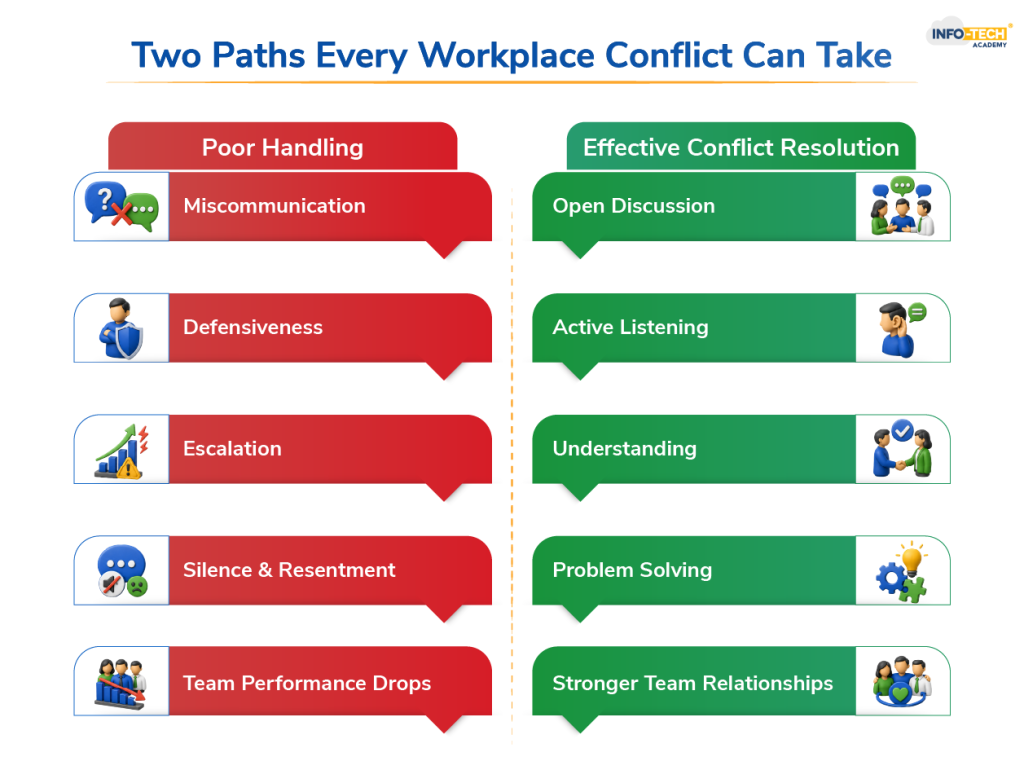
The strongest teams aren’t the ones that avoid disagreements. They’re the ones that know how to work through disagreements without turning them into personal battles.
Can You Actually Get Better at Conflict Resolution?
The short answer is yes.
Most people aren’t naturally good at handling conflict. In fact, many of us spend years trying to avoid it.
We put off difficult conversations. We hope problems will sort themselves out. Sometimes we convince ourselves that staying quiet is easier than speaking up.
And occasionally, that works.
But more often than not, the issue is still there a few weeks later. The awkwardness remains. The misunderstanding grows. The working relationship becomes a little harder than it needs to be.
That’s why conflict resolution is a skill worth developing.
The people who seem calm during disagreements usually aren’t calm because conflict doesn’t bother them. They’re calm because they’ve learned how to approach those situations. They know how to listen without becoming defensive. They know how to ask questions instead of making assumptions. Most importantly, they know how to focus on solving the problem rather than proving a point.
Like any workplace skill, these things can be learned.
For professionals who want a more structured way to build those skills, the Leadership course offers practical training based on real workplace situations. Participants learn how to manage difficult conversations, handle disagreements professionally, and navigate conflicts without damaging trust or working relationships.
The reality is that no workplace is completely free from conflict.
People will disagree. Deadlines will create pressure. Misunderstandings will happen.
What matters is what happens next.
A difficult conversation doesn’t have to become a lasting problem. In many cases, it can become the moment where people understand each other better, work together more effectively, and move forward with greater trust than before.
That’s what effective conflict resolution is really about.
Conflict Resolution FAQs:
What is conflict resolution in the workplace?
Conflict resolution is the process of addressing and managing workplace disagreements in a constructive way that helps individuals find mutually acceptable solutions.
Why is conflict resolution important at work?
Effective conflict resolution improves communication, strengthens teamwork, reduces workplace stress, and helps maintain productivity and positive professional relationships.
What are the five key conflict resolution skills?
The five core conflict resolution skills are active listening, empathy, collaboration, compromise, and problem-solving.
How does active listening help resolve conflicts?
Active listening helps individuals fully understand concerns, reduce misunderstandings, and create an environment where all parties feel heard and respected.

I’ve always been drawn to the power of writing! As a content writer, I love the challenge of finding the right words to capture the essence of HR, payroll, and accounting software. I enjoy breaking down complex concepts, making technical information easy to understand, and helping businesses see the real impact of the right tools.