


In this article
- 1. What is SSG Funding in Singapore?
- 2. Who Can Qualify for SSG Funding?
- 3. How Much Course Fee Subsidy Can You Receive?
- 4. What is SkillsFuture Enterprise Credit?
- 5. What Are the Skills Development Levy and Skills Development Fund?
- 6. How Can You Find the Right SSG-Funded Course?
- 7. SSG Funding FAQs
Training a team can become expensive quite quickly. Course fees are only one part of the cost. Employers may also need to manage staff time, wages and the disruption caused when several employees attend training at once.
SSG funding helps reduce some of that burden. It supports approved courses for individuals and employers, making it easier for workers in Singapore to build practical skills without paying the full training cost.
You may also see newer government pages referring to the Skills and Workforce Development Agency, or SWDA. This follows the integration of SkillsFuture Singapore and Workforce Singapore. However, many people still use the term SSG funding when searching for training subsidies.
What is SSG Funding in Singapore?
SSG funding is a broad term used for government support given to approved training programmes. It is not one standalone grant.
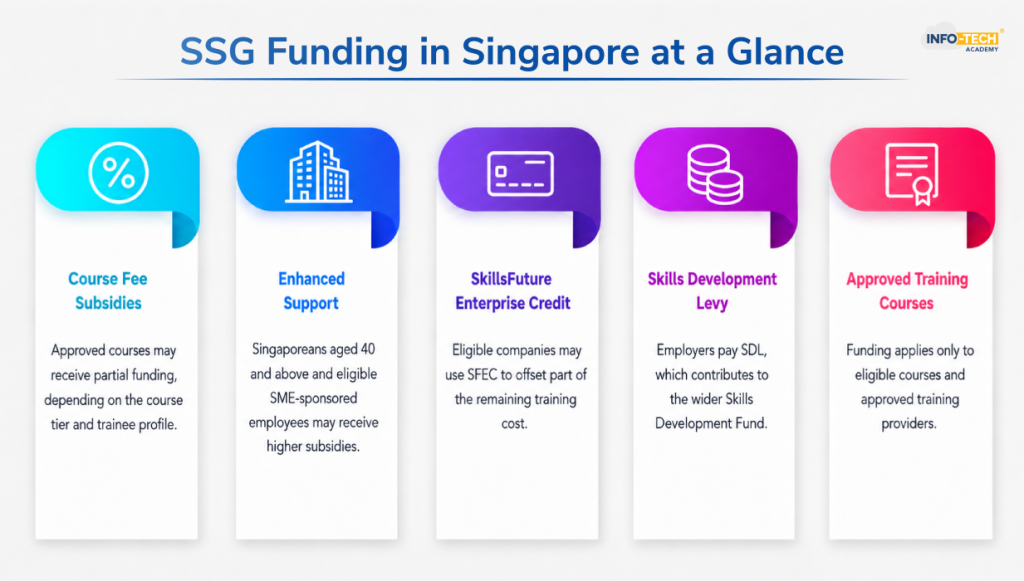
Depending on the course and the person attending it, support may include:
- A subsidy on the course fee
- Higher funding for eligible SMEs
- Extra support for Singaporeans aged 40 and above
- Wage support when employees train during working hours
- SkillsFuture Enterprise Credit for eligible businesses
The course fee subsidy is usually applied first. This means the participant or employer pays the lower nett fee instead of paying the full amount and claiming it later.
Although SkillsFuture Credit works differently, it belongs to an individual Singaporean and is mainly used for self-sponsored courses. It should not be confused with the funding an employer receives when sponsoring an employee.
Read also: SkillsFuture Credit: Eligibility and How to Claim It
Who Can Qualify for SSG Funding?
Eligibility depends on the course, the trainee and whether the training is self-sponsored or paid for by an employer.
For company-sponsored training, the business generally needs to be registered in Singapore. The employee should also have a proper employment relationship with the company.
Funding is commonly available for eligible:
- Singapore Citizens
- Singapore Permanent Residents
- Long-Term Visit Pass Plus holders
Not every course receives the same level of support. The training programme must be approved for funding, and the employee must meet the conditions shown in the course listing.
Employers should check the employee’s nationality, age and employment status before registering. SME status may also affect the final subsidy.
Read also: SkillsFuture Credit After a Singapore PR Application Possible?
How Much Course Fee Subsidy Can You Receive?
Approved courses are placed under different funding tiers. The tier affects how much support a trainee may receive.
| Course category | Standard funding | Enhanced funding |
| Tier 1 courses | Up to 70% | Up to 90% |
| Tier 2 courses | Up to 50% | Up to 70% |
Tier 1 generally covers programmes linked more closely to employment outcomes, emerging skills or recognised qualifications. This can include selected SkillsFuture Series courses, Career Transition Programmes and courses that lead towards certain qualifications.
Tier 2 includes a wider range of workforce training, such as supported WSQ programmes and courses linked to recognised professional or industry skills.
The employee’s profile also matters.
| Employee profile | Tier 1 | Tier 2 |
| Singapore Citizen below 40 | Up to 70% | Up to 50% |
| Permanent Resident | Up to 70% | Up to 50% |
| Singapore Citizen aged 40 and above | Up to 90% | Up to 70% |
| Eligible SME-sponsored employee | Up to 90% | Up to 70% |
An SME generally needs to have no more than 200 employees or annual sales turnover of no more than S$100 million.
These are maximum funding levels. The actual amount may differ between courses, so the nett fee shown in the official directory or by the training provider should be treated as the final reference.
What Is SkillsFuture Enterprise Credit?
SkillsFuture Enterprise Credit, usually called SFEC, is a one-off credit of S$10,000 given to eligible employers. It can cover up to 90% of certain expenses that remain after the main government subsidy has been deducted.
For example, suppose a course costs S$1,000 and receives a S$900 course fee subsidy. The employer is left with S$100. Where the programme qualifies, SFEC may cover up to S$90 of that remaining amount.
| Cost item | Amount |
| Original course fee | S$1,000 |
| Course fee subsidy | −S$900 |
| Amount left for employer | S$100 |
| Possible SFEC support | −S$90 |
| Remaining amount before GST | S$10 |
Companies do not usually submit a new application to receive SFEC. Eligible businesses would have been notified, and the available balance can be checked through the relevant business portal.
The current SFEC scheme is due to end on 30 November 2026. Employers with available credit should check the claim deadlines and programme completion requirements before committing to training.
What Are the Skills Development Levy and Skills Development Fund?
The Skills Development Levy, or SDL, is paid by employers for employees working in Singapore. It applies to local and foreign workers, including many full-time, part-time, temporary and casual employees.
The levy is calculated at 0.25% of an employee’s monthly remuneration. A minimum of S$2 applies to employees earning S$800 or less. The maximum levy is S$11.25 for employees earning S$4,500 or more.
The money goes into the Skills Development Fund, which supports workforce training programmes in Singapore. It does not work like a personal company savings account. An employer does not claim back only the amount it has paid. The money is placed into a shared fund, while access to training subsidies depends on the rules of the course and funding scheme.
This also means a newer company does not need to wait several years before using SSG-funded training. Once it meets the relevant conditions, it may enrol eligible employees in supported courses.
How Can You Find the Right SSG-Funded Course?
The easiest way to begin is through the official SkillsFuture course directories or an approved training provider. Search using the skill, job role or business need rather than simply choosing the course with the largest subsidy. A heavily funded course is not useful if employees cannot apply what they learn at work.
Before registering, look at:
- The full and nett course fees
- The funding tier
- The employee’s eligibility
- The training schedule
- Attendance requirements
- Whether the course supports company-sponsored enrolment
- Whether additional support such as SFEC or wage funding applies
It is also worth asking the provider what your company needs to submit. With Info-Tech Academy, the course subsidy is already deducted during registration, while separate declarations or claims may be required for other types of support. Check out trending WSQ courses: AI course for beginners, AI course, leadership course, corporate training, smart prompting course, power BI for data analysis course, power BI for visual analytics course, accounting course.
SSG funding can make employee training far more affordable, but the details should be checked each time. Funding levels, deadlines and course eligibility can change. A quick review before enrolment can prevent incorrect fees, missed claims or choosing a course that does not qualify.
Reach out to us or visit us for free course consultation.
SSG Funding FAQs
Who is eligible for SSG funding?
SSG funding is generally available to all eligible Singapore Citizens, Permanent Residents and Long-Term Visit Pass Plus holders attending approved funded courses.
What does SSG stand for in Singapore?
SSG stands for SkillsFuture Singapore.
Which ministry is SSG Singapore under?
SkillsFuture Singapore was under the Ministry of Education (MOE). Since June 2026, it has merged into the Skills and Workforce Development Agency (SWDA), which is under the Ministry of Manpower and jointly overseen with MOE.
How much is SSG funding?
SSG funding can cover up to 90% of the course fee, depending on the course tier and trainee profile. Tier 1 courses receive up to 70% standard funding or 90% enhanced funding, while Tier 2 courses receive up to 50% standard funding or 70% enhanced funding.

Transforming thoughts and concepts into clear, compelling words is a powerful tool that connects people. While writing boosts my creativity, reading broadens my perspective and sharpens my understanding of language and narration.