



In this article
- 1. What is Public Speaking?
- 2. Why are Public Speaking Skills Important for Professionals?
- 3. What are the Skills Essential for Public Speaking?
- 4. How to Prepare for Public Speaking?
- 5. How can Professionals Continue Improving Their Public Speaking Skills?
- 6. How to Handle Questions During Presentations?
- 7. What are the Common Public Speaking Mistakes to Avoid?
- 8. Public Speaking Skills – FAQs
Speaking in front of a room full of people can feel completely different from having a normal conversation. Even professionals who can communicate comfortably with their colleagues may feel nervous to present an idea, speak in a meeting or address a larger audience. However, public speaking is not just about standing on a stage and delivering a formal speech. In a workplace, it can include presenting a project update, pitching an idea to the management, providing guidance or training to the team, explaining information to the clients and conducting a meeting.
Public speaking is therefore a practical communication skill that professionals can develop irrespective of their roles. With preparation, regular practice and right techniques, it becomes easier to communicate ideas and engage people easily and effectively.
What is Public Speaking?
Public speaking is the process of communicating ideas, information or opinions verbally to an audience. The size of audience may range from few colleagues in a meeting room to hundreds of people at a conference. The purpose may vary according to the situation. A speaker may want to inform something to the audience, explain a complex topic, persuade the audience.
In a professional setting, public speaking may take different forms like,
- Business presentations
- Team meetings
- Client meetings
- Networking events
- Workshops and webinars
- Training sessions and
- Knowledge sharing sessions
Good public speaking is not just about speaking without nervousness. It is about keeping the audience engaged and helping them understand your message.
Why are Public Speaking Skills Important for Professionals?
Professionals regularly need to communicate information and convey their ideas to other. A strong public speaking skill can help them interact clearly and effectively.
Having good ideas alone cannot make you succeed at workplace. You must be able to communicate your ideas in a way that others can understand.
Public speaking helps professionals to organise their thoughts, identify important information and communicate them in a logical sequence.
Public speaking skills can help the presenters explain data, provide context and highlight the points that really matters.
This skill is important beyond internal meetings. Professionals must communicate with customers to explain their products, present proposals, negotiate with stakeholders and answer client queries.
What are the Skills Essential for Public Speaking?
There are several skills that work together to make public speaking more effective.
Audience Awareness:
Before preparing a presentation, understand who will be listening and prepare content according to that.
For example, a technical presentation may contain terminology that would be confusing to the general audience. Understanding your audience help you decide what information to include and how to communicate it.
Clear Structure:
The structure plays an important role to make public speaking more effective. The overall presentation becomes easier for the listeners to understand when it is delivered in clear structure.
Clear and Concise Language:
Using a complicated language does not necessarily make your presentation sound more professional. Use simple sentences wherever possible and remove unnecessary details that may distract from it.
Voice Control:
How something is said can influence how easily it is understood. Always pay attention to volume, pace, tone, emphasis and pauses.
Body Language:
Non-verbal communication also affects a presentation. Maintain a natural and open posture and use gestures when they support what you are saying.
Active Listening:
Public speaking is not entirely a one-way communication. During discussions and Q&A sessions, listen to what others speak. This can help you provide more relevant response.
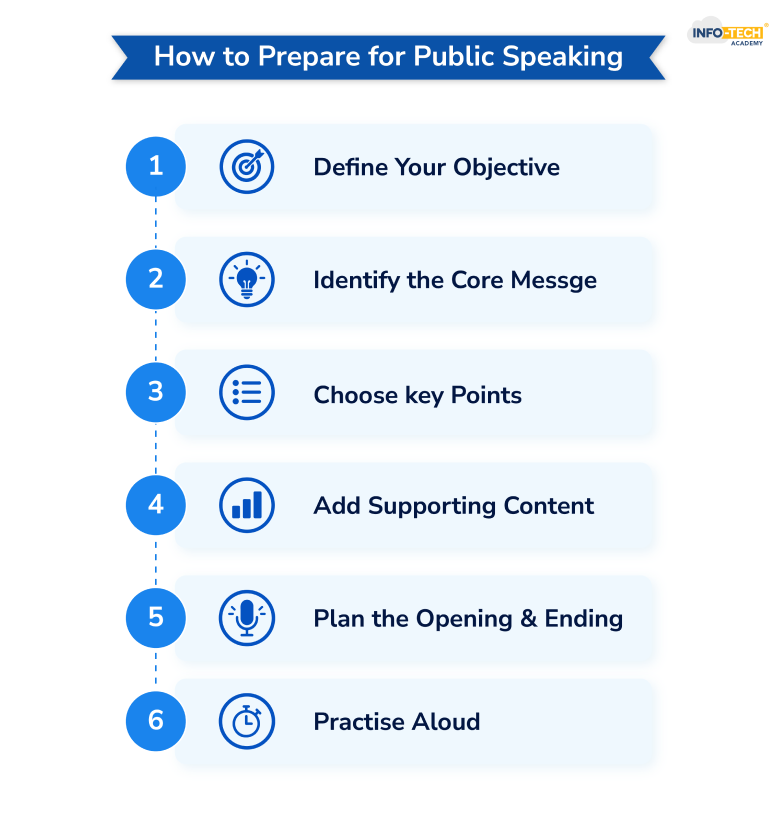
How to Prepare for Public Speaking?
Step 1:
Define your objective clearly and understand what your audience should understand, remember and what action to take from your presentation.
Step 2:
You should be able to summarize your entire presentation in one sentence. If you cannot identify the central message of the presentation, your audience will find it difficult to understand.
Step 3:
Select the most important points that support your message. Do not include unnecessary information just because they are available.
Step 4:
Baes on the presentation type, support your ideas using examples, statistics, case studies, scenarios, visuals and demonstrations.
Step 5:
Give additional attention to the beginning and end. Your opening should quickly establish what the presentation is about and why the audience should listen. The ending should summarize the central message of the presentation.
Step 6:
Reading your presentation silently is different from delivering it. So, practice by speaking aloud. Also note down the time it consumes, so that you need not rush by the end to finish it within the allocated time.
How can Professionals Continue Improving Their Public Speaking Skills?
Public speaking skills improves through continuous practice, communication skills course and regular applications rather than learning different techniques.
Professionals can improve their skills by:
- Delivering short presentations regularly
- Volunteering to host meetings
- Observing effective speakers
- Requesting constructive feedback
- Recording and reviewing presentations for improvement
- Learning workplace communication techniques
How to Handle Questions During Presentations?
Listen carefully to each question, understand what they are asking and then respond to their questions. If the question is unclear ask for clarification, do not assume anything. Keep your answers clear, concise and relevant. If you do not know the answer, avoid guessing and let the audience know that you will verify the information and follow up later.
What are the Common Public Speaking Mistakes to Avoid?
When all sentences are displayed on the screen, audience will focus on reading them and not listen. So, use slides as only prompts and visuals.
Memorising the entire speech can become a problem if you forget one sentence. So, learn the structure and important ideas.
Nervousness can cause speakers to speak fast. Use deliberate pauses and regularly check the pace.
More information will not make a presentation better. So, deliver only the information that needs for the audience to understand the central message.
Industry terminologies may be useful when speaking to specialists, but it confuses the general audience. So, match your language to the audience.
Public Speaking Skills – FAQs
What is public speaking?
Public speaking is the act of communicating ideas, information or opinions to the audience. It can include presentations, webinars, training sessions and other professional discussions.
Why is public speaking important?
Public speaking helps people communicate their ideas clearly, share information effectively and build confidence.
What makes someone a good public speaker?
A good public speaker communicates clearly, understands the audience, organise and deliver ideas in a logical sequence and uses appropriate voice and body language.
How can beginners start practising public speaking?
Beginners can start practising public speaking by speaking in small meetings, giving small presentations, recording and reviewing presentations and practising in front of friends and family.

Transforming thoughts and concepts into clear, compelling words is a powerful tool that connects people. While writing boosts my creativity, reading broadens my perspective and sharpens my understanding of language and narration.