


In this article
Why Are Learning Management Systems Becoming Central To Education In Singapore?
A decade ago, most students associated learning with classrooms, printed notes and fixed lesson schedules. Today, learning continues long after class ends through effective learning management system in Singapore. Lecture recordings can be replayed on the train home, assignments are submitted online, group discussions happen through digital platforms and revision materials are available whenever students need them.
This gradual shift has changed expectations. Students now expect learning resources to be organised, accessible and available across multiple devices. Educators also need better ways to manage courses without spending countless hours handling administrative work. This is where a learning management system becomes invaluable.
Across schools, polytechnics, universities and private education providers, the learning management system singapore institutions adopt is no longer viewed as an optional technology project. It has become part of the everyday learning experience, supporting teaching, collaboration and continuous learning.
What Is A Learning Management System?
A learning management system (LMS) is a digital platform used to create, deliver and manage learning. Instead of relying on separate tools for assignments, announcements, assessments and course materials, an LMS brings everything together in one place.
Students can log in to access lecture notes, watch videos, submit coursework, participate in discussions and check their progress. Educators can upload content, communicate with learners, grade assessments and monitor engagement from a single dashboard.
Good LMS platforms simplify learning rather than complicate it. The technology stays in the background while students focus on developing knowledge and skills.
Why Do Different LMS Platform Segments Exist?
Not every learner has the same needs. A Primary 5 student, a university undergraduate and a working professional completing a certification programme all learn differently.
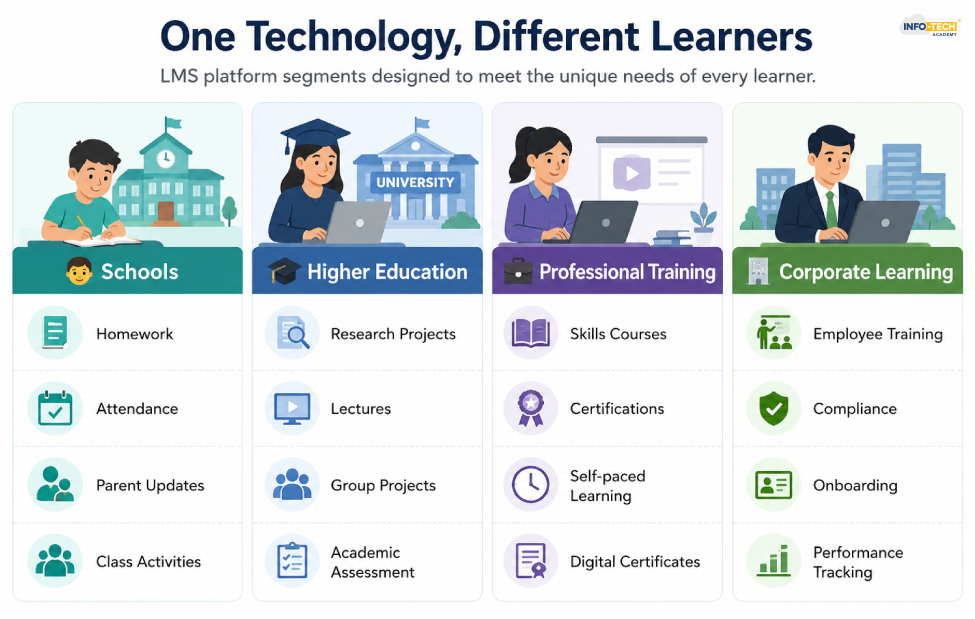
Because of this, LMS platforms have evolved into different segments. Some prioritise simplicity and classroom management, while others focus on research collaboration, professional certifications or workforce training. Understanding these segments helps institutions choose technology that genuinely supports their learners instead of adopting a one-size-fits-all approach.
School LMS platforms
School-focused LMS platforms are designed to help teachers organise lessons and keep younger learners engaged. Navigation is usually simple, colourful and easy to understand.
Typical Capabilities Include:
- Homework and assignment submission
- Attendance tracking
- Classroom announcements
- Parent communication
- Interactive quizzes
Rather than overwhelming students with advanced features, these systems concentrate on making everyday classroom activities easier for both teachers and learners.
Higher Education LMS Platforms
Universities and polytechnics require more sophisticated learning environments. Students manage multiple modules, collaborate on research projects and work independently for much of the semester.
These platforms commonly support recorded lectures, digital libraries, discussion forums, assignment submissions, plagiarism detection, online assessments and detailed gradebooks. Integration with video conferencing and student information systems is also increasingly common.
Professional Training Platforms
Singapore’s emphasis on lifelong learning has increased demand for LMS platforms that support adult learners. Professionals often study outside working hours, making flexibility essential.
These platforms usually support self-paced learning, certification tracking, mobile access and personalised learning pathways. Instead of following academic semesters, courses are often organised around competencies and industry skills. Learners building digital skills may also use our trending courses such as AI course for Beginners or AI Course, where lessons, assessments and progress can all be managed.
What Should Students Look For?
Students rarely choose the LMS their institution uses, but understanding what makes a good platform helps them make better use of it.
Useful features include reliable mobile access, clear course organisation, progress tracking, timely notifications, discussion spaces and straightforward assignment submission. An LMS should reduce unnecessary friction so learners spend more time studying and less time figuring out where everything is located.
Final Thoughts
Digital learning has become part of everyday education across Singapore. As institutions continue investing in technology, selecting the right learning management system Singapore solution is about far more than software features. The right platform supports better organisation, stronger collaboration and more flexible learning experiences for students at every stage of education.
Ultimately, the most successful LMS is the one students hardly notice because it quietly helps learning happen smoothly every single day.
Learning Management System Singapore FAQs
What is a learning management system?
A platform that helps institutions deliver, manage and monitor learning online.
Who uses LMS platforms in Singapore?
Schools, universities, private education providers and corporate training organisations.
Can students access LMS platforms on mobile devices?
Most modern platforms support smartphones and tablets through responsive websites or dedicated apps.
Why are LMS platforms important?
They centralise learning resources, improve communication and help students track their progress.

I’ve always been drawn to the power of writing! As a content writer, I love the challenge of finding the right words to capture the essence of HR, payroll, and accounting software. I enjoy breaking down complex concepts, making technical information easy to understand, and helping businesses see the real impact of the right tools.