



In this article
You type a question into a chatbot and receive a relevant answer. A search engineunderstands what you are searching for even when the words are misspelled and the sentence is not grammatically correct. A translation tool translates a sentence from one language to another within seconds. Behind many of these everyday technologies, there is NLP. It is an area of artificial intelligence that allows people to communicate with the computers in the natural way they speak, instead of using computer languages. NLP enables system to understand, analyse, and generate language closer to the way people naturally speak.
What is NLP?
Natural Language Processing or NLP is a branch of artificial intelligence that enables systems to process, understand, analyse and generate human language.
Human language can exist in different forms including,
- Written texts
- Chat conversations
- E-mails
- Customer reviews
- Messages
- Search queries
- Documents and
- Transcribed speech
NLP attempts to transform the unstructured language into information that computers can understand and act upon. Therefore, it is essentially a bridge between how humans communicate and how computers process information.
How does NLP Work?
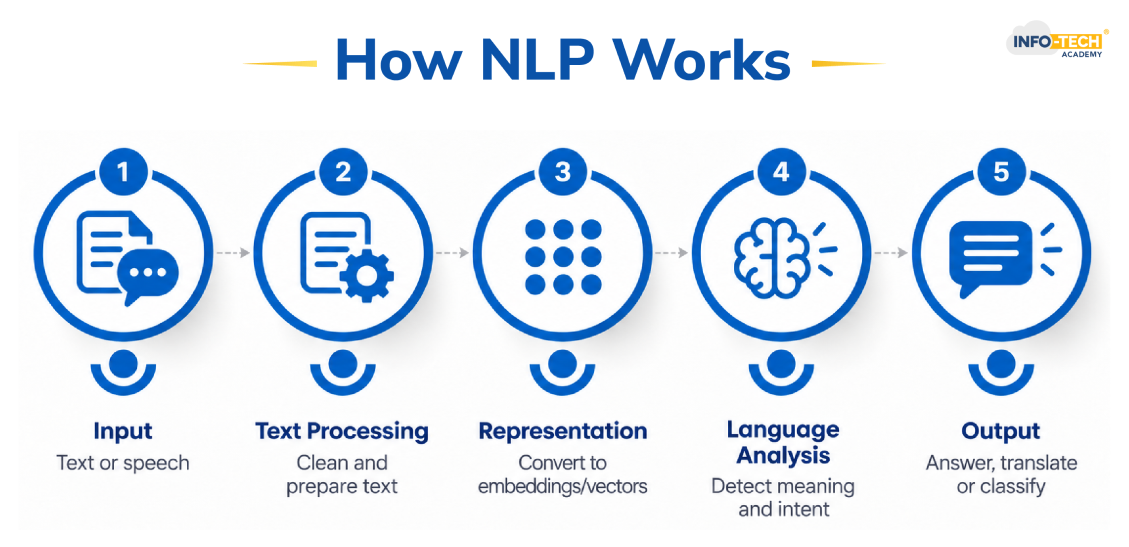
NLP generally involves several stages to transform raw human language into information that computers understand.
The exact processes may vary from one application to another. But the typical NLP workflows may include the following steps.
Step – 1: Text or speech input
The process starts with human language. The input could be written texts, reviews, messages, chat conversations, e-mails, documents or a social media post.
For speech-based conversations, speech recognition will convert the spoken language into texts.
Step – 2: Text processing
Raw language data usually contains unnecessary punctuations, misspelled words, grammatical errors and other information that makes the analysis more difficult. The text may be cleaned and divided into smaller components that a computer can process.
Some of the common Natural Language Processing techniques include,
- Tokenisation
- Lowercasing
- Stop-word removal
- Stemming
- Lemmatization
- Text cleaning
These techniques help transform raw text into a format that an NLP model can analyse.
Step – 3: Converting language into representations
Computers cannot process language in the same way as humans do. Natural Language Processing systems therefore convert language into representations that machine learning models can understand.
Modern Natural Language Processing systems use embedding, where words or pieces of texts are represented as numerical vectors. These representations help the machine learning models understand the relationship between words and the context.
Step – 4: Language Analysis
These systems then analyse the language to identify useful information. Depending on the application this could,
- Detect sentiments
- Summarize documents
- Translate text
- Understand intent
- Extract important information
Step – 5: Generate an output
Finally, the Natural Language Processing gives an output based on the task. For example, the system could,
- Answer a question
- Translate the text
- Summarize a report
- Identifies a customer’s sentiment
- Classify an e-mail as spam
What are the Main NLP techniques?
Natural Language Processing is not one single technology. It allows computers to work with human language and perform multiple tasks.
Sentiment Analysis:
Sentiment analysis helps determining the tone and sentiment expressed in the text. For example, it can analyse the customer reviews and determine whether the overall feedback is positive, negative or neutral.
Name entity recognition:
Name entity recognition (NER) recognizes specific entities in texts such as people, location, organisation, dates, products and monetary values.
Machine Translation:
NLP translates texts from one language into another. Modern machine translation systems use machine learning and deep learning techniques to analyse the relationship between words and sentences across languages.
Question Answering:
NLP systems can understand the questions and generate relevant answers. This capability is used mainly in search engines, customer chatbots and AI assistants.
What are Some Examples of NLP?
You may use many NLP every day without realising it because they are built in many digital tools that we use in day-to-day life.
Search engines:
When you enter a search query, the language technologies interpret the words, analyse them and provide relevant answers.
Chatbots:
The customer support chatbots uses the technology to understand what the user is asking and provides the answers accordingly.
Translation tools:
The language translation application uses Natural Language Processing and other related machine-learning technologies to translate text between languages.
Sentiment analysis:
Companies can analyse customer reviews, surveys, social media content and other responses using Natural Language Processing to identify the sentiments and the recurring patterns.
What is NLP Used For?
Natural Language Processing is used across various industries as organisation generate larger amount of unstructured text and speech data.
Some of the common applications are,
Finance: Analysing documents, financial reports and customer communications.
Marketing: Analysing the customer reviews, feedback and social media conversations.
Customer service: Automating the response and categorising the queries.
Education: Supporting language learning and automating the assessments.
Retail: Analysing the demands, reviews, and product information.
What is the Role of NLP in Modern AI?
NLP plays a crucial role in modern AI to help the machines understand, interpret and generate human languages. Without Natural Language Processing, modern AI systems would find it much harder to communicate with humans using everyday words and sentences.
It is one of the key technologies behind the chatbots, translation tools, search engines, virtual assistants and Large Language Models(LLMs).
Also, modern AI goes beyond simply matching the keywords to considering the context, relationship between words and overall meaning of the sentences. This makes the communication with AI systems more natural and useful.
In simple terms, Natural Language Processing is a layer of modern AI systems which allows people to interact with the intelligent systems using a simple language that they use every day to speak and write.
Want to learn more about NLP and modern AI applications? Explore the following courses from InfoTech Academy.
Register NowRead Also: What Programming Language Is Used for AI in 2026?
NLP – Frequently Asked Questions
What is Natural Language Processing?
Natural Language Processing is a part of Artificial Intelligence that helps computers read, write and understand human language.
Is ChatGPT an NLP?
ChatGPT is an application that uses natural language processing to understand and generate human language. But specifically, it is an AI system built on Large Language Model (LLM).
What is an example of NLP AI?
The common examples of NLP AI include virtual voice assistants, translation tools and customer support chatbots.
What are some of the most used NLP techniques?
Some of the most used NLP techniques are sentiment analysis, word embeddings and text classification.

Transforming thoughts and concepts into clear, compelling words is a powerful tool that connects people. While writing boosts my creativity, reading broadens my perspective and sharpens my understanding of language and narration.