


In this article
- 1. Where Do Machine Learning and Deep Learning Fit into AI?
- 2. What Is Machine Learning?
- 3. Why Is Machine Learning Still So Popular?
- 4. What Makes Deep Learning Different?
- 5. Why Does Deep Learning Need So Much Data?
- 6. Where Do We See Deep Learning Today?
- 7. Deep Learning vs. Machine Learning: What’s the Difference?
- 8. Which One Should You Learn First?
- 9. Final Thoughts
- 10. Machine Learning vs. Deep Learning FAQs
A few years ago, artificial intelligence felt like something that belonged in science fiction. It was the technology behind talking robots, futuristic films and stories about machines taking over the world. Today, it’s much less dramatic—and much more useful, Machine Learning vs. Deep Learning. AI helps us find the quickest route home, filters spam from our inboxes, recommends what to watch next and even answers questions in a chatbot.
As more people become interested in AI, two terms come up again and again: machine learning and deep learning. They’re often mentioned in the same breath, which makes it easy to assume they’re interchangeable. They’re not.
The simplest way to think about it is this: machine learning taught computers how to learn from data instead of following fixed instructions. Deep learning took that idea and pushed it much further, allowing computers to tackle problems that once seemed impossible.
If you’ve ever wondered what separates the two, you’re not alone. The good news is that you don’t need a background in programming to understand the basics. Once you see how they fit together, the jargon starts to disappear.
Where Do Machine Learning and Deep Learning Fit into AI?
Artificial intelligence is the umbrella term. It covers any technology designed to perform tasks that normally require human intelligence, whether that’s recognising speech, translating languages, solving problems or making decisions.
Machine learning sits underneath AI. Instead of telling a computer exactly what to do in every situation, developers give it data and let it learn from patterns. Over time, the system becomes better at making predictions or recognising similarities.
Deep learning is a specialised branch of machine learning. It follows the same principle of learning from data, but it uses much more advanced models that can process enormous amounts of information.
So, every deep learning system is a machine learning system, but not every machine learning system uses deep learning.
That relationship is worth remembering because it clears up one of the biggest misconceptions people have when they’re first introduced to AI.
What Is Machine Learning?
Imagine teaching someone to recognise different kinds of birds.
You could hand them a long checklist explaining wing shapes, beak sizes, feather colours and flight patterns. Or you could simply show them hundreds of pictures with the correct names attached. After enough examples, they’d start recognising the birds on their own.
Machine learning works in much the same way.
Instead of relying on endless instructions written by programmers, the computer studies examples. It looks for patterns, relationships and repeated behaviours. Once it has seen enough data, it begins making predictions when it encounters something new.
That might sound complicated, but you’ve almost certainly benefited from machine learning already.
When your email automatically moves junk messages into the spam folder, machine learning is helping decide which messages don’t belong. When Netflix recommends a new series after you’ve finished watching three crime dramas in a row, it’s analysing your viewing habits and comparing them with millions of others. Online shopping sites use similar techniques to suggest products based on what you’ve browsed or purchased before.
None of these systems are “thinking” like people. They’re simply becoming better at recognising patterns through experience.
Why Is Machine Learning Still So Popular?
With all the attention surrounding AI, it’s easy to assume deep learning has replaced everything that came before it. That isn’t true.
For many businesses, machine learning is still the better option.
A retailer predicting next month’s sales doesn’t necessarily need an incredibly sophisticated AI model. A bank trying to identify unusual spending patterns can often solve the problem with machine learning. Insurance companies, manufacturers and logistics firms also rely heavily on machine learning because it works well with structured business data.
Another advantage is speed. Machine learning models are generally quicker to train and don’t require the same level of computing power as deep learning systems. That makes them practical for organisations that need accurate predictions without investing heavily in specialised hardware.
So, What Makes Deep Learning Different?
Deep learning follows the same basic idea as machine learning, but it’s designed for problems that are far more complicated.
Take facial recognition as an example.
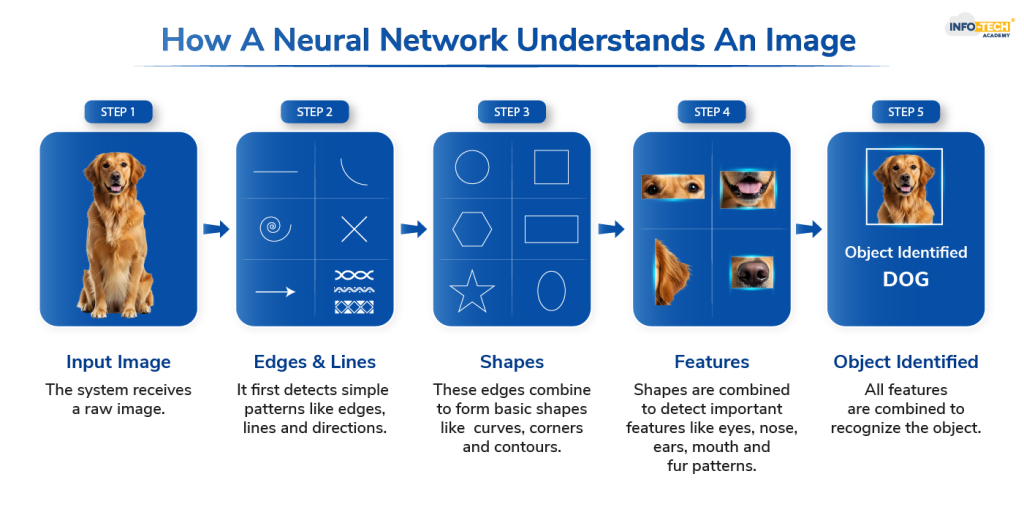
A traditional machine learning model might struggle if someone’s face is partly hidden, viewed from an unusual angle or photographed in poor lighting. A deep learning model, however, can analyse far more details at once.
It doesn’t simply look for one feature. Instead, it processes information layer by layer. One layer might detect edges. Another identifies shapes. Another recognises eyes, noses or mouths. By the time the information reaches the final stage, the system has built a much richer understanding of what’s in the image.
This layered approach is possible because deep learning uses artificial neural networks.
The name often makes people think these networks work exactly like the human brain, but that’s an oversimplification. They’re inspired by the way brain cells communicate, not direct copies of how people think. Their real strength lies in processing huge amounts of information and uncovering patterns that would be almost impossible for humans to spot manually.
Why Does Deep Learning Need So Much Data?
One of the biggest trade-offs with deep learning is the amount of information it needs before it becomes truly effective.
If you’re teaching a machine learning model to identify customer buying habits, a reasonably sized dataset might be enough.
Teaching a deep learning model to recognise speech, understand language or identify objects in millions of photographs is a completely different challenge. It needs vast amounts of data because it’s learning countless small patterns at the same time.
Training these models also requires significant computing power. That’s why organisations working with deep learning often use high-performance graphics processing units (GPUs), which can handle thousands of calculations simultaneously.
The extra effort usually pays off, especially for tasks involving images, video, audio and natural language.
Where Do We See Deep Learning Today?
Deep learning is behind many of the AI tools that have become part of everyday life over the past few years.
Voice assistants understand spoken questions because deep learning models have been trained on huge collections of speech data. Translation services can convert entire conversations between languages in seconds. Hospitals use deep learning to help analyse medical scans, while manufacturers use it to detect product defects that are almost invisible to the human eye.
Generative AI applications, including modern chatbots and image generators, also rely heavily on deep learning. Their ability to write, create images or answer questions comes from analysing enormous datasets and learning complex relationships between words, images and ideas.
Deep Learning vs. Machine Learning: What’s the Difference?
Although both technologies learn from data, they work differently.
| Machine Learning | Deep Learning |
| Uses algorithms to learn from data | Uses multi-layer neural networks |
| Performs well with smaller datasets | Requires very large datasets |
| Usually needs human guidance to improve | Learns many features automatically |
| Faster to train | Takes longer to train |
| Easier to understand and interpret | More difficult to explain decisions |
| Can often run on standard CPUs | Usually requires powerful GPUs |
Which One Should You Learn First?
If you’re completely new to artificial intelligence, starting with machine learning usually makes the most sense.
It introduces the ideas that underpin much of modern AI, including how computers learn from data, how predictions are made and why algorithms improve over time. Once those fundamentals are clear, moving into deep learning feels far less intimidating.
Many professionals working in AI today followed exactly that path. They learned the basics first before exploring neural networks and more advanced models.
Final Thoughts
Machine learning and deep learning aren’t rivals. One grew out of the other, and both continue to solve different kinds of problems.
Machine learning remains an excellent choice for analysing structured data, making predictions and supporting everyday business decisions. Deep learning shines when computers need to understand more complex information, whether that’s recognising faces, interpreting medical images or generating human-like text.
As artificial intelligence becomes increasingly common across industries, understanding these technologies is no longer just for software engineers. Whether you work in business, education, healthcare or marketing, having a clear picture of how machine learning and deep learning differ will help you make better sense of the AI tools becoming part of our daily lives. You don’t need to master the mathematics behind them to appreciate what they can do, with Info-Tech Academy you will learn and understand where each one fits and why both matter.
Machine Learning vs. Deep Learning FAQs
Is deep learning the same as machine learning?
No. Deep learning is a branch of machine learning. While both technologies enable computers to learn from data, deep learning uses artificial neural networks to solve more complex problems, such as image recognition, speech processing and natural language understanding.
Which is better: machine learning or deep learning?
Neither is better in every situation. Machine learning is often the preferred choice for structured data and business predictions, while deep learning performs better when working with large amounts of unstructured data like images, videos and audio. The right choice depends on the problem you’re trying to solve.
Why does deep learning require more data than machine learning?
Deep learning models learn by identifying very detailed patterns across multiple layers of neural networks. To achieve high accuracy, they usually need much larger datasets and more computing power than traditional machine learning models.
What are some real-world examples of machine learning and deep learning?
Machine learning is commonly used for spam filtering, fraud detection, recommendation engines, customer behaviour analysis and sales forecasting. Deep learning powers facial recognition, voice assistants, language translation, autonomous vehicles, medical image analysis and generative AI tools like chatbots.

I’ve always been drawn to the power of writing! As a content writer, I love the challenge of finding the right words to capture the essence of HR, payroll, and accounting software. I enjoy breaking down complex concepts, making technical information easy to understand, and helping businesses see the real impact of the right tools.