


In this article
- 1. Why Are More Seniors Returning to the Classroom?
- 2. What Exactly Are SkillsFuture Courses?
- 3. Which Courses Do Seniors Find Most Useful?
- 4. Are Technology Courses Too Difficult?
- 5. How Should Seniors Choose the Right Course?
- 6. Is It Ever Too Late to Learn?
- 7. Conclusion
- 8. Skillsfuture Courses For Seniors FAQs
A classroom filled with retirees would have been an unusual sight not so long ago. Today, it isn’t.
Walk into many training centres across Singapore on a weekday morning and you’ll find people in their sixties and seventies learning how to create spreadsheets, use artificial intelligence, improve their communication skills or even start an online business. Some spent decades in engineering, healthcare or administration before retiring. Others simply reached a point where they wanted to understand the technology that now shapes everyday life. That’s because skillsfuture courses for seniors are available too!
Retirement hasn’t changed. People’s expectations of it have.
For many older adults, this stage of life offers something they rarely had while working full-time: the freedom to learn without pressure. That explains why interest in skillsfuture courses for seniors continues to grow. Some enrol because they want to remain employable. Others are looking for practical skills they can use at home. Many simply enjoy the challenge of learning something completely new.
Why Are More Seniors Returning to the Classroom?
Learning used to be associated with the early part of life. School, university, first job—once those milestones were behind you, education often faded into the background.
Singapore has gradually shifted that thinking. Lifelong learning has become part of how the country prepares people for changing industries, longer careers and an increasingly digital society. While much of the conversation focuses on younger workers, seniors have embraced the opportunity just as enthusiastically.
There are practical reasons behind that.
Simple everyday tasks, from paying bills to booking medical appointments, now happen online. Video calls keep families connected across countries. Banking apps replace queues at branches. Even community activities are often organised through digital platforms. Picking up these skills makes daily life easier and helps older adults stay independent.
There is another benefit that is harder to measure but equally valuable. Learning gives people something to look forward to. It creates routine, introduces new friendships and offers the satisfaction that comes from mastering something unfamiliar.
What Exactly Are SkillsFuture Courses?
SkillsFuture is Singapore’s national lifelong learning initiative. Eligible Singapore Citizens can use their SkillsFuture Credit to offset fees for thousands of approved programmes offered by recognised training providers.
That doesn’t mean every course is designed for someone chasing a promotion.
Many skillsfuture courses for seniors focus on practical knowledge rather than professional qualifications. Instead of sitting through long academic lectures, learners often spend time solving everyday problems, trying new software, discussing ideas with classmates and completing simple hands-on activities.
The atmosphere is usually very different from what many people remember about school.
Which Courses Do Seniors Find Most Useful?
There isn’t one perfect answer because every learner arrives with different goals.
Some simply want to become more comfortable using technology. Others hope to continue working after retirement, while a growing number are exploring hobbies that could eventually become small businesses.
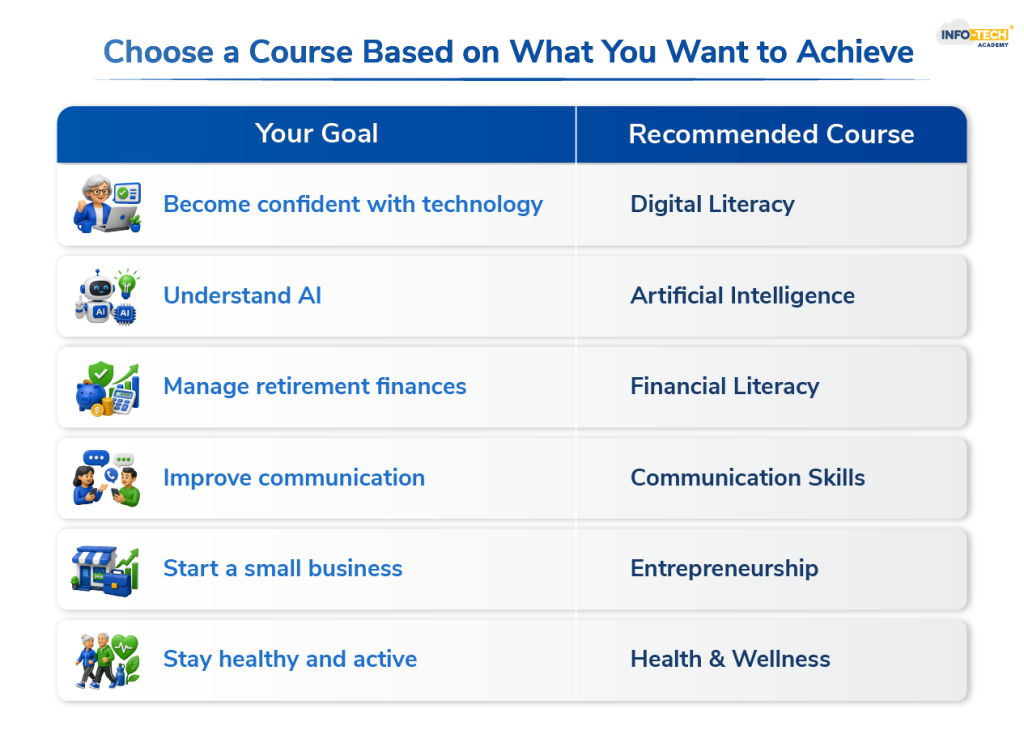
Digital literacy remains one of the most popular choices. Courses covering computers, smartphones, Microsoft Office and online safety help learners become more confident with technology they encounter every day. It’s surprising how much difference a little confidence can make. Tasks that once felt frustrating suddenly become routine.
Artificial intelligence has also attracted growing interest. Although AI sounds technical, many introductory courses focus on practical uses rather than complicated programming. Learners discover how AI can help organise information, summarise documents, generate ideas or simplify repetitive work. For many seniors, the biggest surprise is realising that these tools are far easier to use than they expected.
Financial literacy continues to draw strong interest as well. Retirement often brings new financial questions, whether that’s budgeting, understanding CPF, planning long-term savings or recognising online scams. These courses explain concepts in straightforward language without assuming previous financial knowledge.
Communication skills remain just as relevant after retirement. Some seniors continue consulting or mentoring younger professionals. Others volunteer within the community or participate in residents’ committees. Being able to communicate clearly, listen effectively and speak confidently still matters, regardless of age.
Entrepreneurship has become another unexpected favourite. Retirement gives many people the opportunity to finally explore ideas they never had time for while working. Someone who enjoys baking may decide to sell homemade pastries. A retired accountant might offer advisory services. A keen photographer could begin teaching weekend workshops. Business courses help turn those ideas into realistic plans.
Are Technology Courses Too Difficult?
This is usually the first concern people raise.
The honest answer is no.
Training providers understand that adult learners don’t all arrive with the same level of experience. Classes move at a manageable pace, and instructors expect questions. Nobody is judged for forgetting where a button is or needing extra time to complete an exercise.
In fact, one of the nicest things about adult learning is the atmosphere. People tend to encourage one another instead of competing. Conversations during coffee breaks often become just as valuable as the lessons themselves.
Many learners who begin with a basic digital course later return for more advanced programmes because they realise the hardest part wasn’t learning the technology—it was deciding to walk into the classroom in the first place.
How Should Seniors Choose the Right Course?
The temptation is to pick whatever course seems most popular.
A better approach is to think about what you want your life to look like six months from now.
If keeping in touch with family overseas feels important, digital literacy may be the best place to begin, you’re considering part-time work, communication or office software courses could prove more useful. If you’ve always wondered what artificial intelligence is really capable of, an introductory AI programme might be worth exploring.
There’s no prize for choosing the most difficult course. Learning is far more enjoyable when it matches your interests and current experience.
Check Out Our Trending AI Course & AI Course for Beginners Now!
Is It Ever Too Late to Learn?
Spend a day in almost any adult learning classroom and the answer becomes obvious.
Someone who retired from manufacturing is learning spreadsheet formulas beside a former nurse discovering AI tools. A grandparent who once avoided smartphones is confidently navigating digital apps by the end of the programme.
The common thread isn’t age.
It’s curiosity.
That may be the greatest lesson lifelong learning offers. Skills can be learned at almost any stage of life, provided you’re willing to begin.
Conclusion
The growing interest in skillsfuture courses for seniors reflects a wider change in how Singapore views education. Learning is no longer something that belongs only to students or young professionals. It has become a lifelong journey that supports independence, confidence and personal fulfilment.
Whether you’re hoping to understand technology, strengthen your communication skills, manage your finances more confidently or simply explore something you’ve always been curious about, the right course can open doors you may never have expected.
At Info-Tech Academy, we believe meaningful learning should be practical, welcoming and relevant at every stage of life. Our SkillsFuture-supported programmes are designed to help learners build confidence through hands-on training, experienced instructors and skills that remain useful long after the course has ended. Sometimes, the most rewarding chapter of learning begins after retirement.
Skillsfuture Courses For Seniors FAQs
Can senior citizens use SkillsFuture Credit to pay for courses?
Yes. Eligible Singapore Citizens can use their available SkillsFuture Credit for approved skillsfuture courses for seniors offered by recognised training providers. Depending on the course and your eligibility, additional government funding may also be available.
What are the best SkillsFuture courses for seniors?
The best course depends on your interests and goals. Many seniors choose programmes in digital literacy, artificial intelligence (AI), financial literacy, communication skills, entrepreneurship, and health and wellness because these skills are practical and useful in everyday life.
Do I need computer experience before joining a SkillsFuture course?
Not necessarily. Many beginner-level skillsfuture courses for seniors are designed for learners with little or no prior experience. Trainers usually guide participants step by step, making the learning process approachable and comfortable.
Are SkillsFuture courses only for people who want to continue working?
No. While some courses support career development, many seniors enrol simply to learn something new, keep their minds active, improve digital confidence, meet new people, or pursue personal interests. Lifelong learning is just as much about personal growth as it is about employment.

I’ve always been drawn to the power of writing! As a content writer, I love the challenge of finding the right words to capture the essence of HR, payroll, and accounting software. I enjoy breaking down complex concepts, making technical information easy to understand, and helping businesses see the real impact of the right tools.