


In this article
- 1. What is Deep Learning?
- 2. How Does Deep Learning Work?
- 3. What are the Key Concepts of Deep Learning?
- 4. What are the Types of Deep Learning?
- 5. What are the Benefits of Deep Learning?
- 6. What are Real-world Applications of Deep Leaning?
- 7. What are the Challenges and Limitations of Deep Learning?
- 8. Deep Learning – FAQs
Artificial Intelligence is changing the way people work, learn and finish their everyday activities. From facial recognitions in smartphones to students getting personalised recommendations on how to learn and people being able to see how they would look on the dress they see online are all powered by deep learning. It is an advanced area of AI where the computers learn patterns from large amount of data and work on complex tasks with minimal human intervention.
This guide will explain in detail how deep learning works, its concepts, types and real-world applications.
What is Deep Learning?
Deep Learning is a subset of machine learning and a type of artificial intelligence that teaches the computers to learn from data, learn patterns and make decisions same as how humans learn from experience. Artificial intelligence uses something called artificial neural network to learn patterns and the ideas is inspired from the way how human brain processes information.
To make it clear, instead of a child, a computer will be shown with hundred dog images and make it learn the pattern. Eventually it can find a dog in the new image. The hundred do images used to train the computer are called the data.
It is widely used for image recognition, language translation, predictive analytics and generative AI.
How Does Deep Learning Work?
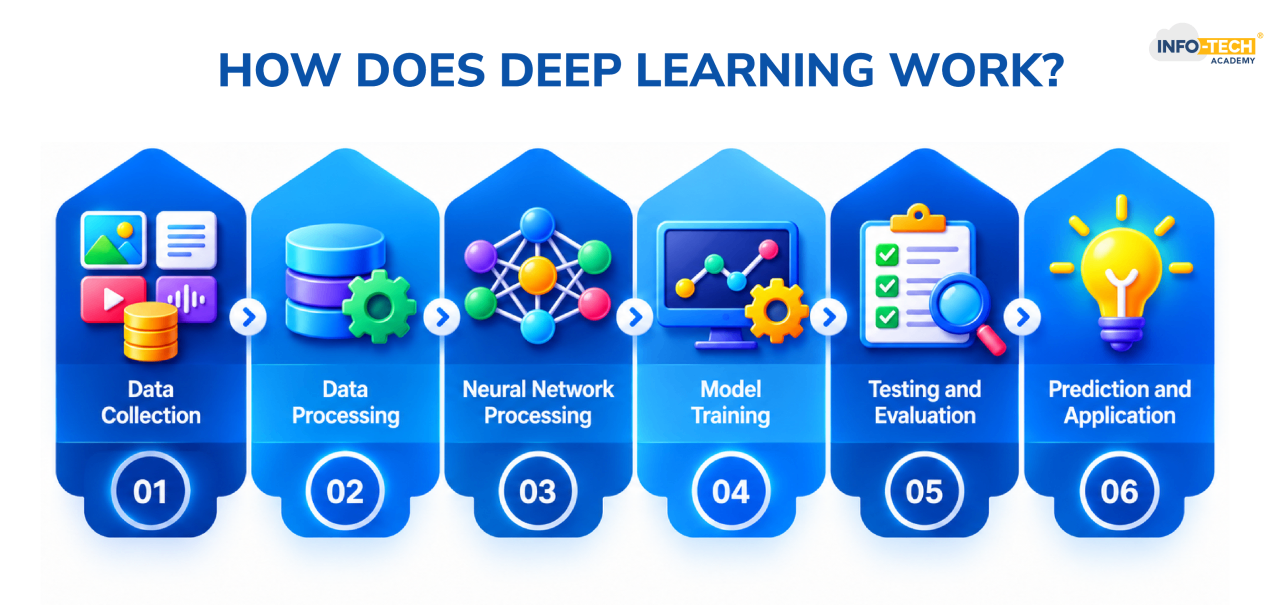
Deep learning works by processing data through multiple layers of interconnected artificial neurons. This process is done to make the computers learn the patterns. Each layer matters in this process as each of them learn different features from the provided data and enable the computer to recognise increasingly complex patterns.
The process generally involves the following steps.
Data Collection:
Large amount of relevant data like texts, images, videos, audios and numerical information are collected to train the model.
Data Processing:
The collected data are cleaned, organised and prepared to increase its suitability for training.
Neural Network Processing:
The processed data passes through multiple layers of neural networks and the mathematical operations identify the patterns and relationships.
Model Training:
The models will receive the training feedback to adjust its parameters so the errors can be reduced and predictions improve.
Testing and Evaluation:
The trained model is trained with separate set of data to check its accuracy and the ability to work with new tasks.
Prediction and Application:
Once the model is trained and validated, they can generate predictions, classifications or other outputs.
What are the Key Concepts of Deep Learning?
Understanding the key concepts of this will make it easier to identify how these systems process information and complete tasks.
Artificial Neural Networks-
Artificial neural networks are the building blocks of deep learning. These neurons are interconnected processing units. These network processes input data and learns relationship by adjusting numerical patterns during training.
Layers in Neural Networks-
A deep learning neural network typically has three main layers,
- Input layer: Receives the initial information in the form of data such as texts, images and audios.
- Hidden layer: Processes the information and learn patterns through mathematic operations.
- Output layer: Produces the final predictions, classifications or other outcomes.
Weights and Biases-
Weights determine how strongly every input influence the neuron’s output, while biases help to adjust the calculations. During training, these parameters will be updated to improve the model performance.
Activation Functions-
The activation functions help the models understand the complex patterns and decide what information to pass on to the next layer.
Loss Function-
The loss function identifies the gap between the model’s prediction and the expected results. The training processes aim to minimize the loss and improve prediction accuracy.
What are the Types of Deep Learning?
There are different types of deep learning architectures based on the data it must process and the problems it must solve.
Artificial Neural Networks:
The artificial neural networks are the foundational neural networks that are used to identify the relationship between the inputs and the outputs. They are commonly used for classification, predictions and pattern recognitions.
Convolutional Neural Networks (CNNs):
The convolutional neural networks are particularly helpful while dealing with visual information. When handing with these types of data, an extra layer is required to identify the shapes, edges, textures and objects within the image.
Transformers:
Transformers are neural network architectures that uses attention mechanism to identify the relationship between different parts of the input data. This method becomes especially important for modern natural language processing and generative AI.
What are the Benefits of Deep Learning?
Deep learning offers a lot of benefits to organisations adopting AI technologies.
The organisations can save a lot of time as the manual works will be taken care by the models in activities such as image analysis, language translation and document processing.
It can be difficult to identify complex patterns using traditional methods. It identifies relations that may be difficult to recognise.
Deep learning provides predictions and insights from large amount of information and helps in important decision-making.
The works that involve images, text, audio and other complex data formats can be easily processed even if they are unstructured.
This can help in automating the repetitive tasks and result in improving the operational efficiency.
These benefits may vary according to the quality of data that we use, the suitability of the model and how effectively the technology is implemented.
Read Also: Singapore’s 5 Best AI Bootcamps: Your Guide for 2026
What are Real-world Applications of Deep Leaning?
Deep Leaning is used across various industries to automate repetitive tasks, analyse complex information and support decision-making.
Healthcare:
Deep learning helps healthcare professionals to analyse the medical images, find patterns in the patients’ medical reports and supports disease detection. These systems provide more benefits to the healthcare professionals. However, there should be a human intervention for appropriate validation and human oversight becomes inevitably important.
Banking and Finance:
Financial institutions use deep learning to understand if there is any unusual patterns in transactions, assess risks and prevent fraudulent activities. Deep learning can also be useful for financial forecasting and document processing.
Education:
Educational platforms use deep learning to support both the students and the teaching professionals. Students can use it to get personalised recommendations and understand difficult concepts easily. But we should ensure that independent thinking is not destroyed by this. The professionals can use it to automate assessments and administrative tasks.
Retail and E-commerce:
The retail and e-commerce platforms use deep learning to understand the buying behaviours of the customers and recommend them with the suitable products. It can also improve the user experience by giving them a chance to see how the products look on them using virtual reality.
Read Also: DeepSeek AI: Business potential in Singapore
What are the Challenges and Limitations of Deep Learning?
Despite its advantages, deep learning has its challenges and limitations.
Many deep learning models require a large amount of high-quality data to be trained to attain reliable outcomes.
The computational costs can be higher to train complex models as they may require specialised hardware and significant processing power.
Models that are trained with incomplete or biased data may generate inaccurate and unfair results.
Organisations must carefully handle the sensitive data used to train the models and make sure to comply with all the data protection requirements including Malaysia’s personal data protection act 2010.
Deep Learning – FAQs
Is deep learning the same as artificial intelligence?
No, artificial intelligence is a broader field of developing systems that performs tasks. Whereas deep learning is a subset of machine learning which is itself a subset of artificial intelligence.
What is an example of deep learning in everyday life?
Facial recognition on smartphones, voice assistants and automatic translations are some of the examples of deep learning in everyday life.
Why is deep learning important for businesses?
Deep learning helps businesses automate tasks, analyse customer information, and supports decision-making across different industries.
What is the difference between deep learning and generative AI?
Deep learning is a broader approach to train models with neural networks, while generative AI focuses on creating new contents such as text, audios and images.
Is deep learning a subset of machine learning?
Yes, deep learning is a subset of machine learning which itself is a subset of artificial intelligence. It learns patterns from data using multilayer neural networks.
Is Natural Language Processing (NLP) a type of deep learning?
No, NLP is a branch of artificial intelligence that helps computers understand and generate human language. It uses deep learning techniques to perform tasks such as language translation and text summarisation.

Transforming thoughts and concepts into clear, compelling words is a powerful tool that connects people. While writing boosts my creativity, reading broadens my perspective and sharpens my understanding of language and narration.