



In this article
- 1. What Does Negotiation Mean at Work?
- 2. Why are Negotiation Skills Important in the Workplace?
- 3. How Do You Prepare For a Negotiation?
- 4. What Are the Most Effective Negotiation Strategies?
- 5. How Can You Communicate Better During a Negotiation?
- 6. How Do You Influence People Without Being Pushy?
- 7. How Do You Stay Calm in a Tough Negotiation?
- 8. How Can You Improve Your Negotiation Skills?
- 9. Negotiation Strategies FAQs
You probably negotiate more often than you actually think. Starting from asking for a pay rise, pushing back on a tight deadline, splitting up project work or agreeing terms with a vendor – all are negotiations. The people who handle these well aren’t necessarily the loudest in the room. They just tend to have a better approach. Here’s how you can build negotiation strategies.
What Does Negotiation Mean at Work?
Negotiation is a conversation where people who want different things work towards an agreement they can all accept as one. At work, that usually involves money, time, resources or responsibilities.
You’ll keep working with the same people who you are to negotiate with, so the aim isn’t to beat the other side. It’s to get what you need while also leaving them feel that the deal was fair for them.
Why are Negotiation Skills Important in the Workplace?
In Singapore’s fast-moving, multicultural workplaces, being able to reach agreements smoothly gives you a clear edge. Good negotiation skills shape your salary and promotions, but they also help you manage your workload, win support for your ideas and settle team disagreements early. And people who speak up calmly and reasonably are seen as more confident and dependable ones.
Read also: Essential Negotiation Skills To Enable Mutual Agreement
How Do You Prepare For a Negotiation?
Most negotiations are decided before they start. Get clear on your ideal outcome, your walkaway point and your backup plan if talks fail, often called your BATNA (Best Alternative to a Negotiated Agreement). A competing job offer or a second supplier quote gives you real confidence at the table.
Then think about the other side. What pressures are they under and what do they care about the most? Finally, gather facts like market salary data or proof of your impact. Evidence always beats just saying “I feel I deserve this.”
What Are the Most Effective Negotiation Strategies?
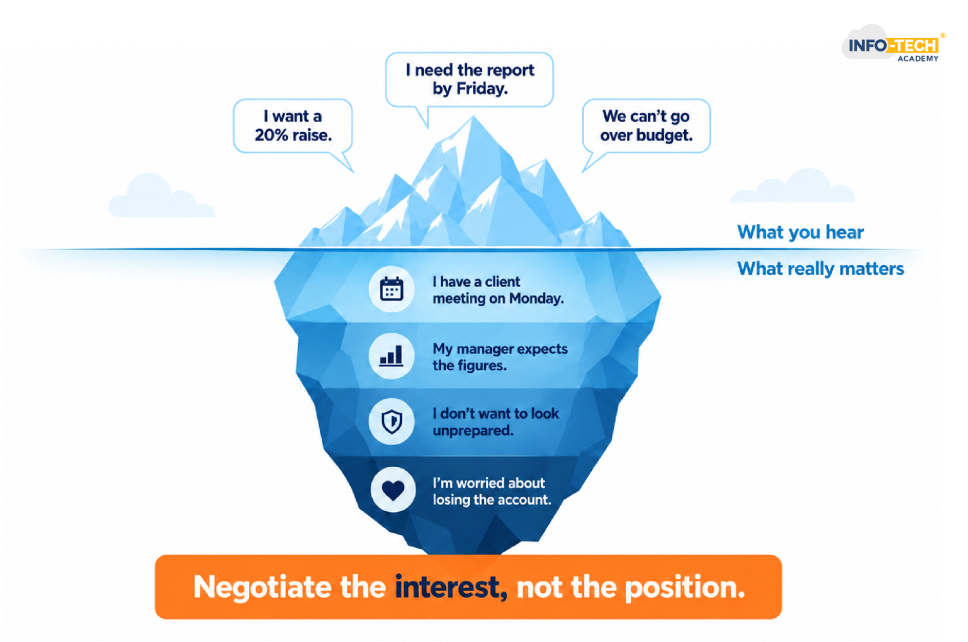
Focus on interests, not positions
A position is what someone asks for. An interest is why they want it. If a colleague insists on a Friday deadline because they need key figures for a Monday client meeting, you could send the summary on Friday and the full report on Tuesday. That way, both needs are met.
Make the first offer when you know the range
The first number on the table tends to anchor the whole discussion. If you know what’s reasonable, open at the ambitious end without going so high that the other side walks away. If you don’t actually know the reasonable range, ask questions first, so that you can clarify their expectations too.
Share some of your cards
Explaining what matters to you often encourages the other person to open up too, which helps you find better solutions together. Just keep your walkaway point private, but do share other things in a suggestive manner.
Trade instead of simply giving in
Make every concession earn something back, like a two-way path of gain. For example, “I’m happy to lead this, and I’d like to revisit my title at the next review.”
Put more than one thing on the table
Talks about a single issue quickly become a tug of war. In a salary discussion, flexible hours, a training budget, extra leave or a promotion timeline give both sides room to move.
Match your style to the situation
Collaborate when the relationship matters long term, meet halfway when speed matters, and be bolder in one-off deals. Sometimes the smartest move is not to negotiate at all.
Read also: How to Win More Deals with Negotiation Skills Training
How Can You Communicate Better During a Negotiation?
Listen properly instead of planning your reply, and ask open questions like “What would make this work for your team?” Repeating back what you’ve heard clears up misunderstandings early.
Be specific with your asks. “One more person on this project for three months” gets a real answer, while “a bit more support” gets forgotten easily. After an offer, pause. Silence often prompts the other side to share more of what they think about your take or soften their stance. Keep your body language open, and handle sensitive talks in person or on video rather than over text message or email.
How Do You Influence People Without Being Pushy?
Influence comes from showing people why your idea works for them. Understand their worries and goals, then frame your proposal around that clearly. Asking your manager for a new tool? Talk about hours saved for the whole team, not convenience for you.
Asking questions that help people spot the problem themselves also works well, since people back solutions they helped shape. A little small talk builds rapport, which matters in many Asian work cultures. And once something is agreed, don’t come back with extra demands. Trust is much easier to keep than to rebuild.
How Do You Stay Calm in a Tough Negotiation?
Nervousness is normal. Reframing them as excitement can help, and rehearsing with a friend makes the real conversation feel familiar and easier to tackle. Knowing your walkaway point keeps you steady too. If things get heated, suggest a short break early, and if the other side turns aggressive, stay focused on the problem rather than the person.
How should you close a negotiation?
Summarize what’s agreed, who does what and by when, then confirm it through email. Avoid adding surprise conditions after shaking hands, as it can sour the relationship for good. If no deal beats your backup plan, part respectfully and leave the door open.
How Can You Improve Your Negotiation Skills?
Practice in low-stakes situations, like dividing team tasks or asking a supplier for better terms, and reflect afterwards on what worked and what didn’t.
If you want to speed up your progress, a negotiation skills course is one of the most practical investments you can make. A good course gives you proven frameworks, lets you practice through realistic role plays and offers feedback from experienced trainers. When comparing options, look for a course that focuses on workplace scenarios and hands-on practice, and check whether it qualifies for SkillsFuture funding. We’ve made this easier for you. Info-Tech Academy’s negotiation skills course ticks all these.
In the end, negotiation isn’t about winning arguments. It’s about communicating clearly, understanding people and finding agreements that move everyone forward.
Negotiation Strategies FAQs
What are the five negotiation techniques?
The five main negotiation techniques are accommodating, competing, collaborating, compromising and avoiding.
What is the most effective strategy for negotiating?
For most workplace situations, the most effective strategy is collaborative negotiation, also known as the win-win approach. Instead of arguing over fixed positions, you focus on the interests behind them and look for solutions that give both sides what they really need.
What are the five C’s of negotiation?
The five C’s of negotiation are a simple way to remember what a successful negotiation needs: clarity, confidence, communication, collaboration and commitment.
What is the golden rule of negotiation?
The golden rule of negotiation is to never go in without knowing when you’re willing to walk away. When you’re clear on your walkaway point and have a solid backup plan, you can negotiate calmly, avoid agreeing to a bad deal out of pressure and make confident decisions.

Transforming thoughts and concepts into clear, compelling words is a powerful tool that connects people. While writing boosts my creativity, reading broadens my perspective and sharpens my understanding of language and narration.