


In this article
- 1. Where Things Stand Right Now?
- 2. Why the Singapore Job Market Feels More Competitive
- 3. What About Fresh Graduates?
- 4. Sector Trends: Where Opportunities Are Concentrated
- 5. Why is There Increase in Contract and Project-Based Roles
- 6. Why is it Important to Upskill to Stay Relevant in Singapore’s Job Market
- 7. What courses do Info-Tech Academy Offer?
- 8. Key Takeaways
- 9. Singapore Employment Rate FAQs
Singapore’s employment rate market in 2026 remains relatively stable, but it is no longer as straightforward as it once was. While unemployment levels are still low by global standards, many job seekers are finding that securing the right role takes more time and strategy than before.
This has led to a common question:
Is Singapore employment rate still strong? And why does job searching feel harder?
The answer lies in how the job market is evolving.
Where Things Stand Right Now
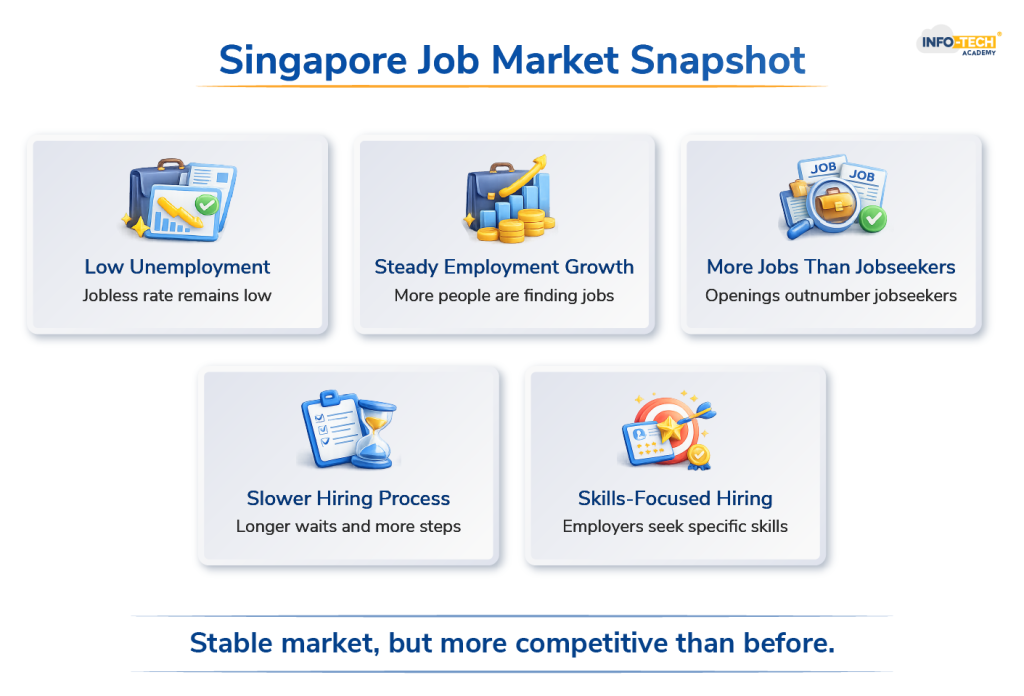
Singapore’s job market continues to maintain a high employment rate. It suggests that people who are actively looking for jobs are, in most cases, able to find something.
At the same time, the labour dynamics have shifted. In some sectors, job openings may still outnumber job seekers, but this depends heavily on skills alignment and industry demand.
A lot of these roles require specific skills or experience, which means not everyone can easily step into them. So while jobs exist, they may not always match what candidates are ready for.
Why the Singapore Job Market Feels More Competitive
Even with stable Singapore employment rate levels, many candidates feel that job searching has become more challenging.
This is largely due to structural changes in how companies hire.
Employers today tend to prioritise:
– Candidates with directly relevant, applied skills
– Experience that closely matches the role
– Individuals who can contribute with minimal ramp-up time
As a result, general experience is often no longer enough. Candidates who do not meet specific skill requirements may find themselves filtered out earlier in the hiring process.
This shift can make the job search feel slower and more uncertain, even when opportunities exist.
You might notice:
- Longer waiting times after interviews
- More rounds in the hiring process
- Higher expectations even for entry-level roles
Skills Mismatch: A Key Factor
One of the main reasons behind this disconnect is the growing skills mismatch.
Certain sectors continue to face talent shortages, particularly in areas such as:
- Technology and data-related roles
- Cybersecurity and digital infrastructure
- Healthcare and specialised services
At the same time, other roles may be more saturated, leading to increased competition among candidates with similar backgrounds.
This means that job availability is not evenly distributed, it depends heavily on whether a candidate’s skills align with current market demand.
What About Fresh Graduates?
Graduate employment outcomes have shown signs of recovery in recent years, although results vary significantly across disciplines.
Graduates entering fields such as technology, engineering, and healthcare tend to experience stronger demand. In contrast, those from more general or less specialised fields may face a more competitive landscape.
This reflects a broader shift:
– Employers are placing greater emphasis on practical, job-ready skills
– Academic qualifications alone are often not sufficient
For many graduates, this means taking additional steps to build relevant capabilities before securing their first role.
But there’s a catch. Not everyone is landing a full-time, permanent role right away. Many are starting with contract jobs, internships, or short-term roles. That’s becoming quite normal.
There’s also a mindset shift happening. Some graduates are being more selective; they’re willing to wait a bit longer for something that fits them better instead of jumping into the first offer as such.
Sector Trends: Where Opportunities Are Concentrated
As hiring becomes more skills-focused, many professionals are turning to practical, short-term training to stay competitive.
In Singapore, SkillsFuture and WSQ-supported programmes provide structured pathways to develop in-demand capabilities across areas such as:
– Digital tools and emerging technologies
– Communication and workplace effectiveness
– HR, accounting, and business systems
For example, gaining familiarity with tools like generative AI, improving communication skills, or learning how to use workplace systems can make candidates more adaptable in a changing job environment.
Training providers such as Info-Tech Academy offer short, application-focused courses designed for working professionals who need skills they can apply immediately at work.
The key is to focus on learning that directly supports employability, rather than pursuing credentials without clear application.
Not all industries are moving in the same direction.
Some sectors continue to show steady demand:
– Technology and digital services
– Healthcare and eldercare
– Logistics and supply chain
Financial services remains an important sector in Singapore’s economy, although hiring demand can vary depending on market conditions and specific roles.
Understanding where demand exists is increasingly important for job seekers looking to position themselves effectively.
Why is There Increase in Contract and Project-Based Roles
Another noticeable trend is the increase in contract, freelance, and project-based employment.
Companies are becoming more cautious about long-term hiring commitments and are instead opting for:
– Fixed-term contracts
– Project-based roles
– Flexible workforce arrangements
For job seekers, this can create uncertainty, but it also opens up alternative entry points into industries. Many professionals use contract roles to gain experience, build networks, and transition into permanent positions over time.
Why is it Important to Upskill to Stay Relevant in Singapore’s Job Market
As hiring becomes more skills-focused, many professionals are turning to practical, short-term training to stay competitive.
In Singapore, SkillsFuture and WSQ-supported programmes provide structured pathways to develop in-demand capabilities across areas such as:
– Digital tools and emerging technologies
– Communication and workplace effectiveness
– HR, accounting, and business systems
For example, gaining familiarity with tools like generative AI, improving communication skills, or learning how to use workplace systems can make candidates more adaptable in a changing job environment.
Training providers such as Info-Tech Academy offer short, application-focused courses designed for working professionals who need skills they can apply immediately at work.
The key is to focus on learning that directly supports employability, rather than pursuing credentials without clear application.
What courses do Info-Tech Academy Offer?
Info-Tech Academy offers various upskilling WSQ courses in Singapore that are broadly related to AI, HR, Leadership, and Corporate Training.
AI / Digital Courses
- AI course for Beginners (1 day): If you’ve always been curious about AI but didn’t know where to start, this session breaks it down in a very simple, easy-to-follow way, without any technical overload.
- Gen AI ChatGPT course (Understand Generative AI using ChatGPT – 1 day): This course walks you through how ChatGPT actually works and how you can start using it in your daily tasks instead of just experimenting with it casually.
- AI Course (Effective Use of Generative AI Tools – 2 days): Over two days, you’ll explore tools like ChatGPT, Gemini, and Copilot, with a focus on how they can genuinely save time and make your work a bit easier.
- AI Course for HR (Transform HR Management with Generative AI – 2 days): A practical look at how HR teams can start using AI tools to handle routine tasks, organise information better, and reduce manual effort.
- Essential Office Skills Course (with Digital Tools – 1 day): This session focuses on the kind of everyday digital skills people often pick up the hard way—here, you’ll learn them properly and apply them right away.
- AI Course for Business Management (Generative AI for Efficient Business Management – 1 day): A straightforward session on how AI can support business operations, especially when it comes to saving time and handling repetitive work.
HR / Accounting Courses
- Human Resource Course (Basics of HR Management & Info-Tech HRMS – 2 days): You’ll cover the fundamentals of HR while also getting hands-on experience with HRMS software, so it’s not just theory.
- HR Course (Integrating HRMS for Enhanced Productivity – 3 days): This course goes deeper into how HR systems are actually used in organisations and how they can improve workflow when set up properly.
- AI Course for HR (Transform HR Management with Generative AI – 2 days): A closer look at how AI can be introduced into HR processes in a practical, manageable way without overcomplicating things.
- Accounting Course (Basics of Accounting & Info-Tech Software – 2 days): Learn the core ideas behind accounting while working directly with accounting software, so you can see how things are done in real scenarios.
Communication Skills Courses
- Communication Skills Course (Master Workplace Communication – 2 days): Helps you get more comfortable expressing your thoughts clearly at work, whether it’s in meetings, emails, or day-to-day conversations.
- Negotiation Skills Course (Master Business Negotiation – 2 days): Focuses on real-world negotiation situations and how to handle them with more confidence and clarity.
- Leadership Course (Master Conflict Resolution – 2 days): Teaches practical ways to deal with disagreements at work calmly, without letting situations get out of hand.
Corporate Training
- Corporate training program for bridging the skill gaps of employees at corporate offices.
Info-Tech Academy helps professionals in Singapore upskill themselves through short, high-quality courses to enhance productivity for employers and marketability for employees. Contact us to find a course that will suit and boost your career goals.
Key Takeaways
If you’re trying to make sense of the current Singapore employment rate, here’s the honest takeaway:
- The job market is still stable
- Opportunities are there, but not always obvious
- Employers are more selective than before
- Skills matter more than ever
It might take a bit longer to land the role you want, and it might not look exactly how you imagined, but that’s okay.
Most careers today aren’t built in a straight line anyway.
Singapore Employment Rate FAQs
Does Singapore have a high unemployment rate?
No, Singapore does not have a high unemployment rate, but it does have a competitive job market.
Which country is number 1 in unemployment?
Though there isn’t a single fixed “number 1” country for unemployment because it changes over time, but in recent years, South Africa has consistently had one of the highest unemployment rates in the world.
How much percent of Singaporeans work?
Most Singaporeans do work, but the exact percentage depends on how you measure it. Out of every 100 Singaporeans of working age, about 65–70 people are working, and a few more are actively looking for jobs.
Is it easy to get a job in Singapore?
Generally, it’s not “easy,” just manageable to get a job in Singapore if you approach it right. Jobs are available but you need to be strategic, not just apply blindly.

Transforming thoughts and concepts into clear, compelling words is a powerful tool that connects people. While writing boosts my creativity, reading broadens my perspective and sharpens my understanding of language and narration.