


Why Corporate Training Has Become a Business Priority?
Not too long ago, corporate training was treated as something companies did occasionally—usually when there was extra budget or when a gap became too obvious to ignore. It wasn’t ignored, but it wasn’t exactly central either.
Today, training sits much closer to the heart of how businesses operate. The reason is fairly straightforward: the pace of change has picked up, and skills are struggling to keep up with it. What worked even a couple of years ago can start to feel outdated surprisingly quickly.
Because of that, companies are no longer asking whether they should invest in training. They’re asking how to do it better, faster, and in a way that actually moves the needle.
How is the Current Market Landscape?
The corporate training market today looks very different from what it used to be. It’s no longer just about classroom sessions or one-off workshops. Instead, it has evolved into a broader ecosystem that blends technology, content, and strategy.
Here’s a simple way to look at how the market is structured right now:
| Segment | Description | Role in Today’s Market |
| EdTech Platforms | Learning systems, LMS, AI-driven tools | Enable scalable, flexible learning |
| Corporate Training Providers | Customized, instructor-led programs | Address specific business needs |
| Bootcamps & Skill Programs | Short, intensive WSQ courses | Deliver fast, practical outcomes |
| Internal Learning Systems | In-house training frameworks | Support long-term workforce growth |
What’s interesting is how these lines are starting to blur. Many providers are offering both platforms and content, while companies themselves are building internal learning ecosystems instead of relying entirely on external vendors.
What’s Driving Growth in This Market?
The growth we’re seeing isn’t accidental. It’s being driven by a few very real pressures that almost every organization is dealing with right now.
- Skills Are Becoming Outdated Faster
One of the biggest challenges companies face is how quickly skills lose relevance. Roles are evolving, tools are changing, and expectations are rising.
Instead of constantly hiring new people—which is expensive and often difficult—companies are investing in the people they already have. Upskilling has become the more practical option.
- Employees Expect Growth, Not Just Stability
There’s also been a shift in what employees want. A stable job is no longer enough. People are thinking more about progression—what they’re learning, how they’re growing, and where their career is heading.
When those expectations aren’t met, they don’t usually stay long. Training, in that sense, has become just as much about retention as it is about performance.
- Digital Transformation Is Touching Every Industry
It’s not just tech companies anymore. Almost every industry is going through some form of digital change.
Whether it’s automation, data tools, or AI-driven systems, employees are expected to adapt quickly. That naturally creates a constant need for training, not just once, but continuously.
How Investment Patterns Are Evolving?
One of the more interesting shifts is how companies are thinking about spending on training.
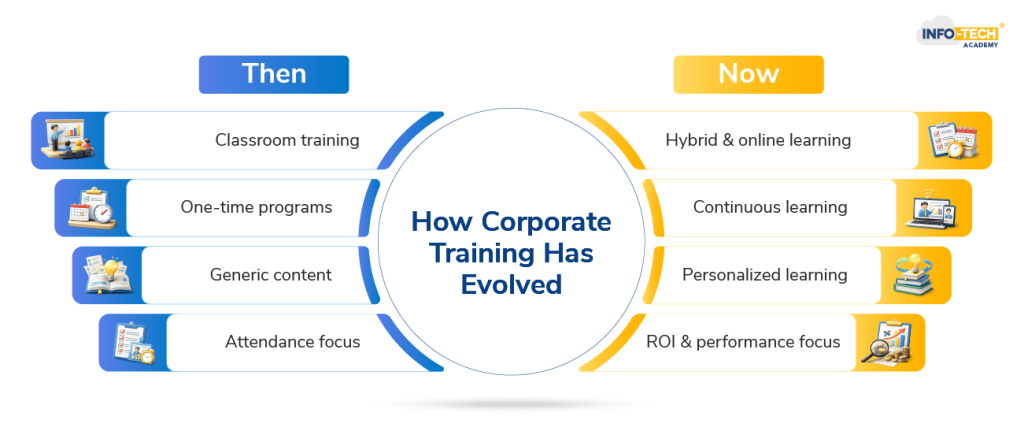
Earlier, it was often treated as a one-time expense—run a program, tick the box, move on. Now, it’s becoming a more structured, ongoing investment.
More importantly, companies are starting to ask better questions. Instead of focusing on attendance or completion rates, they’re looking at outcomes.
Are teams more productive?
Are processes more efficient?
Is there a noticeable improvement in performance?
This shift is pushing companies toward solutions that can actually demonstrate impact, not just deliver content.
What are the High-Growth Areas Within the Market?
While the overall market is growing, some areas are clearly gaining more attention than others.
| Segment | Growth Level | What’s Driving It |
| AI & Tech Training | Very High | Demand for future-ready skills |
| LMS & EdTech Platforms | Very High | Scalability and recurring usage |
| Leadership Development | High | Need for stronger management capability |
| Compliance Training | Steady | Ongoing regulatory requirements |
What stands out is how much momentum technology-driven learning solutions have. Platforms that combine learning delivery with tracking and personalization are becoming increasingly valuable.
What is the Role of Technology in Modern Training?
Technology hasn’t just improved training—it has changed how people experience it.
Learning is no longer tied to a fixed schedule or location. It’s becoming more flexible, often happening in smaller, more manageable chunks that fit into the workday.
Artificial intelligence is also starting to play a role here. It can suggest what someone should learn next, identify gaps, and track progress in a way that feels much more tailored.
For companies, this makes training more efficient. For employees, it makes it more relevant.
What Challenges Still Need Attention?
Even with all this growth, the market isn’t without its challenges.
- Measuring ROI Isn’t Always Clear
One of the biggest sticking points is still measuring impact. While it’s easy to track participation, it’s much harder to directly connect training to business results.
That uncertainty can make companies more cautious about long-term investments.
- Too Much Content, Not Enough Clarity
There’s no shortage of learning material available today. If anything, there’s too much.
Employees can easily feel overwhelmed, which leads to lower engagement. The challenge now is not access to content, but helping people focus on what actually matters.
- Slower Adoption in Traditional Industries
Some sectors are quicker to adopt modern training approaches than others. Industries with more traditional structures often take longer to integrate new systems, which can slow down overall progress.
What the Future of Corporate Training Looks Like?
If current trends continue, training will become less of a separate activity and more of a natural part of work.
Instead of setting aside time to learn, employees will learn as they work—solving problems, adapting to tools, and building skills in real time.
We’re also likely to see more data-driven decision-making, where companies can anticipate skill gaps before they become issues.
In many ways, learning will become less visible—but more constant.
Conclusion
The corporate training market has moved well beyond its traditional role. It’s no longer just about learning for the sake of development—it’s about staying relevant in a fast-changing environment.
Companies are investing in training because they need to adapt. Employees are embracing it because it shapes their future. And investors are paying attention because the demand isn’t going away anytime soon.
At its core, this market is about one simple idea: the ability to keep learning is what keeps businesses moving forward.
And right now, that ability is more valuable than ever.
Corporate Training FAQs
Why is the corporate training market growing so fast in 2026?
The corporate training market is expanding rapidly because businesses are facing constant skill changes driven by technology, especially AI and digital tools. Companies can no longer rely only on hiring, so they are investing in upskilling their existing workforce to stay competitive and retain talent.
What are the most in-demand areas in corporate training today?
The most in-demand areas include AI and data analytics, digital transformation skills, leadership development, and role-specific technical training. Companies are prioritizing practical, job-ready skills that can immediately improve performance and productivity.
Is corporate training a good investment for businesses?
Yes, corporate training is increasingly seen as a strategic investment rather than a cost. When done effectively, it improves employee performance, reduces turnover, and helps companies adapt faster to market changes, making it a strong long-term value driver.
What are the biggest challenges in the corporate training industry?
One of the main challenges is measuring the return on investment (ROI) of training programs. Companies also face issues with content overload, where too many learning options lead to low engagement, and slower adoption in traditional industries.

I’ve always been drawn to the power of writing! As a content writer, I love the challenge of finding the right words to capture the essence of HR, payroll, and accounting software. I enjoy breaking down complex concepts, making technical information easy to understand, and helping businesses see the real impact of the right tools.