


In this article
- 1. What Does LLM Mean?
- 2. How Does a Large Language Model Work?
- 3. How Are Large Language Models Trained?
- 4. What Can LLMs Be Used For?
- 5. What Are Some Examples of Large Language Models?
- 6. Why Are Large Language Models So Popular?
- 7. What Is the Difference Between an LLM and Generative AI?
- 8. How Are LLMs Changing the Way People Use Technology?
- 9. LLM Frequently Asked Questions
Large language models are the ones behind many of the AI tools that people widely use today. When you ask a chatbot a question like help with rewriting an email or turning a long document into a short summary, there is often a large language model involved – working in the background.
Though the name sounds technical, the basic idea is fairly simple. A large language model learns patterns from huge amounts of text. It then uses what it has learned to understand a prompt and generate a suitable response.
What Does LLM Mean?
LLM stands for Large Language Model. The word “large” refers to the scale of data involved. These models are trained using enormous amounts of information and can contain billions of internal parameters.
A language model, meanwhile, is built to recognise patterns in language. It learns how words are usually used together, how sentences are formed and how a word’s meaning can change depending on context. It can also figure out the exact meaning of the unintended typos that people generally tend to make while typing out a prompt or query, and answer correctly.
This is what allows an LLM to work with normal human language instead of relying on fixed commands.
Read also: What Is An AI Chatbot?
How Does a Large Language Model Work?
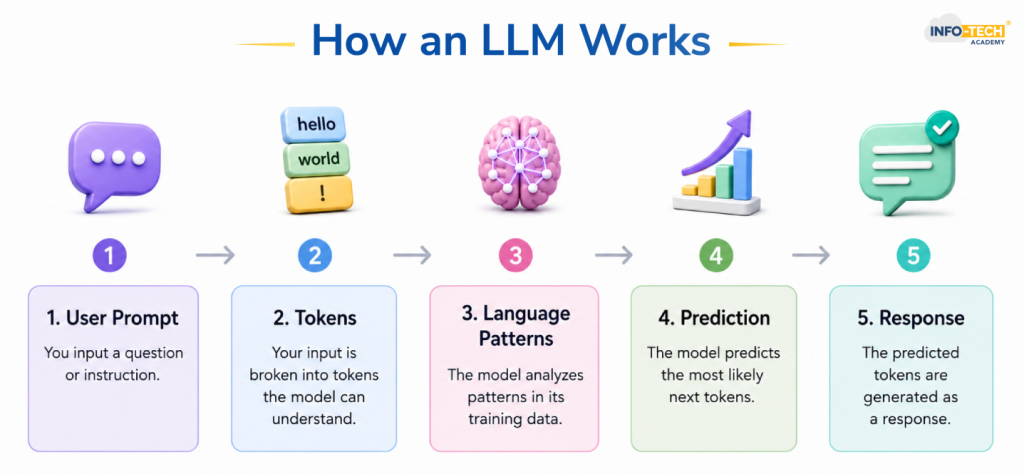
An LLM works largely through prediction. When you type a prompt, the model breaks the text into smaller pieces or parts called tokens. These may be whole words, parts of words phrases, or even individual characters.
The model looks at those tokens, analyses the order they appear in and the relationships between them. It then predicts what should come next. This happens repeatedly as the response is created.
So if you ask an LLM to explain something, it is not pulling an already finished paragraph from a stored answer bank. It builds the response as it goes based on language patterns learned during its training.
Read also: What Is Gen AI and How Does It Work?
How Are Large Language Models Trained?
Training a model starts with a huge collection of text. Depending on the model, this can come from books, articles, websites, code, documents or even other written sources. The model goes through this material and repeatedly practises predicting parts of the text. Imagine seeing:
“The train arrived at the…”
A model learns from many examples that words such as “station” are more likely to follow than unrelated words such as “banana” or “people”. Real training happens on a far larger scale. The model makes predictions, measures how far those predictions are from the expected result and adjusts its internal parameters accordingly.
After enough training, it becomes much better at rightly recognising grammar, context, writing styles, common facts and relationships between ideas. Some models are later fine-tuned using more focused data so they perform better at particular tasks.
Read also: What Is OpenAI? Everything You Need to Know
What Can LLMs Be Used For?
Large language models are useful because one model can handle many different kinds of language tasks one after the other. Someone might use the same AI system to summarise a report in the morning, rewrite an email after lunch and explain a piece of code later in the day.
Common Uses Include:
- Answering questions
- Writing and rewriting text
- Summarising documents
- Translating languages
- Generating code
- Explaining technical topics
- Classifying information
- Analysing text
- Powering chatbots
- Searching through large collections of information
Businesses can also connect language models to their own documents, databases and software systems. This allows an AI tool to work with company-specific information rather than only responding from the knowledge built into the model.
What Are Some Examples of Large Language Models?
Some of the best-known AI platforms today are powered by large language models. Examples include models such as ChatGPT, Claude, Gemini, Copilot and Llama.
There are also many smaller and specialised language models built for particular industries or tasks. Not every model works in exactly the same way. They can differ in size, training data, architecture and the amount of information they can handle at one time.
Some are designed mainly for conversation. Others focus more heavily on coding, research, business tasks or working across several types of media.
Read also: Why Learning Artificial Intelligence Matters
Why Are Large Language Models So Popular?
One foremost reason is convenience. Older software often expected people to first learn how the software worked. You had to know which buttons to press, which search terms to enter or which commands to use in order to land on the answer that you expect.
LLMs reverse much of that relationship. You can simply describe what you want in the minimum set of words.
“Summarise this document.”, “Make this email shorter.”, “Explain this formula.”, “Turn these notes into a report.”
The model interprets the instruction and produces a response. That makes sophisticated AI much easier for ordinary users to work with. You do not need to understand machine learning to use a language model. The same flexibility also makes LLMs useful across areas such as customer service, marketing, education, software development, research and administration.
What Is the Difference Between an LLM and Generative AI?
LLMs and generative AI are closely connected, but they are not the same thing.
Generative AI is a broad term for AI that creates new content based on the user’s requirement. That content might be in the form of text, images, music, audio, video or code. A large language model focuses mainly on understanding and generating language.
This means an LLM can be part of a generative AI system, while generative AI can also include completely different kinds of models. An AI image generator, for example, belongs to generative AI even though its main job is creating pictures rather than working with language.
Read also: How is AI different from Generative AI
How Are LLMs Changing the Way People Use Technology?
The biggest shift may be the way people communicate with computers now. Instead of giving software a series of structured, precise instructions, users can increasingly explain what they want in ordinary language – even with grammatical or typing errors. This leverage changes what software can feel like to use. A person can give an AI tool a rough idea, ask a follow-up question, change direction or request another version without starting again from scratch. LLMs can remember the previous instructions or conversations too.
Large language models are also moving beyond text. Newer AI systems can work with combinations of text, images, video, audio, documents and other information. They are also being connected to tools that can search databases, work with uploaded files and complete parts of a workflow.
The technology behind an LLM may be complex, but the reason it has become so widely used is much simpler: it makes interacting with computers feel more like asking for what you need. In-depth understanding of its usage can be further developed by taking up courses such as AI course for Beginners, AI course, and ChatGPT course. Explore more WSQ courses at Info-Tech Academy or contact us to get a clear understanding of the available courses.
LLM Frequently Asked Questions
What does LLM mean for AI?
LLM is Large Language Model which is trained on large amounts of text and data so it can understand language patterns, respond to prompts, generate content, summarise information, translate text and handle other language-based tasks.
Is ChatGPT an LLM?
Yes, ChatGPT is powered by Large Language Models.
What is the difference between LLM and GPT?
LLM is designed to understand and generate language, while GPT (Generative Pre-trained Transformer) is a specific family of LLMs developed by OpenAI using the transformer architecture.
Are all AI agents LLM?
No, not all AI agents are LLMs.

Transforming thoughts and concepts into clear, compelling words is a powerful tool that connects people. While writing boosts my creativity, reading broadens my perspective and sharpens my understanding of language and narration.