


In this article
A few years ago, most people interacted with Artificial Intelligence without even noticing it. AI existed mostly in the background — useful, but invisible.
Then Gen AI arrived, and suddenly AI became personal.
People started asking machines to write emails, generate business proposals, create marketing campaigns, summarise meetings, design images, explain homework, and even brainstorm life decisions. What once sounded futuristic became strangely normal almost overnight.
In Singapore, this shift is happening especially fast. In fact, the Government announced plans to help 40,000 tech professionals gain practical AI capabilities by 2029, while also building AI literacy among 100,000 non-tech workers across industries like healthcare, finance, and law.
That tells us something important: Much like digital literacy transformed offices in the early internet era, AI literacy is now beginning to shape how modern organisations operate, compete, and innovate. Students are using AI tools to study more efficiently. Businesses are experimenting with AI-powered productivity systems. HR teams are automating repetitive documentation. Customer service departments are deploying conversational AI assistants. Even healthcare institutions and financial organisations are beginning to explore how Generative AI can improve workflows without increasing manpower pressure.
And yet, despite all the hype, many people still do not fully understand what Gen AI actually is.
Some assume it is simply “smarter Google.” Others think it is a robot that thinks like a human. Some believe it will replace entire industries within a few years.
The reality is both more fascinating and more complicated.
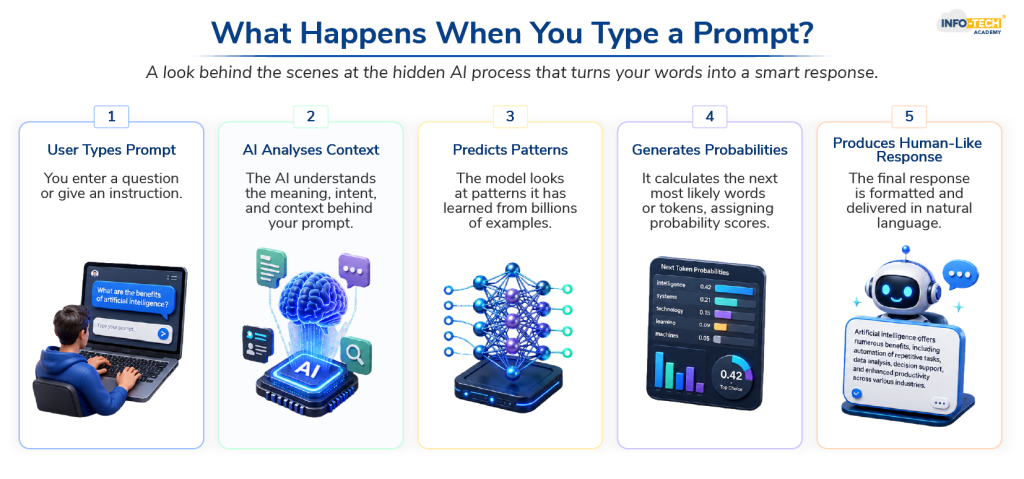
To truly understand why it matters, you first need to understand what is happening behind the screen every time you type a prompt and receive a surprisingly human response.
What Exactly Is Gen AI?
Gen AI, short for Generative Artificial Intelligence, refers to AI systems that can create new content instead of simply analysing existing information.
That distinction is important.
Older AI systems were mainly designed to recognise patterns or make predictions. For example, an AI system might detect fraud in banking transactions or recommend products based on customer behaviour.
This goes a step further.
Instead of only analysing data, it generates something new from what it has learned.
The reason this feels revolutionary is because content creation was traditionally considered a deeply human capability.
Machines could calculate. Humans could create.
It disrupted that assumption.
Today, someone with no design background can generate marketing visuals in minutes. A business executive can draft a presentation outline instantly. A student can simplify difficult concepts using conversational AI explanations.
This is why Gen AI has moved beyond being just a technology discussion. It is now influencing how people work, learn, communicate, and think.
Why Does Gen AI Feel So Different From Previous Technology?
Most technologies improve efficiency in visible ways.
Gen AI feels different because it interacts through language — the most natural human interface.
You do not need to learn coding to use it. You simply talk to it.
That simplicity hides an enormous amount of complexity underneath.
For many people, the first interaction with Generative AI feels almost unsettling because the responses appear intelligent, conversational, and context-aware. It can explain difficult concepts, mimic writing styles, generate creative ideas, and respond with surprising fluency.
But this is also where misconceptions begin.
Gen AI does not “think” like humans.
It does not possess emotions, self-awareness, beliefs, or consciousness. What it does exceptionally well is recognise patterns across massive amounts of information and predict what kind of response is likely to make sense based on the prompt it receives.
In other words, it sounds intelligent because it has learned from extraordinary amounts of human-generated content.
That distinction matters more than most people realise.
How Does Gen AI Actually Work?
At its core, Generative AI works through pattern learning.
Imagine someone who has spent decades reading books, articles, research papers, conversations, websites, and historical documents from across the world. Over time, that person would naturally begin recognising language structures, storytelling patterns, tone, logic, and relationships between ideas.
AI models operate similarly — except on a scale humans cannot realistically achieve.
These systems are trained using enormous datasets that may include billions or even trillions of words, images, code examples, and information patterns.
During training, the AI analyses relationships between pieces of data.
For example:
- Which words commonly appear together,
- How questions are usually answered,
- How stories are structured,
- How programming syntax works,
- Or how humans explain concepts conversationally.
Over time, the system becomes extremely skilled at predicting what should come next.
That prediction ability is the foundation of modern AI.
When you type a prompt into ChatGPT or another AI tool, the model rapidly calculates probabilities to determine which sequence of words is most likely to form a coherent and relevant response.
The speed of this process makes it feel almost magical.
But underneath the experience is an enormous mathematical prediction engine.
What Role Does Machine Learning Play in Gen AI?
Machine learning is the foundation that makes Gen AI possible.
Traditional software relies on fixed instructions written by programmers. Every rule must be manually defined.
Machine learning works differently.
Instead of explicitly programming every response, developers train systems using large amounts of data so the AI can identify patterns independently.
A simple example helps explain this.
Imagine teaching a child what a cat looks like. You could describe every possible detail manually — ears, whiskers, fur, eyes, tail shape — but that would be inefficient.
Instead, you would probably show thousands of cat images until the child naturally recognises the pattern.
Machine learning works similarly.
The AI learns through exposure to examples rather than fixed rules.
This allows Gen AI systems to become flexible, adaptive, and capable of handling complex language interactions that would be impossible to manually program line by line.
What Makes Prompts So Powerful?
One of the most fascinating things about Generative AI is that the quality of the output often depends heavily on the quality of the prompt.
A vague instruction usually produces vague results.
A detailed instruction produces significantly better responses.
For example:
A prompt like:
“Write about marketing.”
gives the AI very little direction.
But a prompt such as:
“Explain how Gen AI is changing digital marketing strategies for SMEs in Singapore in 2026 using real-world examples.”
provides context, audience, purpose, tone, and scope.
This is why prompt engineering has become such a valuable skill.
People are beginning to realise that effectively communicating with AI is becoming a form of digital literacy.
The future workplace may increasingly reward people who know how to guide AI systems intelligently rather than simply use them casually.
How Is Gen AI Being Used in Singapore Today?
Singapore has positioned itself as one of Southeast Asia’s most digitally forward economies, so it is not surprising that Gen AI adoption is accelerating across industries.
But what makes Singapore interesting is not just the speed of adoption — it is the practical focus behind it.
Most organisations are not chasing AI because it sounds trendy. They are exploring it because labour efficiency, productivity, and digital competitiveness matter in a highly developed economy with limited manpower resources.
What Are the Biggest Risks and Limitations of Gen AI?
Despite the excitement, Gen AI is far from perfect.
One of the biggest misconceptions today is assuming AI-generated outputs are automatically accurate.
They are not.
AI systems can:
- Generate false information,
- Reflect bias,
- Misinterpret context,
- Fabricate sources,
- Produce misleading responses confidently.
This creates major concerns in industries where accuracy matters deeply.
Privacy is another growing issue.
As more people use public AI tools for workplace tasks, organisations must think carefully about confidential information, internal documents, and sensitive customer data.
Singapore’s emphasis on responsible AI governance reflects growing awareness that AI adoption cannot happen without strong ethical and regulatory frameworks.
Will Gen AI Replace Human Jobs?
This question dominates almost every AI discussion today.
The reality is more nuanced than sensational headlines suggest.
Some repetitive tasks will almost certainly become automated.
But history shows that major technological shifts often reshape jobs more than eliminate work entirely.
The more likely scenario is that many roles evolve.
Workers who understand how to collaborate with AI tools may become significantly more productive than those who avoid them entirely.
Human strengths such as:
- Emotional intelligence,
- Judgement,
- Creativity,
- Relationship-building,
- Ethical reasoning,
- And strategic thinking
remain extremely difficult to replicate fully.
The future workplace may increasingly value people who can combine human thinking with AI-assisted efficiency.
Conclusion:
Gen AI is no longer a distant technology trend discussed only by tech companies.
It is rapidly becoming part of everyday work, education, communication, and decision-making.
What makes this moment particularly significant is that society is still in the early stages of understanding how deeply this technology may reshape modern life.
Some people will overhype AI. Others will underestimate it entirely.
But somewhere between fear and hype lies the more practical reality:
Gen AI is becoming a powerful tool — and people who understand how to use it thoughtfully will likely gain a major advantage in the years ahead.
For professionals, students, business owners, and organisations in Singapore, learning how Gen AI works is increasingly less about curiosity and more about future readiness.
If you want to build practical skills in this area, exploring courses related to Gen AI tools, AI fundamentals, Machine Learning, Data Science, and Digital Skills can help you better understand how these technologies are being applied across real-world industries today.
Gen AI Frequently Asked Questions
What is Gen AI in simple terms?
Gen AI refers to Artificial Intelligence systems that can create new content such as text, images, videos, music, or code based on patterns learned from large datasets
How does Gen AI work?
Gen AI works by analysing enormous amounts of training data and predicting patterns to generate human-like responses, content, or outputs.
What is the difference between AI and Gen AI?
Traditional AI mainly analyses data or automates tasks, while Gen AI creates entirely new content such as writing, visuals, audio, and code.
Is Gen AI already used in Singapore?
Yes. Gen AI is increasingly used across Singapore in education, finance, HR, healthcare, marketing, customer service, and business productivity workflows.

I’ve always been drawn to the power of writing! As a content writer, I love the challenge of finding the right words to capture the essence of HR, payroll, and accounting software. I enjoy breaking down complex concepts, making technical information easy to understand, and helping businesses see the real impact of the right tools.