



In this article
- 1. What is OpenAI?
- 2. When Did OpenAI Start?
- 3. Why Was OpenAI Created?
- 4. How Did OpenAI Become Popular?
- 5. What Are The Main Products of OpenAI?
- 6. How Does OpenAI Work?
- 7. Why Is OpenAI Important?
- 8. How Does OpenAI Help Businesses?
- 9. What Are The Benefits Of OpenAI?
- 10. What Are The Risks Of OpenAI?
- 11. Is OpenAI Useful For The Future?
- 12. Why Should You Learn About OpenAI Now?
- 13. OpenAI FAQs
What is OpenAI?
OpenAI is a company that works with building of advanced AI tools that can aid faster work by decoding text, writing codes, generating images, and understanding speech. It is widely known because of ChatGPT. But it has much more than just chatbots.
The ultimate goal of OpenAI is to develop useful and safe artificial intelligence for people. Their focus for long-term is artificial general intelligence (AGI), which is capable of performing highly complex tasks that is even beyond the capabilities of human beings.
Read also: What Is An AI Chatbot?
When Did OpenAI Start?
OpenAI was founded in December 2015 by people from tech and research sectors. They were Sam Altman, Greg Brockman, Ilya Sutskever, John Schulman, Wojciech Zaremba, and some more individuals. Though Elon Musk was also a part of the early group, he left the company later.
OpenAI just started off as a nonprofit research lab back then, with no idea of building a popular product. They only had one question in mind that drove their invention: ‘What will happen if AI becomes more powerful?’ They did not want AI to be used in any harmful ways, so it was handled with utmost safety and care.
Why Was OpenAI Created?
Back when OpenAI first started, AI was already becoming a huge topic in the tech world. People could very well notice that it was improving fast, and naturally, there were mixed reactions. Some were excited about what it could do. Others were just being more cautious.
The people involved behind OpenAI were thinking beyond just building smarter software. They were also thinking about what would happen if powerful AI tools were used carelessly or controlled by only a few groups in power. That concern was a major reason behind why OpenAI was created in the first place.
From the beginning, the company kept talking about building AI responsibly. Not in a dramatic “robots taking over” way, but more in a practical sense. Things like misinformation, unfair results, fake content, and misuse were already being the hot topic of discussion.
At the end of the day, their idea was pretty straightforward. AI should help people do things better, not create more problems than it solves.
Read also: How is AI different from Generative AI
How Did OpenAI Become Popular?
For most people, OpenAI suddenly appeared out of nowhere when ChatGPT became popular in 2022.
Before that, the company was mostly known only inside tech circles. Researchers, developers, and people working in AI had heard of it, but a common man probably had not.
Then ChatGPT showed up, and people got curious about it soon.
At first, many used it just to test it out by asking random questions, trying funny prompts, seeing if it could actually answer properly. But after a while, people realised it could really save their time on everyday things too.
Students started using it to study before exams. Office workers used it to draft emails. Writers used it when they got stuck with writer’s block. Businesses started experimenting with it for customer support, content ideas, reports, and basic admin work.
That is probably why it spread so quickly. It did not feel complicated. There was no need of technical knowledge to try it. You just typed something and got a reply instantly.
What Are The Main Products of OpenAI?
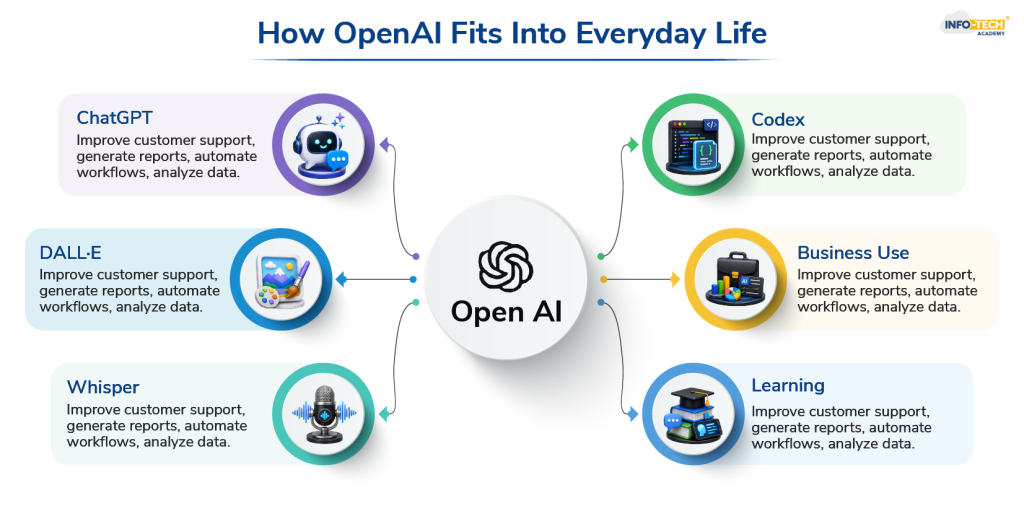
OpenAI has released quite a few tools over the years, though ChatGPT is obviously the one most people know.
| OpenAI tool | What people generally use it for |
| ChatGPT | Writing, ideas, summaries, emails, answering questions |
| DALL·E | Creating images from written prompts |
| Whisper | Turning spoken words into text |
| Codex | Helping with coding tasks |
| OpenAI API | Adding AI into apps and websites |
| Sora | Creating videos from text prompts |
DALL·E became popular with designers and content creators because it could generate images just from descriptions. Whisper is more useful for things like subtitles, transcription, and speech recognition.
And honestly, these tools keep changing constantly. OpenAI updates its models so often that what feels advanced today may look basic a year later.
Read also: What is Copilot and What are its Uses
How Does OpenAI Work?
To put it simply: OpenAI trains AI systems using huge amounts of data collections.
The models learn patterns from sources such as text, images, speech, code. Over time, they get better at predicting what kind of response makes sense when someone gives a prompt and instructs for a particular kind of response.
So when someone asks ChatGPT to write an email or explain a topic, it is not “thinking” like a person. It is responding based on patterns it has already learned during its training using available data collections.
That is why it can sometimes sound surprisingly natural.
But AI still gets things wrong. It can misunderstand questions, mix up facts or give answers that sound confident even when they are not fully accurate. That is why people still need to double-check important information instead of blindly trusting every response immediately.
OpenAI keeps improving its systems through updates, testing, and user feedback, but no AI tool is perfect yet.
Read also: How AI Detectors Work: Limitations & Methods
Why Is OpenAI Important?
One reason OpenAI matters so much is because it made AI feel normal for everyday people.
A few years ago, artificial intelligence felt distant. It sounded like something only researchers or giant tech companies talked about. Now people use it for work, study, content writing, coding help, planning, and even small daily tasks.
Students use it to revise topics quickly. Office workers use it for rough drafts and summaries. Teachers use it for lesson ideas. Small businesses use it for marketing content or customer replies.
That shift happened surprisingly fast.
OpenAI also pushed more conversations around topics people were not discussing much before; things like AI ethics, privacy, copyright, jobs, and misinformation. Whether someone likes AI or not, it is already becoming part of normal work life.
Read also: Master Essential AI Skills Today to Lead Tomorrow
How Does OpenAI Help Businesses?
For businesses, the biggest attraction is usually speed.
A lot of routine work takes time. Answering customer questions, writing reports, preparing first drafts, summarising meetings, organizing information — these are things AI can help with.
Small businesses find it very useful because they usually do not have huge teams handling tasks. AI can help them in managing simple work faster and without the need for extra people in everything.
Larger companies often use OpenAI tools in a more technical manner. Some integrate AI directly into internal systems or customer platforms through APIs so employees can use it during daily work.
Still, most companies fully understand that AI should not completely replace human decisions. It works better as support rather than a full replacement for a particular work.
Read also: Choose AI Course to Gain Practical Training for Modern Workplace
What Are The Benefits Of OpenAI?
The biggest benefit is probably the amount of time it can save.
Sometimes the hardest part of any task is simply starting the work. Writing an email, planning content, summarizing notes, or organizing ideas can take longer than expected. AI helps people get moving faster that way.
It is also useful for brainstorming. Even if the first answer is not perfect or satisfying enough, it can still give people a proper direction to begin their work from.
Accessibility is another area where AI helps. Speech-to-text tools, transcription support, subtitles, and language assistance can make things much easier for many users with different needs.
For businesses, AI can reduce repetitive work and free up time for tasks that will need more human attention.
Read also: Why Learning Artificial Intelligence Matters
What Are The Risks Of OpenAI?
Though AI tools are largely useful, there are still plenty of concerns around their usage and dependency.
Accuracy is one of the foremost issues. AI can confidently give wrong information, and that becomes risky when people stop checking answers carefully.
Bias is another problem. Since AI learns only from information that exists online, it can sometimes repeat unfair or outdated views without understanding the context completely.
There is also misuse. AI can be used to create fake content, spam, scams, misleading images, and misinformation. That is why discussions around AI safety have become much more important recently.
Privacy matters too. People should start thinking carefully before providing anything sensitive or personal to the AI system.
Is OpenAI Useful For The Future?
It most likely will be. AI is slowly becoming part of normal work life in the same way search engines, email, and office software have become normal over time. Though it may not replace every job, it will probably change how many jobs are carried out now.
The technology will also keep improving over time. AI tools will likely become better at handling repetitive tasks, organizing information, helping with research, and supporting businesses.
But AI still works best when people guide it properly. Human judgment still matters for its functioning.
Read also: Top 3 AI Productivity Tools for Every Professional To Use Today
Why Should You Learn About OpenAI Now?
AI is already becoming part of everyday work now.
You do not need to become a programmer to understand it either. Even basic knowledge of tools like ChatGPT can help in work areas like marketing, admin work, customer support, writing, HR, education, and business operations.
That is why many people are starting to learn AI skills now instead of waiting until it becomes unavoidable at work. An AI course that is WSQ approved can also help people move beyond just experimenting with prompts and actually understand how to use these tools properly in real situations.
Read also: How to Improve Productivity at Work Using ChatGPT
OpenAI FAQs
Is it safe to use OpenAI?
Yes, OpenAI is generally safe to use, but users should still verify important information and avoid sharing sensitive personal or business data.
Why did Elon Musk quit OpenAI?
Elon Musk left OpenAI in 2018 mainly because of disagreements over the company’s direction and a possible conflict with Tesla’s own AI development work.
Is OpenAI free or paid?
OpenAI offers both free and paid plans. Basic tools like ChatGPT are available for free, while advanced features and newer models require a paid subscription.
How to tell if someone is using ChatGPT to text you?
It can be hard to tell for sure, but some signs include overly polished replies, very fast responses, generic wording, perfect grammar all the time, or messages that sound helpful but slightly unnatural or emotionless. Still, none of these prove someone is using ChatGPT because many people naturally text that way too.

Transforming thoughts and concepts into clear, compelling words is a powerful tool that connects people. While writing boosts my creativity, reading broadens my perspective and sharpens my understanding of language and narration.