


In this article
- 1. When Did AI Stop Being a “Tech Industry Thing”?
- 2. Why Are Employers Suddenly Looking for AI Skills?
- 3. Is AI Really Affecting Every Industry?
- 4. Why Are Governments Investing So Heavily in AI Skills?
- 5. What Happens If Professionals Ignore AI?
- 6. Why Is Taking an AI Course Becoming a Practical Career Investment?
- 7. The Real Question Isn’t Whether AI Will Affect Your Career
- 8. Frequently Asked Questions
A decade ago, knowing how to use Excel well could quietly set you apart at work.
Before that, simply being comfortable with email and digital documents gave some employees an advantage over others. The people who adapted early often found themselves moving faster, solving problems more efficiently, and becoming the colleagues everyone relied on.
Today, a similar shift is happening again.
The difference is that this time, the technology isn’t another piece of software. It’s Artificial Intelligence.
And unlike many workplace trends that come and go, AI is already changing how people write reports, analyse data, answer customer enquiries, create presentations, manage projects, and make business decisions.
What’s particularly interesting is that AI is no longer confined to software developers or data scientists. A marketing executive uses it to brainstorm campaign ideas. An HR professional uses it to draft job descriptions. A finance manager uses it to summarise reports. A teacher uses it to create lesson plans.
The technology may be the same, but the applications look different in every profession.
That is exactly why AI skills are becoming less of a specialist advantage and more of a workplace necessity.
When Did AI Stop Being a “Tech Industry Thing”?
For years, Artificial Intelligence felt distant.
Most people heard about it through news stories discussing self-driving cars, robotics, or futuristic innovations coming out of Silicon Valley. It was fascinating, but it didn’t feel relevant to the average office worker.
Then something changed.
Generative AI tools arrived.
Suddenly, AI wasn’t hidden behind complicated systems. It was sitting directly in front of people on their laptops and phones. Anyone could type a question, request a summary, generate content, analyse information, or brainstorm ideas within seconds.
For many professionals, this was the first time AI felt personal.
The technology became something they could use themselves rather than something being built by someone else.
That moment accelerated adoption in a way few experts predicted.
Across Singapore and around the world, businesses that were previously experimenting cautiously with AI began actively exploring how it could improve productivity and efficiency.
The conversation shifted from “What is AI?” to “How can we use it?”
Why Are Employers Suddenly Looking for AI Skills?
Most employers are not hiring people because they know AI.
They are hiring people because of what AI allows them to accomplish.
Imagine two employees with similar qualifications and experience.
One spends three hours creating a first draft of a report.
The other spends thirty minutes using AI to organise ideas, generate a structure, identify missing information, and refine the final document.
The difference isn’t intelligence.
The difference is leverage.
Businesses have always valued people who can achieve more with the resources available to them. AI simply happens to be one of the most powerful productivity tools introduced in recent years.
This explains why job descriptions increasingly mention AI familiarity, prompt-writing skills, automation tools, and digital transformation experience.
Employers recognise that the future workforce will not be divided between people who use AI and people who don’t.
It will be divided between people who know how to use AI effectively and people who struggle to adapt.
Is AI Really Affecting Every Industry?
The short answer is yes.
The longer answer is even more interesting.
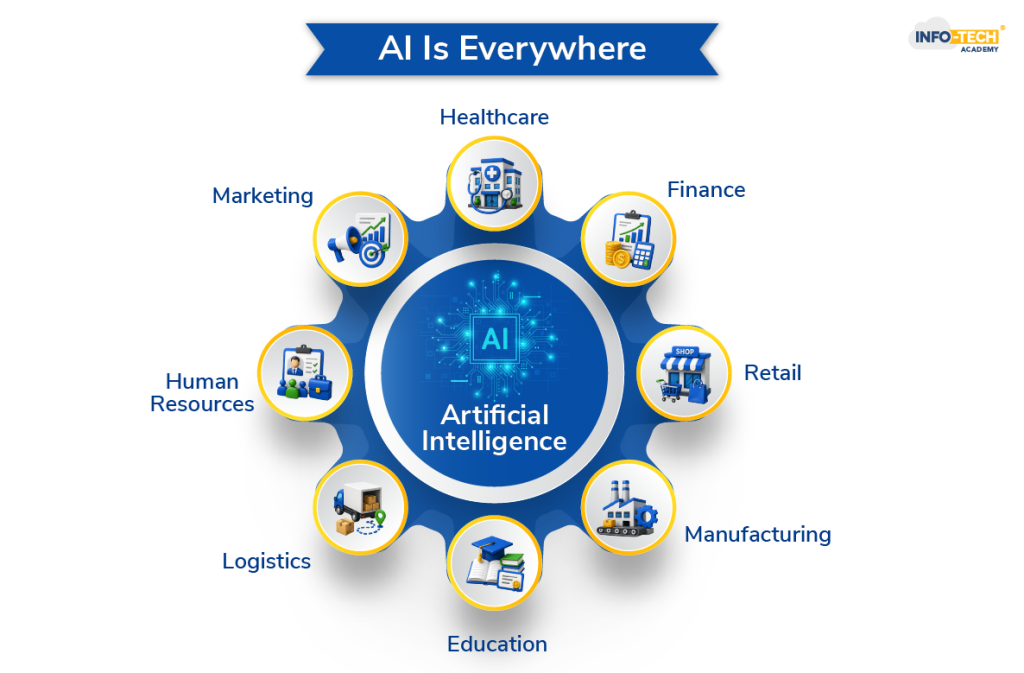
Take healthcare.
Most people imagine AI helping doctors diagnose illnesses. That certainly happens. But hospitals are also using AI to manage appointments, streamline administrative processes, reduce paperwork, and improve operational efficiency.
In finance, AI is helping institutions detect unusual transactions, assess risk, and analyse market behaviour. Yet many finance professionals now use AI for something far simpler: summarising lengthy reports and extracting key insights.
Retailers use AI to predict what customers might buy next.
Manufacturers use it to identify equipment issues before costly breakdowns occur.
Educational institutions use it to personalise learning experiences.
Human resource teams use it to screen applications, draft policies, and improve employee communications.
What makes AI different from many previous technologies is its versatility.
Most workplace tools solve one specific problem.
AI can support hundreds of different tasks across entirely different industries.
That flexibility is one reason adoption has been so rapid.
Why Are Governments Investing So Heavily in AI Skills?
If you look at workforce development policies around the world, a clear pattern emerges.
Governments are no longer treating AI as a niche technology issue.
They are treating it as an economic issue.
Singapore’s National AI Strategy 2.0 is a good example. Rather than focusing only on research and innovation, the strategy places significant emphasis on workforce readiness, skills development, and industry adoption.
The reason is straightforward.
Countries understand that future competitiveness will depend not only on how much AI technology they create but also on how effectively their workforce can use it.
A nation with advanced AI tools but an unprepared workforce gains little advantage.
A nation where workers understand how to apply AI productively across industries is far more likely to benefit economically.
This is why AI training, digital upskilling initiatives, and workforce transformation programmes continue to receive significant support.
What Happens If Professionals Ignore AI?
This is perhaps the most important question.
Historically, technological shifts rarely eliminate opportunities altogether.
Instead, they redistribute them.
When computers became common, people who learned essential office skills gained an advantage.
When the internet transformed business, those who embraced online tools often progressed faster.
The same pattern is emerging with AI.
Professionals who understand how to work alongside AI are increasingly able to produce better outcomes in less time.
They can focus more energy on strategic thinking, creativity, relationship-building, and problem-solving because routine tasks require less manual effort.
Those who ignore AI may not lose their jobs overnight.
But they may gradually find themselves operating at a disadvantage compared to colleagues who have learned how to combine human expertise with AI-powered support.
Why Is Taking an AI Course Becoming a Practical Career Investment?
Many professionals assume an AI Course is only relevant for programmers.
In reality, some of the fastest-growing AI learners today are business professionals, managers, marketers, HR practitioners, educators, and administrators.
They are not learning AI to build algorithms.
They are learning AI to become better at their existing jobs.
A good AI Course helps people understand where AI creates value, where its limitations exist, and how to use it responsibly within real workplace situations.
More importantly, it shortens the learning curve.
Instead of spending months trying to piece together information from scattered online resources, professionals gain structured guidance and practical examples they can apply immediately.
In many ways, learning AI today resembles learning Microsoft Office twenty years ago.
At first, it feels optional.
Eventually, it becomes expected.
The Real Question Isn’t Whether AI Will Affect Your Career
For most people, AI is no longer a future discussion.
It is already present in the software they use, the platforms they interact with, and the workplaces they operate in every day.
The real question is not whether AI will influence your career.
The real question is whether you will be ready when AI becomes as normal as email, spreadsheets, and video meetings.
History suggests that every major workplace transformation rewards those who adapt early.
Artificial Intelligence appears to be no different.
And that is why AI skills are rapidly becoming essential in virtually every industry—not because technology is replacing people, but because people who understand technology are increasingly outperforming those who don’t.
Frequently Asked Questions
What is AI literacy?
AI literacy refers to the ability to understand, use, evaluate, and work effectively with Artificial Intelligence tools and technologies in everyday professional environments.
Do I need a technical background to take an AI Course?
No. Many AI Course programmes are designed specifically for beginners, working professionals, managers, and business users without programming experience.
Which industries require AI skills the most?
Healthcare, finance, education, manufacturing, logistics, retail, marketing, human resources, and customer service are among the industries experiencing significant AI adoption.
Will AI replace jobs completely?
Most experts believe AI will transform jobs rather than replace all workers. Employees who learn to work alongside AI are likely to remain valuable and adaptable.

I’ve always been drawn to the power of writing! As a content writer, I love the challenge of finding the right words to capture the essence of HR, payroll, and accounting software. I enjoy breaking down complex concepts, making technical information easy to understand, and helping businesses see the real impact of the right tools.