


In this article
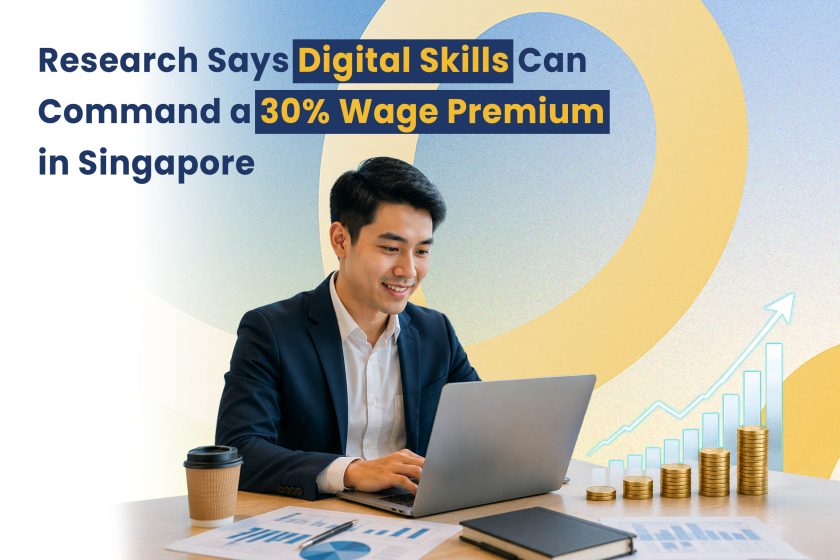
Digital skills are no longer just an advantage for people working in technology. In Singapore, they are increasingly influencing how much employers are willing to pay more, even when comparing similar jobs within the same company.
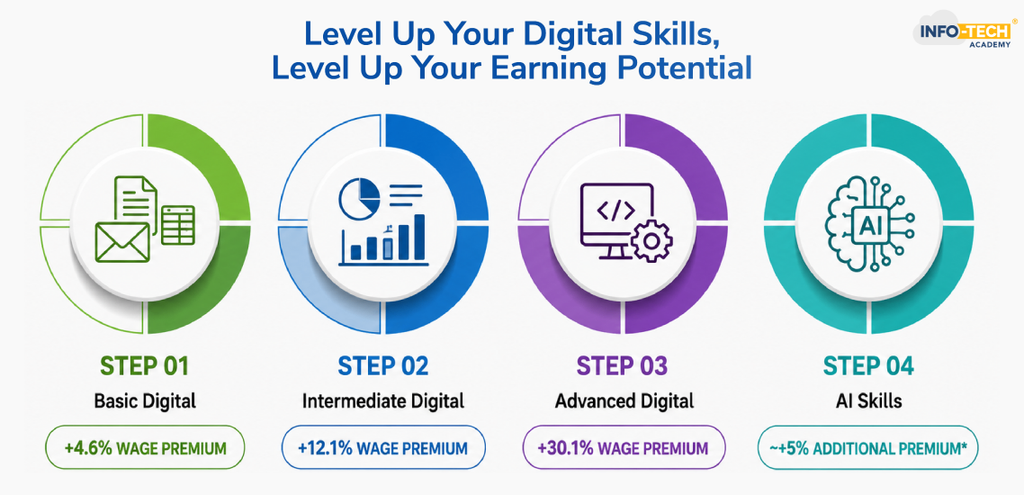
Based on a research from the Asian Development Bank (ADB) and Indeed Hiring Lab, it was found that jobs requiring advanced digital skills in Singapore carried a 30.1% wage premium. Intermediate digital skills were associated with a 12.1% premium, while even basic digital capabilities were linked to a 4.6% premium.
For employees and jobseekers, the message is pretty clear: developing stronger digital capabilities may affect not only the jobs you qualify for, but also your earning potential.
How Can Advanced Digital Skill Pay Higher?
The research analysed around six million job postings across Singapore, Australia, India, Malaysia, the Philippines and the Republic of Korea between 2019 and 2024. Importantly, researchers compared vacancies within the same job titles and firms. This helps distinguish the value employers place on digital capabilities from the higher salaries that might simply come from working in a technology occupation.
In Singapore, the difference was substantial:
| Digital skill level | Singapore wage premium |
| Basic | 4.6% |
| Intermediate | 12.1% |
| Advanced | 30.1% |
The biggest financial gains therefore appear as workers progress beyond everyday digital literacy towards more specialised capabilities. But what does moving up these levels actually involve?
Basic digital skills
These include everyday workplace capabilities such as using email, office applications and spreadsheets. They have become fundamental requirements across many occupations, including administration, customer service, sales, education and healthcare.
Intermediate digital skills
At this level, employees move from simply using everyday software towards using technology to manage information, customers and business processes.
Examples include:
- Data analysis
- CRM systems
- Dashboards and reporting tools
- Digital content management
- More sophisticated workplace software
These capabilities can be particularly valuable for professionals working in administrative, sales, service and operational roles.
Advanced digital skills
Advanced capabilities include areas such as programming, artificial intelligence, machine learning and IT systems management. These skills require considerably greater technical proficiency, and the Singapore wage data suggests employers are prepared to pay substantially more for them.
Read also: Digital Skills That Instantly Make You More Employable
Are AI Skills Moving Beyond Technology Jobs?
There is another important shift taking place. AI is becoming a workplace skill rather than something relevant only to AI developers. Following the public release of ChatGPT in November 2022, the ADB research found that demand for workers capable of using AI tools increased rapidly.
Across the six economies studied, the proportion of intermediate digital-skill jobs requiring AI-use capabilities more than doubled, reaching almost 2% by the end of 2024. Among jobs requiring advanced digital skills, the figure reached nearly 11%.
Singapore was among the economies with the highest levels of AI-related skill demand. And that demand is appearing well beyond traditional technology occupations. AI-related requirements are increasingly found in areas including:
- Banking and finance
- Insurance
- Legal services
- Industrial and mechanical engineering
- Social sciences
- Arts and entertainment
This distinction matters. You may not need to become an AI engineer to benefit from the growth of AI. Increasingly, employers need people who can apply AI effectively within their existing profession.
A finance professional might use AI to analyse information. A marketer might incorporate generative AI into content workflows. An operations employee might use AI alongside data and automation tools to improve processes.
The valuable skill is not simply knowing that AI exists. It is knowing how to use it productively and responsibly in your work. Know all about applying your AI skills by learning from the top AI training provider in Singapore. Info-Tech Academy provides WSQ-approved courses with upto 70% subsidy. Enroll today!
Read also: Learning Digital Skills in 2026: Why Upskilling Is Essential
How AI Skills Are Carrying Their Own Wage Advantage?
The research also found evidence of an additional premium associated specifically with AI. Across the countries studied, jobs explicitly requiring workers to use AI tools offered approximately 5% higher wages, even after accounting for other digital requirements. That suggests a potentially important development in the labour market.
Digital literacy is becoming a baseline. More advanced digital skills can differentiate workers. And the ability to apply AI may become another layer of differentiation on top of those capabilities.
For workers deciding what to learn next, this changes the question from: “Do I need digital skills?” to: “Which level of digital skills will make me more valuable in my role?”
Read also: Digital Skills Course in Singapore For Smart Nation Era
What Should Singapore Workers Learn?
The findings do not mean everyone should immediately learn advanced programming or machine learning. A better approach is to build capabilities progressively and according to your career.
If your digital experience is limited, strengthening digital office skills such as spreadsheets, workplace productivity applications and digital collaboration tools is a useful starting point. If you already have those foundations, consider skills that help you work with business information and processes — for example, data analytics, dashboards, CRM platforms and digital content tools.
For people pursuing technical careers, more advanced capabilities such as programming, cloud technologies, AI, machine learning and systems management may open the door to roles where digital expertise attracts significantly higher pay.
And across all three levels, learning how to work effectively with generative AI is becoming increasingly relevant. The goal should not be to collect as many technology skills as possible. It should be to develop digital capabilities that complement your profession and help you solve real workplace problems.
Read also: Why Artificial Intelligence Skills Are Essential in Every Industry
Why Digital Upskilling Is Becoming Career Upskilling?
Perhaps the most important takeaway from the research is that the digital skills conversation is no longer confined to the IT department. Technology is becoming embedded in ordinary jobs.
Administrative employees use digital platforms to manage workflows. Sales teams work with CRM and analytics systems. Finance professionals increasingly interact with data and AI tools. Marketers operate across digital platforms. Managers use dashboards to make decisions.
As this happens, the boundary between “digital jobs” and other jobs becomes less meaningful. Instead, digital proficiency is becoming part of what makes someone effective in almost any modern occupation.
For Singapore workers, that makes continuous digital upskilling more than a way to keep up with technological change. With advanced digital capabilities associated with a 30.1% wage premium, it can increasingly be viewed as an investment in long-term employability, career progression and earning potential.
Source: Asian Development Bank and Indeed Hiring Lab research based on approximately six million online job postings across Australia, India, Malaysia, the Philippines, Singapore and the Republic of Korea, 2019–2024.
Digital Skills FAQs
What are the 5 basic digital skills?
The five basic digital skills are email communication, word processing, spreadsheets, presentations, and internet & file management.
What are digital skills?
Digital skills are the ability to use digital tools, technologies, and software effectively to communicate, manage information, solve problems, and perform everyday work tasks.
How do I learn a digital skill?
You can learn a digital skill by choosing a skill relevant to your goals, taking a course or tutorial, practising it through real tasks, and applying it regularly.
What is the highest paid digital skill?
In Singapore, some of the highest-paid digital skills include artificial intelligence (AI), machine learning, cybersecurity, cloud computing, data science, and advanced software development.

Transforming thoughts and concepts into clear, compelling words is a powerful tool that connects people. While writing boosts my creativity, reading broadens my perspective and sharpens my understanding of language and narration.