


In this article
- 1. What Are Interpersonal Skills?
- 2. Why Do Interpersonal Skills Matter in Singapore’s Workplace?
- 3. What Are the Different Types of Interpersonal Skills?
- 4. How Can You Improve Your Interpersonal Skills?
- 5. How Do You Show Interpersonal Skills on a Resume or in an Interview?
- 6. Which Interpersonal Skill Should You Focus on First?
- 7. Interpersonal Skills FAQs
Your resume gets you the interview, but it’s rarely what keeps you in the room, gets you promoted, or makes people want to work with you again. That comes down to how you communicate, listen, and handle the everyday friction of working with others, which are basically your interpersonal skills.
Here’s a simple, practical breakdown of what they are, why they matter – especially in a market like Singapore’s, and how you can actually get better at them.
What Are Interpersonal Skills?
Interpersonal skills are the abilities used to interact, communicate, and build relationships with colleagues, relatives, or random people at work, at home, or anywhere in between. They’re often called “people skills” or “soft skills” because, unlike technical know-how, they’re less about what you know and more about how you show it and work with others.
They show up in small, everyday moments in things such as how you handle a disagreement with a colleague, how clearly you explain an idea, and how you respond when someone gives you feedback you didn’t expect.
Also read: Soft Skills Explained: Definition, Examples, and Importance
Why Do Interpersonal Skills Matter in Singapore’s Workplace?
Singapore’s economy relies heavily on the services, finance, and trade sectors, where client relationships and teamwork matter as much as technical expertise. Added to that, a genuinely multicultural workforce, with colleagues, clients, and managers from very different cultural backgrounds, and communication style becomes something you have to actively manage rather than take for granted.
This is also why Skills & Workforce Development Agency (SWDA) Skills Framework lists communication, collaboration, and interpersonal effectiveness as core “Generic Skills and Competencies”, which roughly represent the skills every worker, regardless of industry, is expected to build alongside their technical training. It reflects a broader global shift, too: workplace skills surveys have repeatedly flagged people-management skills such as active listening and empathy as among the most in-demand core skills over the next few years.
Practically, this means that:
- Employers increasingly interview and assess soft skills, not just qualifications
- Cross-cultural communication is a daily requirement, not just something nice-to-have
- As AI takes over more routine and technical tasks, human skills like judgment, empathy, and persuasion become the major differentiator
What Are the Different Types of Interpersonal Skills?
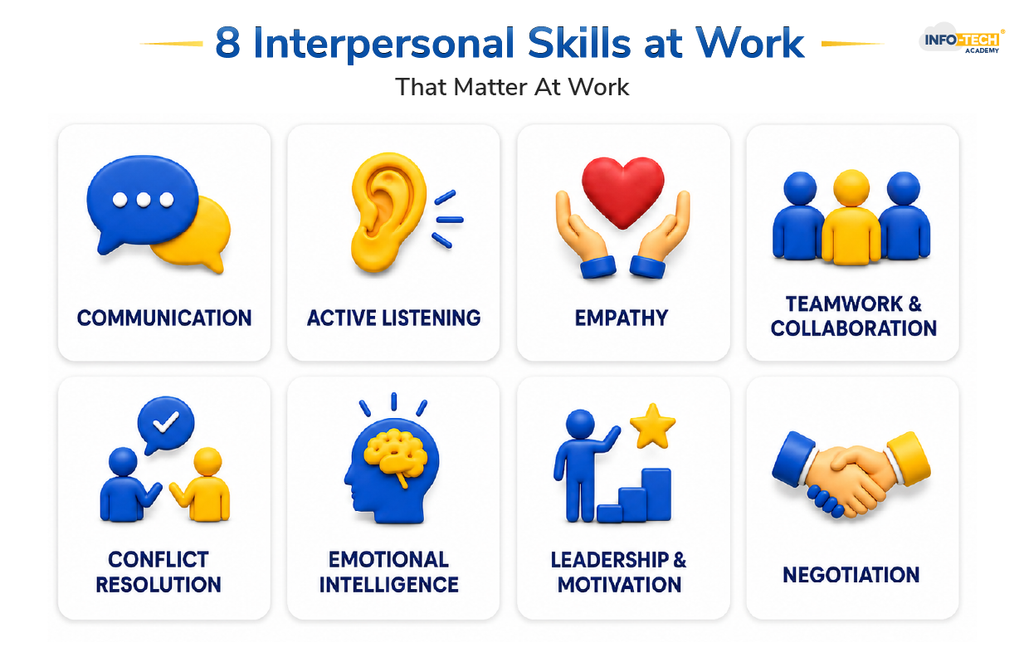
There isn’t one master list of them, but most fall into a handful of recognizable categories:
| Skill | What it looks like in practice |
| Communication | Explaining ideas clearly, tuning your message for different audiences |
| Active listening | Staying focused on the speaker, asking follow-up questions, not just waiting for your turn to present |
| Empathy | Understanding how a situation looks or feels from someone else’s side before responding to something |
| Teamwork & collaboration | Coordinating with others, following commitments, and adjusting to different working styles |
| Conflict resolution | Addressing disagreements directly and calmly, without letting them turn personal |
| Emotional intelligence | Recognizing your own reactions under pressure and choosing a considered response instead of a reactive one |
| Leadership & motivation | Guiding, encouraging, and bringing out the best in others, with or without a formal title |
| Negotiation | Finding an outcome both sides can accept, without damaging the relationship |
Most people already have several of these in some form. So, the goal isn’t starting from zero, it’s sharpening what’s already there.
How Can You Improve Your Interpersonal Skills?
Interpersonal skills aren’t fixed personality traits, they’re built through practice and feedback, the same way any other skills are. Simple ways to approach it are:
- Get specific feedback: General comments like “you’re a good communicator” don’t tell you what to change. Ask a manager or colleague for one concrete real example of something you could do differently.
- Pick one skill at a time: Trying to fix everything at once rarely clicks. Choose the one that’s causing you the most friction right now and move in the same order.
- Practise the pause: Before responding in a tense or high-pressure moment, take a moment to breathe before reacting. This alone improves both conflict resolution and emotional intelligence.
- Observe how others do it well: Notice how a colleague you admire opens a difficult conversation or keeps a meeting on track and borrow what will work for you.
- Put yourself in real situations: Volunteering to lead a small project, join a client call, or mediate a disagreement builds these skills far faster than simply learning or reading about them.
- Reflect afterwards: After trying something new, notice how it went. If it felt better, keep going. If not, adjust your approach rather than dropping it entirely.
Read also: Top Soft Skills Training in Singapore for Today’s Job Market
How Do You Show Interpersonal Skills on a Resume or in an Interview?
Simply listing “strong communicator” or “team player” on a resume doesn’t prove much, since recruiters see that phrasing all the time. It’s more convincing when it’s backed by a specific example.
The STAR method (Situation, Task, Action, Result) works well here:
- Instead of: “Excellent leadership skills”,
- Try: “Led a cross-functional team of 6 to deliver a client project two weeks ahead of schedule, resolving a resourcing conflict between two departments along the way.”
In interviews, the same principle applies. Talk through a real situation where you had to listen carefully, manage a disagreement, or adapt your communication style, and explain what you did and what came of it.
Which Interpersonal Skill Should You Focus on First?
If you’re not sure where to start, active listening is a reasonable first pick. It’s foundational because better listening naturally improves how you communicate, resolve conflict, and read what others actually need, without requiring you to change several habits altogether.
Interpersonal skills won’t really show up from a certificate alone. They’re often what quietly decides who gets trusted with more responsibility. The good news is that, unlike some talents, these genuinely improve with deliberate practice, so a small, consistent effort here tends to pay off.
To kick off, you can take leadership courses, communication skills course, or other courses that Info-Tech Academy provides.
Interpersonal Skills FAQs
What are examples of interpersonal skills?
Interpersonal skills include communication, active listening, empathy, emotional intelligence, teamwork, conflict resolution, negotiation, leadership, adaptability, dependability, and networking.
What are the 7 interpersonal skills?
The 7 core interpersonal skills are communication, active listening, empathy, emotional intelligence, teamwork, conflict resolution, and leadership.
Should I put interpersonal skills on my resume?
Yes, but show them through specific achievements in your experience bullets rather than just listing them as skills.
How can I know how many interpersonal skills I have?
You can gauge your interpersonal skills by reflecting on your recent interactions and asking others for specific feedback, rather than relying on a single test or score.

Transforming thoughts and concepts into clear, compelling words is a powerful tool that connects people. While writing boosts my creativity, reading broadens my perspective and sharpens my understanding of language and narration.