



In this article
- 1. What Does a Career Change Mean?
- 2. Why Are More Singaporeans Considering a Career Change?
- 3. How Do You Know It May Be Time for a Career Change?
- 4. What Are the Emotional Fears Behind a Career Change?
- 5. What are the Benefits of Career Change Beyond Salary?
- 6. Why Is Career Change Becoming More Normal in Singapore?
- 7. Where do you get a UEN in Singapore?
- 8. How Do Career Conversion Programmes (CCP) Help Mid-Career Workers?
- 9. Which Industries in Singapore Are Seeing Strong Career Transition Demand?
- 10. How Important Is Upskilling During a Career Change?
- 11. What Should You Do If You Have No Idea Where to Start?
- 12. Can You Still Make a Career Change in Your 40s or 50s?
- 13. What Does a Successful Career Change Really Look Like?
- 14. Career Change FAQs
There is a strange kind of tiredness that comes from staying too long in the wrong job. Not the normal kind where you just need sleep or a holiday. This one sits somewhere deeper. You wake up already counting down to Friday. Meetings feel longer than they are. Small tasks annoy you more than they should. Even when work is “stable”, something feels off. A lot of people in Singapore are carrying that feeling quietly.
And honestly, many of them never planned to feel this way. They studied hard, got decent jobs, followed the safe route, stayed loyal to companies, did what they were supposed to do. But somewhere along the line, the work stopped feeling meaningful. Or the industry changed. Or burnout slowly became normal. That is why the idea of a career change has become far more common than it used to be.
Not because people suddenly became reckless, but because people are starting to ask themselves harder questions about the kind of life they actually want.
What Does a Career Change Mean?
Years ago, changing careers sounded dramatic. People imagined someone quitting suddenly, throwing away years of experience, and starting over completely from scratch. But that is not really how most career changes happen anymore.
A person working in customer service may slowly move into HR because they realize they enjoy people management more. Someone in finance might pick up data skills and transition into analytics. A marketing executive may move toward AI-related work because digital tools are becoming part of daily operations anyway.
Sometimes the shift is huge. Sometimes it is more like a gradual turn.
In Singapore especially, career paths have become less straight than before. Industries are moving quickly. Jobs are evolving faster. Even people who once felt secure are beginning to realize they cannot rely only on old experience forever.
So now, a career change is less about “running away” and more about adapting before you are forced to.
Why Are More Singaporeans Considering a Career Change?
A simple answer is: work itself has changed.
A lot of people entered industries that looked stable ten years ago. Then technology changed things. Automation took over part of the work. AI started reshaping tasks. Companies restructured. Expectations increased while job satisfaction dropped. At the same time, employees themselves changed too.
Younger workers are openly talking about mental health, flexibility, toxic workplaces, and burnout. Older workers are also starting to rethink whether constantly sacrificing personal life for work still makes sense.
Sometimes it is not even about hating the job. Some people are simply bored of their redundant tasks. This part surprises many professionals because boredom sounds harmless until it lasts for years. Doing repetitive work for too long can slowly affect confidence, motivation, and even self-worth. People stop feeling challenged. They stop learning. Eventually, they stop seeing a future version of themselves in the role. And once that happens, thoughts about a career change usually start appearing more often.
Read also: How to Strengthen Your Leadership Skills Effectively
How Do You Know It May Be Time for a Career Change?
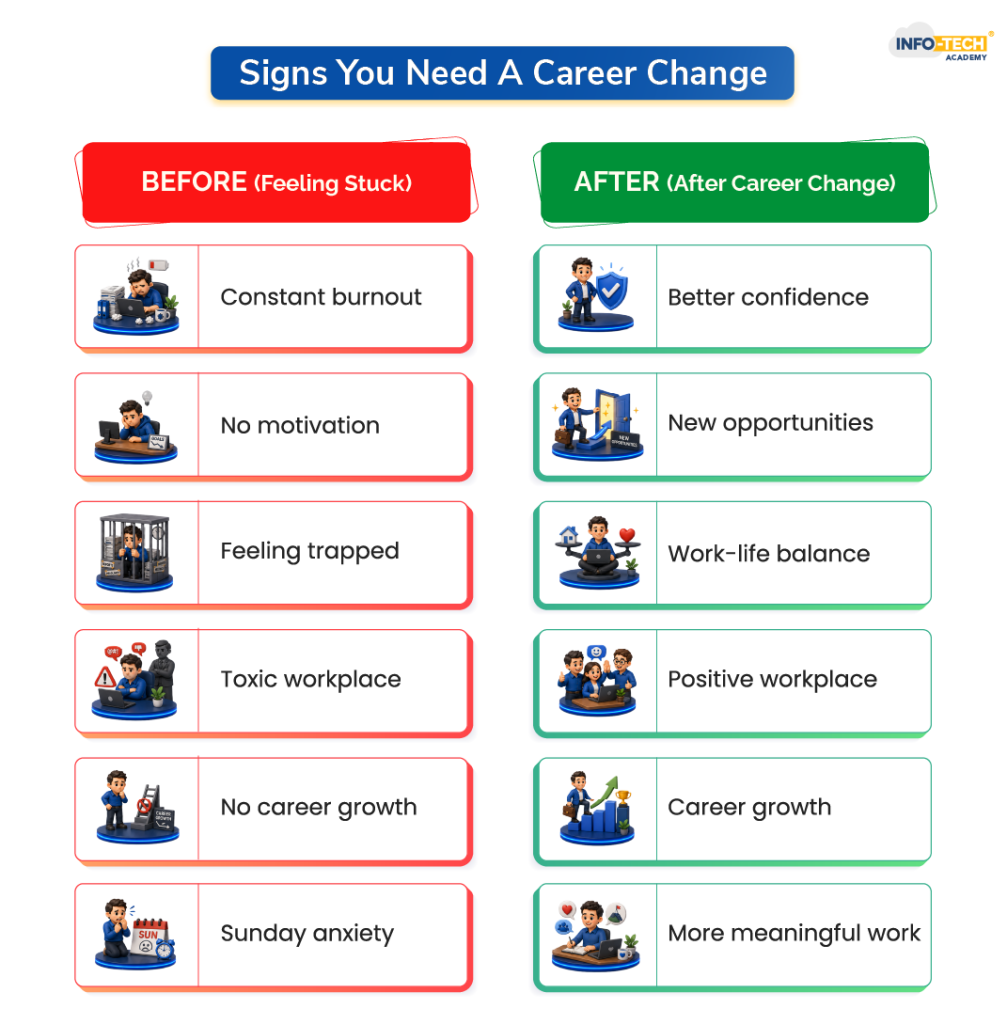
Usually, the signs are not dramatic. Nobody suddenly hears background music and realizes it is time to resign. It tends to happen quietly and gradually.
You may notice you have become emotionally disconnected from work. You are physically present, but mentally checked out. Maybe you no longer care about doing well because the work itself no longer excites you.
Some people become unusually exhausted even though their workload has not increased much. Others become cynical. Small things irritate them. Sundays feel stressful because Monday is approaching again.
There are also moments that hit unexpectedly hard. Like seeing someone in another industry talk passionately about their work and realizing you have not felt that way in years. Or updating your resume and noticing how long it has been since you learnt something genuinely new. A lot of professionals ignore these feelings because they think stability should automatically equal happiness, but it does not always work that way.
Read also: Why Every Professional Should Learn Pivot Table In Excel
What Are the Emotional Fears Behind a Career Change?
Career transitions sound exciting in motivational videos. In real life, they are uncomfortable. One of the biggest fears is becoming a beginner again. Especially in Singapore, where career identity is strongly tied to status and stability, it can feel embarrassing to suddenly not know what you are doing anymore.
People worry about things like:
- “What if I make the wrong choice?”
- “What if I regret leaving?”
- “What if employers think I’m too old?”
- “What if my salary drops?”
- “What if everyone else seems ahead of me?”
And then there is family pressure. Not always intentional pressure. Sometimes parents or relatives simply do not understand why someone would leave a stable job voluntarily. To them, staying put feels safer.
Staying in the wrong place for too long has risks too. People just do not talk about those risks enough. Mental exhaustion. Loss of confidence. Constant stress. Feeling emotionally numb. These things slowly build over time.
What are the Benefits of Career Change Beyond Salary?
Most people assume career changes are mainly about chasing higher pay. Sometimes they are. But honestly, many professionals who switch careers later say the biggest changes were emotional rather than financial.
Some feel lighter mentally. Some finally feel challenged again after years of routine work. Others simply feel relieved to stop pretending they enjoy something they outgrew a long time ago.
One interesting thing about a career change is that it often forces people to rediscover parts of themselves they forgot existed. A person who felt invisible in one role may suddenly become confident in another environment. Someone who thought they were “bad at work” may realize they were simply in the wrong type of work.
There is also the issue of future employability. Industries are changing quickly in Singapore. Workers who continue learning tend to adapt better when economic conditions shift. Those who avoid change entirely sometimes struggle later because their skills become too specialized or outdated.
So yes, a career change can improve salary eventually. But for many people, the bigger gain is feeling mentally awake again.
Read also: Soft Skills Explained: Definition, Examples, and Importance in 2026
Why Is Career Change Becoming More Normal in Singapore?
Singapore has been pushing heavily toward digital transformation, AI adoption, sustainability, healthcare expansion, and future-focused industries. Naturally, that affects jobs too. The old idea that someone joins one company and stays there until retirement feels much less realistic now.
Companies evolve. Industries evolve. Workers have to evolve as well. Government support has also changed the conversation.
SkillsFuture, Workforce Singapore, Career Conversion Programmes and other initiatives have made upskilling more accessible for working adults. Years ago, many people avoided career changes because training was expensive or difficult to manage alongside work.
Now there are part-time courses, WSQ programmes, flexible certifications, and structured transition pathways designed specifically for mid-career workers. This support matters because career transitions become less frightening when people know they are not navigating everything alone.
Read also: Why Communication Training Is Important for Career Growth
How Do Career Conversion Programmes (CCP) Help Mid-Career Workers?
One of the hardest things about changing careers is this frustrating problem: Companies want experience, but you need someone to hire you before you can gain experience.
That is where Career Conversion Programmes help. CCPs are meant to support people entering growth industries through structured training and practical work exposure. Instead of expecting workers to magically become qualified overnight, these programmes create a transition period where learning happens alongside actual work.
This is especially useful for mid-career workers who already have transferable skills but need industry-specific knowledge.
For example, someone with years of communication and client-handling experience may still become valuable in HR, training, digital support, operations, or project coordination after proper reskilling. The experience they already carry still matters. This is something many people underestimate during a Career Change.
Read also: WSG Singapore CCPs 2026: Are They Worth for Skilled Learners
Which Industries in Singapore Are Seeing Strong Career Transition Demand?
Some industries are attracting more career switchers simply because demand continues to grow. Technology-related sectors remain strong, especially areas involving AI tools, cybersecurity, cloud systems, digital operations, and analytics.
Healthcare and care-related services are also expanding steadily due to Singapore’s ageing population.
Then there are fields many people overlook at first: sustainability roles, workplace learning, employee development, digital communication, and business support functions.
Interestingly, not all career switchers enter these industries with matching degrees. A lot of them build their transition slowly through short courses, networking, certifications, side projects, or government-supported programmes.
Read also: How to Know If a Career in HR Is Right for You
How Important Is Upskilling During a Career Change?
Upskilling is very much important, but people sometimes misunderstand what upskilling actually means. It is not about collecting random certificates just to look productive. Good upskilling usually solves a specific gap.
Maybe someone wants to move into leadership but lacks confidence managing teams. Maybe another person realizes AI tools are becoming part of their industry, and they do not want to fall behind. Someone else may want stronger communication or negotiation skills because their future role requires more stakeholder interaction.
The strongest career switchers are usually not the smartest people in the room. They are often just the most adaptable. This matters a lot now because industries are shifting so quickly that continuous learning has become part of working life itself.
Read also: Upskilling vs. Reskilling: What to Know
What Should You Do If You Have No Idea Where to Start?
Honestly, this is where most people get stuck. Not because they are lazy, but because uncertainty feels overwhelming. People think they need the entire plan figured out before taking action. Usually that just leads to months of overthinking.
Sometimes the better approach is smaller and messier. Talk to people. Attend events. Explore industries casually first. Take one short course instead of committing immediately to a two-year plan. Read job descriptions. Watch how industries are changing.
Most people do not discover clarity by sitting alone worrying. They discover it by exposing themselves to different possibilities little by little.
Read also: Advance Your HR Career with HRMS Course
Can You Still Make a Career Change in Your 40s or 50s?
Yes. Although many people still secretly believe otherwise. Mid-career professionals often assume younger workers automatically have an advantage. In some areas, they might. Younger candidates may adapt faster to certain technologies.
But experience brings other strengths too. Older workers usually communicate better under pressure. They understand workplace dynamics, handle clients differently and often make decisions more calmly.
Those qualities matter in leadership, operations, training, HR, consulting, relationship management, and many other fields. The adjustment may feel uncomfortable initially because learning something new later in life can challenge your confidence.
But discomfort does not mean impossibility. Many people in Singapore are making successful career transitions well into their 40s and 50s now because the workforce itself is changing faster than traditional career timelines.
What Does a Successful Career Change Really Look Like?
Sometimes a successful career change simply means you no longer feel trapped. It may mean your work finally feels sustainable, or you are learning again instead of repeating the same cycle every year, or your mental health improves because you are no longer forcing yourself into an environment that drains you constantly.
Not every successful transition comes with a massive salary increase immediately. Sometimes success is quieter than that. You wake up less anxious, stop dreading Mondays and you feel hopeful about your future again. That counts too.
Read also: The Role of Language Learning Skills in Career Advancement
Conclusion: Is Career Change Really Worth It?
A career change is not easy. It disrupts routines, challenges confidence, and forces people into uncertainty. But many professionals eventually realize staying unhappy for years was not exactly safe either.
Singapore’s workforce is changing whether workers are ready or not. AI, automation, digital systems, and new business demands will continue reshaping industries. Because of that, adaptability matters more than perfect stability now.
That is why more working adults are exploring AI courses, leadership courses, negotiation courses, communication courses, HR course and other forms of practical learning. Not because they want to collect certificates, but because they want to remain employable, useful, and prepared for what comes next.
You do not need to reinvent yourself overnight. But staying open to growth may end up being one of the smartest career decisions you make.
Read also: Top Courses in Singapore That Actually Lead to Jobs
Career Change FAQs
What is the 30 30 30 rule for career transition?
The 30-30-30 rule for career transition means spending 30 days learning, 30 days networking, and 30 days taking action toward a new career path.
What is career change?
A career change is the process of moving from one job, industry, or profession to another in search of better growth, satisfaction, opportunities, or work-life balance.
Is 40 too late for a career change?
No, 40 is not too late for a career change. Many people switch careers in their 40s to find better growth, stability, purpose, or work-life balance.
Is it okay to do a career change?
Yes, it is completely okay to do a career change, especially if your current job no longer supports your growth, well-being, interests, or long-term goals.

Transforming thoughts and concepts into clear, compelling words is a powerful tool that connects people. While writing boosts my creativity, reading broadens my perspective and sharpens my understanding of language and narration.