


In this article
- 1. What is Professional Development?
- 2. Why is Professional Development Important in Singapore?
- 3. What are the Benefits of Professional Development for Employees and Employers?
- 4. What Are Some Examples of Professional Development?
- 5. What Are the Best Professional Development Skills to Learn in Singapore?
- 6. How Do You Create a Professional Development Plan?
- 7. How Can You Fund Professional Development Courses in Singapore?
- 8. How Do You Choose the Right Professional Development Course in Singapore?
- 9. Professional Development FAQs
By 2030, employers expect 39% of the core skills workers use today to change (World Economic Forum, Future of Jobs Report 2025). If you work in Singapore, you’ve probably noticed it already: new software at the office, AI tools creeping into your day, job ads asking for skills nobody mentioned five years ago.
This guide covers what professional development involves, what’s worth learning, how to plan it and how to pay for it.
What is Professional Development?
Professional development is any learning you do to get better at your job or move up in your career. A short course counts. So does a certification, a mentor, or a stretch project your boss hands you.
It differs from personal development in focus. Learning to cook is personal growth. Learning Power BI because your team needs better reports is professional development.
Why is Professional Development Important in Singapore?
Because employers are struggling to keep up. In the Singapore Business Federation’s National Business Survey 2024, 47% of companies with technology adoption problems said upskilling their staff was a key challenge. A year earlier, that figure was 29%.
Workers are responding. About 555,000 people took SWDA (formerly SSG) supported courses in 2024, up from roughly 520,000 in 2023.
In some jobs, it isn’t optional. Accountants, lawyers and healthcare professionals usually have to log Continuing Professional Development (CPD) hours to keep their licence. MOE even builds training into its teacher career tracks, with separate paths for teaching, school leadership and senior specialist roles.
What are the Benefits of Professional Development for Employees and Employers?
For you, the clearest payoff is career progress. SWDA’s Year-in-Review 2024 found that 64% of SWDA-supported learners credited their course with a career advancement. 69% gave top marks when asked if training improved their work performance.
There are quieter gains too:
- You walk into presentations, client meetings and unfamiliar tasks with more confidence
- A recognised certificate gives employers something concrete to look at
- Classmates and trainers often turn into useful contacts
For employers, it mostly comes down to keeping good people. In LinkedIn’s Workplace Learning Report, 94% of employees said they would stay longer at a company that invested in their learning. Training existing staff is also usually cheaper than hiring.
What Are Some Examples of Professional Development?
| Type | What it looks like |
| Short courses and workshops | One- to three-day classes on a specific skill |
| Certifications | Industry certificates, CPD-accredited programmes |
| Mentoring and coaching | Regular check-ins with someone a few steps ahead of you |
| Job shadowing | Time spent with a colleague in a role you’re curious about |
| Stretch projects | Leading a project or covering for a senior colleague |
| Industry events | Conferences, webinars, professional association meetups |
| Self-study | Books, podcasts, newsletters, side projects |
Whichever you choose, use the skill soon after. Presenting, negotiating and giving feedback only improve with practice.
What Are the Best Professional Development Skills to Learn in Singapore?
Most roles now need two things: comfort with digital tools, and the ability to work well with people. These are the areas we’d prioritise.
| Skill | Why it’s worth learning | Course |
| AI basics | A good first step if AI tools are new to you | AI course for Beginners |
| AI at work | Draft emails, summarise documents and prepare reports faster with ChatGPT, Gemini and Copilot | AI course |
| Prompting | What you get from AI depends on how you ask | Smart Prompting course |
| Agentic AI | AI that carries out multi-step tasks for you, not just answers questions | Agentic AI with Claude course |
| Data analysis | For spreadsheets that have outgrown Excel | Power BI for Data Analysis course |
| Dashboards | Show your manager the numbers in a form they’ll actually read | Power BI for Data Analytics course |
| Workplace communication | Fewer misunderstandings, shorter meetings | Communication Skills course |
| Negotiation | Useful for sales, vendor deals and your own salary review | Negotiation Skills course |
| Conflict resolution | Often the hardest part of a new manager’s job | Leadership course |
Working in HR? Try AI course for HR. Running a team or a business? AI course for Business Management is built around management tasks.
How Do You Create a Professional Development Plan?
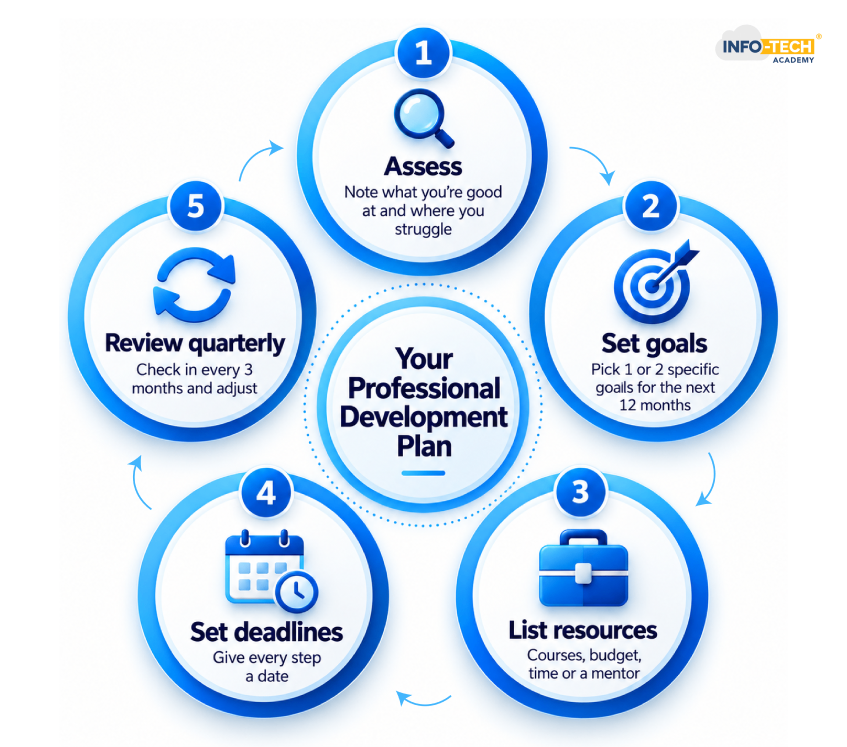
Keep it short. A one-page plan you actually look at beats a detailed one you forget.
- Write down what you’re good at and where you struggle. Your manager’s view helps here.
- Pick one or two goals for the next 12 months. Be specific: “build a sales dashboard by March” works better than “get better at data”.
- List what you need, whether that’s a course, budget, time off or a mentor.
- Give each step a deadline.
- Check in every quarter and adjust.
A simple version might look like this:
| Goal | Steps | How you’ll know |
| Team lead role in 18 months | Lead one project, take a conflict resolution course, mentor a junior | Promotion talk at mid-year review |
| Monthly sales dashboard in 3 months | Do a Power BI course, rebuild one existing report | Manager signs off on it |
| Halve weekly reporting time in 2 months | Learn generative AI tools, save prompts for routine reports | Hours saved each week |
How Can You Fund Professional Development Courses in Singapore?
Most Singaporeans can get a good chunk of their course fees covered.
| Option | Who qualifies | What you get |
| SkillsFuture Credit | Singaporeans aged 25 and above | S$500 for eligible courses |
| SWDA Level-Up Programme | Singaporeans aged 40 and above | An extra S$4,000 SkillsFuture Credit (Mid-Career) for selected courses |
| SWDA course fee subsidies | Singapore Citizens and PRs | Up to 70% off SWDA-supported courses, or up to 90% for Singaporeans aged 40 and above |
| Employer sponsorship | Employees | Full or partial fees, sometimes with training on company time |
Amounts and rules change, so check and confirm the course is eligible before you sign up.
Asking your boss to pay instead? Go in knowing the cost, the time you’ll need, who’ll cover your work, and one clear way the team benefits.
How Do You Choose the Right Professional Development Course in Singapore?
Ask yourself a few questions before you pay:
- Is it pitched at my level?
- Can I fit it around work? One- or two-day formats are the easiest for most people.
- Will I practise with real tools, or mostly watch slides?
- Has the trainer actually worked in the field?
- Can I use SkillsFuture Credit or subsidies for it?
Professional Development FAQs
What is a professional development plan?
A professional development plan is a simple roadmap for your career. It shows where you are now, where you want to be, and what you’ll do to close the gap, whether that’s a course, a new project or finding a mentor.
What is continuing professional development?
CPD is structured, ongoing learning that professionals complete to stay qualified in their field. In Singapore, professions like law, medicine and accounting require members to earn a set number of CPD hours or points each year to keep their licence or membership.
What is professional development for teachers?
It’s the ongoing training teachers do to sharpen their teaching and prepare for bigger roles. In Singapore, MOE backs this with training courses, sponsorships, work attachments at outside organisations, and leadership programmes for teachers moving into school management.
How does professional development support staff retention?
It gives employees a reason to grow with you instead of leaving to grow elsewhere. Staff who build new skills can step into bigger roles internally, and they tend to feel more engaged at work. It works best when training leads to real opportunities, like new responsibilities or a promotion.

Transforming thoughts and concepts into clear, compelling words is a powerful tool that connects people. While writing boosts my creativity, reading broadens my perspective and sharpens my understanding of language and narration.