


In this article
Setting a goal is important for everyone in their professional life. The goals can range from learning a communication skill, developing leadership among the team, switching to a better career or completing a digital skills course. Having a goal can help individuals and organisations work with focus and measure how far they have come to attain the goal they set. This is where SMART goals become important and useful.
For working professionals in Singapore, SMART goals provide them a structured approach to improve workplace performance and develop in their career.
What are SMART Goals?
SMART goals are specific, measurable, achievable, relevant and time-bound objectives that help the individual and organisations to have a clear plan about what they are working for and when the plan must be accomplished completely.
The SMART framework turns out the plan to become more realistic and practical by defining how the goal is going to be attained, how the progress will be measured and setting a deadline to accomplish the goal. The goals set using this framework will have details about what the goal is and how much of the task will be competed at a particular time. This helps you measure the progress easily.
What Does SMART Stand For?
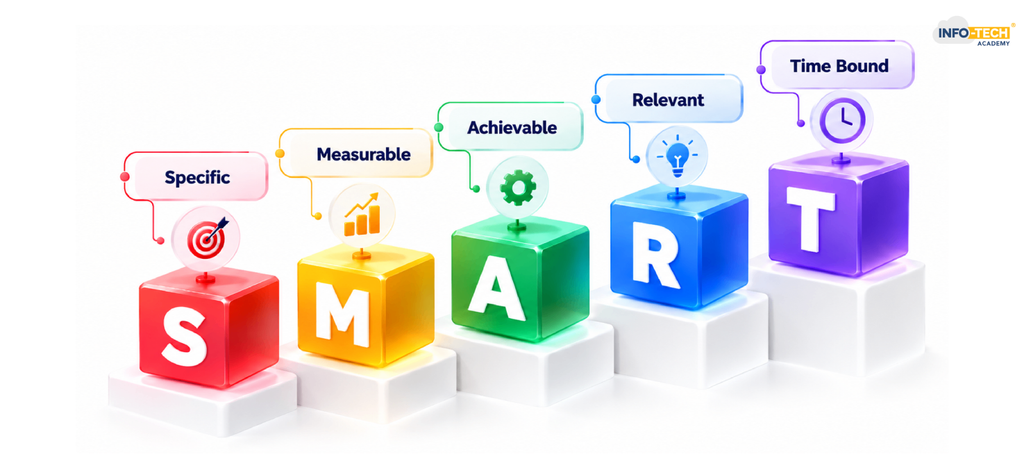
SMART is an acronym that defines five important aspects of setting a clear goal.
Specific:
A goal should clearly define what you are working for. Instead of having a general objective, be specific about what is the expected outcome of the goal.
Measurable:
A goal should have methods by which the progresses are going to be measured. This will help us to identify if the goal is attained or not.
Achievable:
The targets that you set must be realistically achievable. This can be checked by considering elements like the available resources, time availability and existing skills.
Relevant:
Make sure that the goal you set aligns with yourcareer interests, current job responsibilities or future growth opportunities. Your goal should have relevance with your interests.
Time Bound:
The goals you set must have a deadline to complete. Prioritizing the deadline will help the employees to stay focused towards the work and they must be accountable for any work that remains incomplete within the mentioned timeframe.
Why are SMART Goals Important in the Workplace?
SMART goals help employees and organisation work towards a clear and defined goals. Everyone who is a part of the goal will know what the project is about and what should be their contribution to attain the expected outcome. The SMART goals provide direction, improve accountability and makes the evaluation process easier.
The confusion among the employees can be reduced as the objectives will be clearly communicated. This helps you to identify activities that contribute the attaining the goal, so that more time can be spent on that make the goal more easily attainable.
If the goals are clear to the employees and they are given a realistic deadline to complete the tasks. They will start completing the tasks on priority basis and avoid wasting time on any unnecessary activities. The employees may not be equipped with all the required skills to complete the task. This SMART goal gives a structured approach for the employees to understand what the skills are they need to develop to accomplish the goal. They can create a structured learning plan to learn skills like communication, leadership, data analysis and digital skills.
When the team members are clear about the goal and know their responsibilities, they can coordinate tasks effectively and work towards the common goal.
What are Some Examples of SMART Goals for Employees and Professionals?
Smart goals can be used across different roles, departments and industries. Here are some practical examples that the employees and the professionals can adapt for their workplace responsibilities.
SMART Goals for Time Management:
Reduce the incompletion of works everyday by setting a realistic task schedule by giving first hand to the priority tasks and complete at least 95% of the priority tasks daily for a month.
SMART Goals for Communication Skills:
Improve workplace communication skills by participating in at least two team discussion activities every month and attending one workshop on communication skill within a month.
SMART Goals for Leadership Development:
Develop the leadership skills by conducting two team discussion activities, managing one small project, conducting weekly progress meeting and completing the priority tasks on daily basis for the next three months.
Read Also: What Top Leadership Skills Managers Need in Singapore?
How to Set SMART Goals at Work?
The main idea behind SMART goal is to identify what you want to achieve and creating a structured way to attain that purpose.
Step 1: The first step in setting a SMART goal is to identify what is the target that has to be achieved and create a structural way to attain that result within a stipulated timeframe.
Step 2: Be very specific about the goal that you set. You should be able to clearly explain what your goal is all about.
Step 3: Measuring the progress in goal is one important aspect of attaining the goal. Ensure that you have approaches by which the progress is going to be measured. It can be measured using completed tasks, accuracy and time saved.
Step 4: Make sure your goal is practically achievable. It can be determined if the goal is achievable by considering the existing knowledge, available resources and timeline.
Step 5: The goal you set should have relevance with your current job responsibilities or future career interests.
Step 6: Identify the level of complication in completing the task and set a realistic deadline. This helps you stay consistent and accountable in finishing the tasks regularly.
SMART Goals – FAQs
What are the five elements of SMART goals?
The five elements of SMART goals are specific, measurable, achievable, relevant and time bound. These elements help to set clear targets, track progress and achieve goals effectively.
What are some SMART goals for employees?
Common SMART goals for employees include improving communication skills, increasing productivity, learning leadership skills and completing a professional course.
What is the difference between SMART goals and KPIs?
SMART goals define specific objectives that must be attained within a particular timeframe, while key performance indicators are measurable values used to evaluate performance against business objectives.
How SMART goals can improve employee performance?
SMART goals improve employee performance by providing clear expectations, measurable targets and deadlines. This can help them stay focused in work and identify the areas of improvement.

Transforming thoughts and concepts into clear, compelling words is a powerful tool that connects people. While writing boosts my creativity, reading broadens my perspective and sharpens my understanding of language and narration.