


In this article
- 1. What Is the National Institute of Technical Education Certificate?
- 2. Is NITEC Only Meant for Certain Students?
- 3. What Can You Actually Study?
- 4. What Is Learning at ITE Actually Like?
- 5. Can NITEC Lead to Higher Qualifications?
- 6. What Kind of Jobs Do NITEC Graduates Take On?
- 7. Why Doesn’t Learning Stop After Graduation?
- 8. Is NITEC the Right Choice?
- 9. NITEC certification FAQs
Introduction To NITEC Certificate:
There comes a point in every student’s life when one question seems to follow them everywhere.
“So, what’s your plan after secondary school?”
Some people answer without hesitation. They’ve had their sights set on a polytechnic course or junior college for years. Others need a little more time. They know what they enjoy, but they’re still figuring out how to turn that interest into a career.
That’s often when the National Institute of Technical Education Certificate (NITEC) enters the conversation.
Mention NITEC Certificate, and chances are everyone has an opinion. Some people see it as a practical route into the workforce. Others assume it’s only for students who aren’t academically inclined. Both views miss the bigger picture.
Over the years, ITE has quietly built a reputation for producing graduates who know how to do the job, not just talk about it. Many employers appreciate that, and plenty of NITEC graduates don’t stop there either. They continue to Higher NITEC, polytechnic, and beyond.
So, what exactly is NITEC, and why do so many students choose this pathway?
What Is the National Institute of Technical Education Certificate?
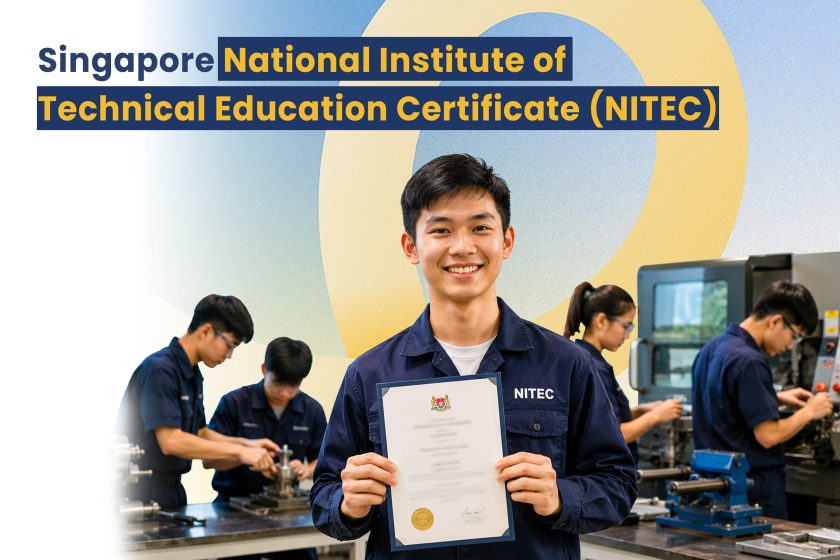
The National Institute of Technical Education Certificate, better known as NITEC Certificate, is awarded by Singapore’s Institute of Technical Education (ITE).
Unlike programmes that lean heavily on textbooks and written examinations, NITEC puts a strong emphasis on learning by doing. Students still attend classes and study the theory behind their subjects, but much of their time is spent applying what they’ve learnt.
Depending on the course, that could mean assembling engineering components, troubleshooting computer networks, preparing financial records with accounting software, serving customers in a training restaurant, or practising healthcare procedures in simulated clinical settings.
The goal isn’t simply to help students pass an examination. It’s to help them become confident enough to step into a workplace and contribute from day one.
Is NITEC Only Meant for Certain Students?
Not really.
One of the longest-running myths about NITEC is that it’s a pathway with limited options. That idea has lingered for years, even though it doesn’t reflect what actually happens.
Some students choose ITE because they prefer practical learning. Others discover that they learn better when they can see, build, test and practise instead of spending hours memorising information from a textbook.
There’s nothing unusual about that. People simply learn differently.
ITE also attracts adult learners who want to pick up new skills or move into another industry. Walk around an ITE campus and you’ll find students from different backgrounds, all working towards different goals.
What Can You Actually Study?
A lot more than people expect.
Technology is an obvious choice for many students, especially with industries looking for people who understand networking, cybersecurity, software applications and digital systems.
Engineering continues to attract students interested in designing, repairing and maintaining equipment across manufacturing, aerospace and electronics.
Then there are programmes in business, accounting, logistics, hospitality, culinary arts, healthcare, design, media and several other fields.
The variety often surprises people. ITE isn’t built around one type of career. It’s built around industries that need skilled people.
That also explains why the courses change over time. As industries evolve, programmes are reviewed to make sure students are learning skills that employers still value.
What Is Learning at ITE Actually Like?
Ask someone who has studied at ITE, and they’ll probably talk about the practical sessions before they mention the lectures.
A lesson doesn’t always begin with pages of notes. Sometimes it starts with a machine that needs repairing. Other times it’s a customer scenario. Sometimes it’s a project that has to be completed as a team.
An accounting student may spend an afternoon learning accounting software instead of filling pages with manual calculations. Hospitality students practise interacting with guests rather than only reading customer service theories. Engineering students work with equipment they’ll likely encounter again after graduation.
There’s still plenty to learn in the classroom, of course. But the practical side of the programme helps bring those lessons to life.
For many students, that’s what makes the difference.
Can NITEC Lead to Higher Qualifications?
It certainly can.
People sometimes assume that receiving a NITEC certificate means the education journey is over. In practice, that’s often not the case.
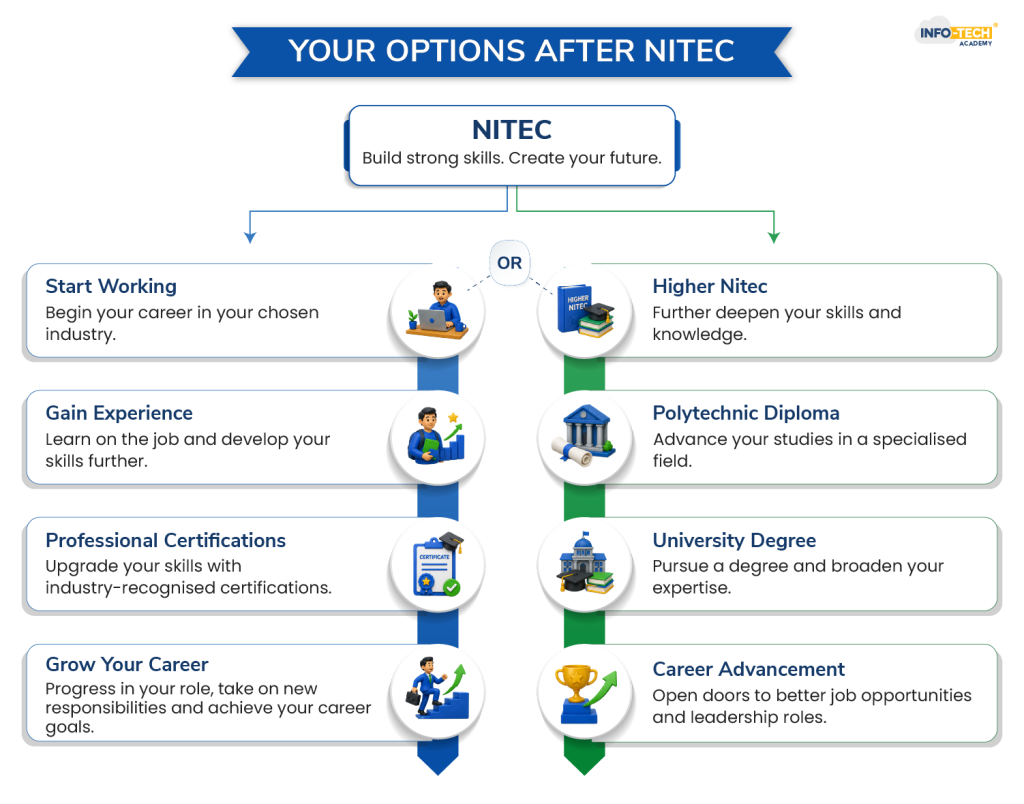
Many graduates continue to Higher NITEC. From there, some progress to polytechnic diploma programmes, while others continue upgrading themselves later through professional certifications or part-time study.
Singapore has spent years encouraging lifelong learning, so moving between work and education has become quite normal.
A person’s first qualification rarely ends up being their last.
What Kind of Jobs Do NITEC Graduates Take On?
That depends entirely on the course they’ve completed.
Someone from an IT programme might begin as a technical support specialist. An accounting graduate could join a finance team as an accounts assistant. Engineering graduates often work as technicians before moving into supervisory or specialist positions with experience.
Healthcare graduates support hospitals, clinics and community care services. Hospitality graduates find opportunities in hotels, restaurants, tourism and events.
Nobody expects an entry-level role to be the peak of a career.
Most people grow through experience, additional training and new responsibilities over time. That’s true whether they started with NITEC, polytechnic or university.
Why Doesn’t Learning Stop After Graduation?
Because workplaces don’t stand still.
The software businesses relied on five years ago may already have changed. Artificial intelligence is becoming part of everyday work. Digital tools continue to reshape accounting, HR, customer service, logistics and administration.
That’s why many working professionals return to the classroom long after they’ve started their careers.
Some take short courses in AI. Others improve their Excel skills, learn Power BI, study payroll administration or complete HR certifications.
It’s no longer unusual to keep upgrading your skills throughout your career. In fact, many employers now expect it.
Is NITEC the Right Choice?
There’s no universal answer because every student has different strengths.
Some people thrive in lecture halls. Others understand concepts much faster once they start applying them. Neither approach is better than the other.
What NITEC Certificate offers is a different way of learning—one that places equal importance on knowledge, practical ability and workplace readiness.
For many Singaporeans, that’s exactly what they need.
The certificate itself isn’t the destination. It’s simply one milestone along the way. Whether someone enters the workforce, progresses to Higher NITEC, continues to polytechnic or keeps studying later in life, the opportunities don’t end with that first qualification.
If anything, that’s one of the biggest lessons behind NITEC. Careers aren’t built overnight, and neither is learning. Both happen one step at a time.
NITEC certification FAQs
Is a NITEC qualification recognised in Singapore?
Yes. NITEC is a nationally recognised qualification awarded by the Institute of Technical Education (ITE) and is accepted by employers and education institutions across Singapore.
Can I continue studying after completing NITEC?
Yes. Many graduates progress to Higher NITEC and, depending on their results, may continue to selected polytechnic diploma programmes or other continuing education pathways.
How long does a NITEC programme usually take?
Most full-time NITEC programmes take around two years, although the duration varies depending on the course and entry route.
Does NITEC focus mainly on practical learning?
Yes. Practical training is one of the defining features of NITEC programmes. Students learn through workshops, projects, simulations, laboratory sessions and, for many courses, industry attachments.

I’ve always been drawn to the power of writing! As a content writer, I love the challenge of finding the right words to capture the essence of HR, payroll, and accounting software. I enjoy breaking down complex concepts, making technical information easy to understand, and helping businesses see the real impact of the right tools.