


In this article
- 1. Is Workplace Literacy Is Just About Communication?
- 2. Why Singapore Employers Care About It More Now?
- 3. Has Workplace Has Become More Digital?
- 4. Is AI Is Changing Workplace Expectations?
- 5. What Is WPLN Singapore?
- 6. Can Workplace Literacy Actually Be Improved?
- 7. Why Practical Workplace Courses Matter?
- 8. Final Thoughts
- 9. Workplace Literacy FAQs
A lot of people only hear the phrase “workplace literacy (WPL)” after they start working.
Usually, it happens during one of those uncomfortable moments nobody really prepares you for.
Maybe it’s the first time your manager asks you to “send a quick update email” and you spend 20 minutes wondering how formal it should sound. Or maybe you join a meeting and suddenly realise everyone is discussing timelines, systems, spreadsheets, and client expectations at the same time — and somehow, you’re expected to keep up.
That’s when many people realise something important.
Working life is not just about qualifications.
It’s about how well you function around people, information, technology, pressure, and constant change.
That’s essentially what workplace literacy is.
And in Singapore, it’s becoming one of the most talked-about employability issues — even if employers don’t always use the exact phrase out loud.
Is Workplace Literacy (WPL) Is Just About Communication?
This is probably the biggest misunderstanding people have.
When someone hears “literacy,” they immediately think about language. Reading. Writing. Grammar.
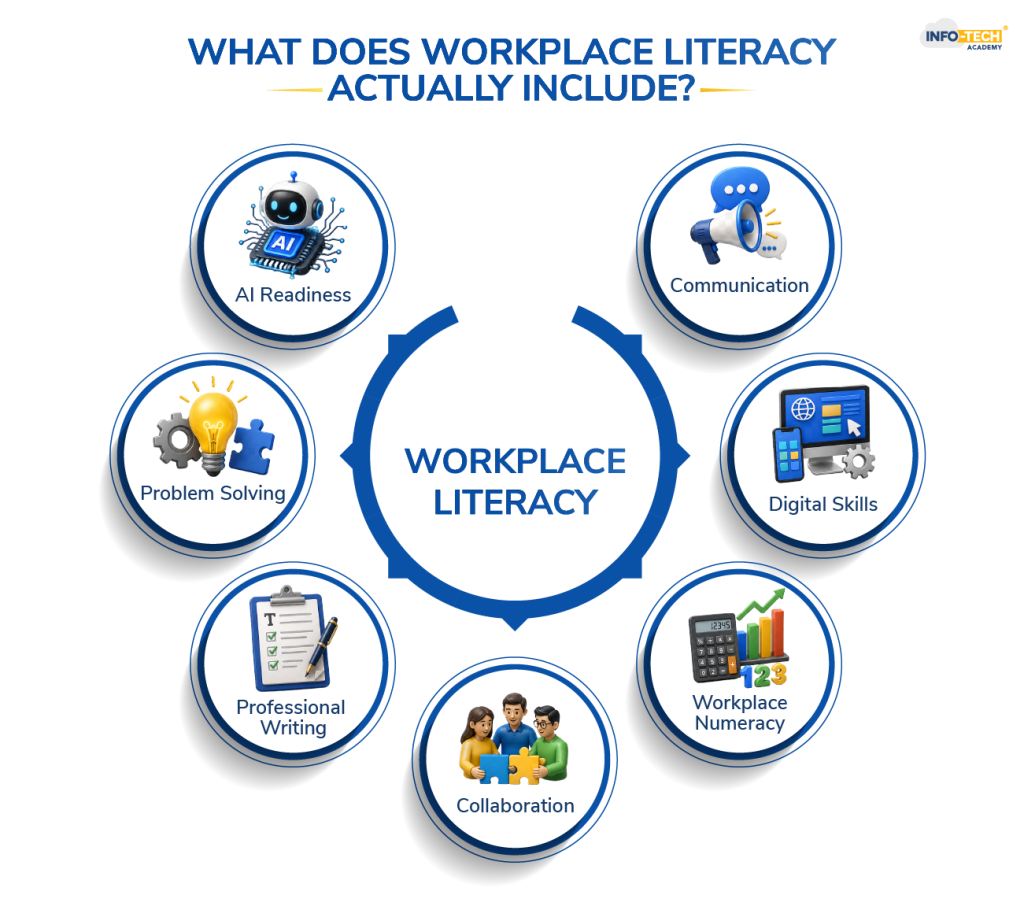
But workplace literacy today goes far beyond that.
It’s really about whether someone can operate confidently and effectively in a modern work environment.
Can you understand instructions properly?
Are you able to communicate clearly without confusing people?
Will you organise information in a way that makes sense?
Are you able to use workplace systems without panicking every time software changes?
Can you ask questions professionally instead of staying silent and hoping things somehow work out?
That’s workplace literacy.
And honestly, most people don’t realise how much of it affects everyday work until they start working themselves.
A junior admin executive updating reports. A retail supervisor handling customer complaints. A polytechnic graduate trying to manage multiple digital systems during an internship. These situations may look completely different on the surface, but they all rely on the same core workplace skills: communication, comprehension, adaptability, and digital confidence.
Also Read: Why Communication Training Is Essential for Career Growth
Why Singapore Employers Care About It More Now?
Singapore’s workplaces have changed a lot over the last few years.
Even basic jobs feel more digital than before.
There are online systems everywhere now — HR portals, scheduling platforms, cloud documents, AI tools, workplace chat systems, virtual meetings. Communication moves quickly, and people are expected to adapt almost immediately.
That shift has quietly changed employer expectations.
In the past, companies might have been more patient about teaching workplace systems slowly over time. Today, many employers expect new hires to already be reasonably comfortable with workplace communication and digital tools from the beginning.
This is one reason some fresh graduates struggle during their first few months at work.
It’s not necessarily because they lack intelligence or qualifications. Sometimes they simply haven’t had enough exposure to real workplace environments before entering them.
School and work operate very differently.
In school, instructions are usually clear. Deadlines are fixed. Questions often have correct answers.
At work, things can be vague.
A manager says, “Can you help settle this first?” without explaining every detail. A client changes expectations halfway through a project. A colleague sends a short Teams message that somehow sounds urgent even though it only contains six words.
Learning how to function in these environments is part of workplace literacy too.
Has Workplace Has Become More Digital?
This is the strange contradiction happening right now.
Technology is becoming more dominant in workplaces, but human skills are becoming more valuable too.
Most office communication now happens digitally. People spend entire workdays switching between emails, spreadsheets, Zoom calls, internal messaging apps, shared documents, and project systems.
But because communication happens so quickly, clarity matters even more than before.
A badly written email can delay work.
A confusing message can create unnecessary mistakes.
Someone who cannot explain problems properly may slow down an entire team.
That’s why workplace communication skills matter so much now.
Interestingly, being “good with technology” socially does not always help professionally.
A lot of younger workers are extremely confident online but still feel nervous using workplace software or communicating in formal settings. Writing an Instagram caption and writing a professional follow-up email require completely different instincts.
Singapore employers are noticing this gap more often now.
Is AI Is Changing Workplace Expectations?
A few years ago, AI sounded like something only tech companies cared about.
Now, even regular office workers are being introduced to AI-powered tools.
Some employees use AI to summarise documents. Others use it to organise information, prepare drafts, generate ideas, or speed up administrative work.
But here’s something interesting.
AI hasn’t reduced the importance of workplace literacy (WPL).
If anything, it has made it more important.
Because now employees need another layer of judgment. They need to know when AI-generated information makes sense, when it sounds inaccurate, and how to communicate AI-assisted work responsibly.
You still need human thinking, communication skills and workplace awareness.
That’s why AI literacy is slowly becoming part of employability itself in Singapore.
Not in a dramatic “robots are taking over” way.
More in a practical “employees need to know how to work alongside technology” way.
What Is WPLN Singapore?
In Singapore, there’s also something called Workplace Literacy and Numeracy, commonly referred to as WPLN.
The framework focuses on foundational workplace capabilities like reading, writing, speaking, listening, comprehension, and numeracy.
But the important thing is this: WPLN is designed around workplace application, not academic perfection.
That distinction matters.
Someone may perform reasonably well in school but still struggle with practical communication at work. Another person may not be academically exceptional but may function extremely well in real workplace situations because they communicate clearly, learn quickly, and adapt easily.
Workplace literacy and numeracy are really about whether someone can handle practical work situations confidently and accurately.
Can Workplace Literacy Actually Be Improved?
Definitely.
In fact, most workplace literacy skills improve through exposure and practice rather than memorisation.
People become better communicators by communicating more. They become more digitally confident by actually using workplace tools regularly. They become more adaptable through real workplace experience.
This is why practical courses are becoming increasingly popular among students, fresh graduates, and mid-career workers in Singapore.
Not because people suddenly enjoy taking courses.
But because many realise there’s a gap between academic learning and actual workplace readiness.
Practical training helps close that gap.
Why Practical Workplace Courses Matter?
One thing learners often underestimate is how much confidence comes from familiarity.
The first time someone uses spreadsheets, workplace collaboration tools, AI systems, or professional communication formats, everything feels awkward.
But repeated exposure changes that.
Courses like Office Skills Course or AI Course are useful not because they magically transform someone overnight, but because they help people become more comfortable with real workplace expectations.
That comfort eventually becomes confidence.
And confidence changes how people communicate, respond, and function at work.
For many Singapore learners, SkillsFuture-supported and WSQ courses also make upskilling feel more accessible and practical rather than intimidating.
Final Thoughts
Workplace literacy sounds like a technical phrase, but really, it’s about something very human.
It’s about whether someone feels capable functioning in modern working life.
Not just academically.
Not just technically.
But practically.
The ability to communicate clearly, adapt to technology, work with people, understand information, and continue learning may quietly become some of the most valuable skills in Singapore’s future workforce.
And the reality is, most people are still learning these things as they go.
That’s normal.
Workplace Literacy FAQs
What is workplace literacy?
Workplace literacy refers to the practical communication, comprehension, digital, and problem-solving skills people need to function effectively in a workplace environment. It includes reading, writing, speaking, workplace numeracy, and using digital tools confidently at work.
Why is workplace literacy important in Singapore?
Workplace literacy is becoming more important in Singapore because workplaces are increasingly digital, fast-paced, and collaborative. Employers now expect workers to communicate clearly, adapt quickly, and use workplace technology confidently across different industries.
What is WPLN Singapore?
WPLN Singapore stands for Workplace Literacy and Numeracy. It is a framework that supports foundational workplace skills such as reading, writing, speaking, listening, comprehension, and workplace numeracy to improve employability and workplace readiness.
How does workplace literacy affect employability?
Strong workplace literacy improves employability by helping individuals communicate professionally, understand workplace expectations, collaborate effectively, and adapt to digital work environments. These skills are highly valued by employers in Singapore.

I’ve always been drawn to the power of writing! As a content writer, I love the challenge of finding the right words to capture the essence of HR, payroll, and accounting software. I enjoy breaking down complex concepts, making technical information easy to understand, and helping businesses see the real impact of the right tools.