



In this article
You’ve probably heard the term “AI agent” thrown around a lot lately, and honestly it can get confusing because everyone seems to use it a little differently. So let’s break it down in plain terms.
An AI agent is basically a piece of software that can take a goal, figure out on its own how to get there, and actually go do it. Not just answer a question, actually do things. It plans, it pulls in information it needs, it acts, and then it checks whether it actually solved the problem. If not, it tries again or re-adjusts.
What Makes Something an “agent”?
Here’s a shocking thing, an LLM by itself isn’t an agent. It’s just a model that predicts text. What turns it into an agent is everything stacked around it, memory, the ability to call tools and APIs, some kind of planning logic, and a way to learn from what worked or didn’t.
Say you tell an agent, “find me the best week next year to go surfing in Greece.” The model itself has no clue about weather patterns for Greece specifically. So instead of making something up, a real agent goes and pulls actual weather data, maybe checks with something that knows surf conditions, and then puts it all together into an actual answer. That back-and-forth, going out, getting info, coming back, adjusting, is really the whole point of an agent.
Also read: What are Large Language Models (LLM)?
How is an AI Agent Different from a Chatbot?
This is where people get mixed up. A chatbot (the old kind) just responds to whatever you type. No memory, no planning, no going off to fetch anything. It answers and that’s it.
An AI assistant is a step up. It can help you with tasks and even suggest actions, but you’re still the one calling the shots.
An agent is a different one. It doesn’t wait around for you to tell it what to do next.
| Bot | AI Assistant | AI Agent | |
| Needs your input every step | Yes | Mostly | Not really |
| Can plan multiple steps ahead | No | A little | Yes |
| Learns and improves | Barely | Somewhat | Yes |
| Who decides the final action | Rules | You | The agent itself |
Basically, the less it needs you hovering over it, the more “agentic” it is.
Check out: What is an AI Chatbot?
How Does an AI Agent Work?
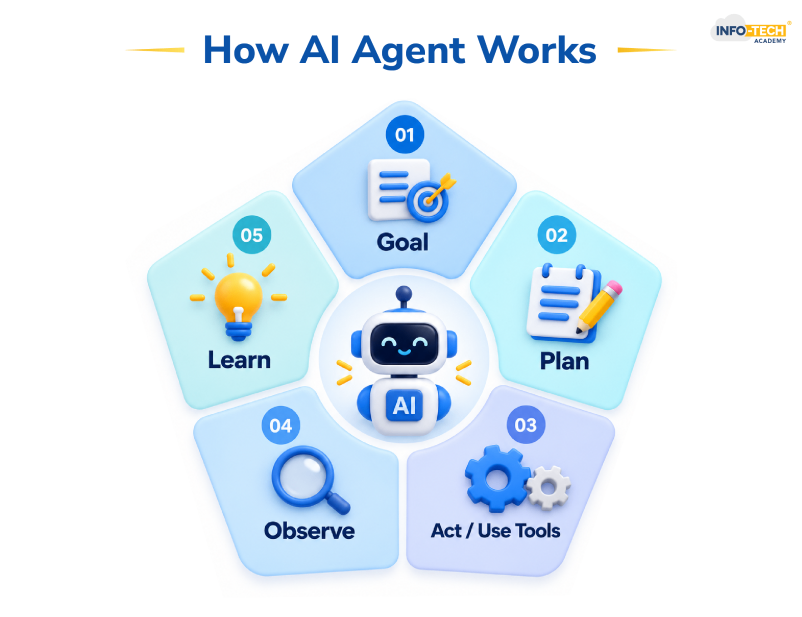
There’s no single blueprint every agent follows, but most of them do something like this:
- Someone (or something) gives it a goal
- It breaks that goal down into smaller steps instead of trying to do everything at once
- If it’s missing information, it goes and gets it, through an API, a search, a database, sometimes even another agent
- It works through the steps one at a time
- Once it’s done, it checks its own work and stores what it learned so it doesn’t repeat mistakes
There are also a couple of different “styles” for how agents plan things out. One is called ReAct, where the agent thinks, does something, looks at what happened, then thinks again, kind of like talking to yourself while solving a puzzle. The other is ReWOO, where instead of reacting step by step, it maps out the whole plan first and then executes it. The second one saves time and computing power but is a bit less flexible if things change mid-task.
Read this: How is AI different from Generative AI
What are the Different Types of Agents?
Not every agent needs to be super advanced. Sometimes a normal rule-based one is all you need, and building something fancier would just be a waste of resources.
Simple reflex agents just react. No memory, no thinking ahead. Like a thermostat that kicks on the heat at 8pm, every single day, no matter what.
Model-based reflex agents keep a rough picture of their surroundings in their head, so they can handle situations that aren’t fully visible at once. A robot vacuum bumping around furniture and remembering which rooms it already cleaned is a good example.
Goal-based agents actually plan ahead toward a specific outcome. Your GPS picking the fastest route is one of these.
Utility-based agents go a step further, weighing multiple factors, not just speed but cost, tolls, fuel, whatever matters, and picking whichever option scores best overall.
Learning agents are the ones that actually get better with time. Think of a shopping site’s recommendation engine slowly figuring out your taste the more you use it.
And then there are setups where multiple agents work together, sometimes with one “boss” agent handing off pieces of a task to smaller specialized ones. That’s usually called a multi-agent system, and it’s becoming pretty common for anything too big for one agent to handle alone.
Read also: What Is OpenAI? Everything You Need to Know
Where are People Using These Agents?
Quite a few places already, honestly:
- Customer support, where an agent handles a query end to end and only loops in a human if it’s something tricky
- Healthcare, helping with things like triage or medication scheduling
- Finance, watching markets and adjusting strategies in real time
- Coding, generating and reviewing code, or helping teams untangle old legacy systems
- Security, keeping an eye on threats and speeding up how fast a team can respond
- Everyday office work, like handling scheduling or answering internal questions so people don’t have to
- Disaster response, scanning social media to help locate people who need rescuing
Why to Use AI Agents?
- They take repetitive or multi-step work off people’s plates
- Decisions get made faster because the agent isn’t waiting on someone to approve every little step
- They get more personalized over time since they remember what happened before
- They can cut costs by reducing manual work and mistakes
- You can run a bunch of them in parallel instead of scaling up human effort
Check out: What Is Gen AI and How Does It Work?
What Could go Wrong?
Not everything about agents is smooth sailing. A few real concerns are:
- They often need access to sensitive data, which is a privacy risk if not handled carefully
- A poorly built agent can get stuck looping the same action over and over without realizing it’s not working
- If multiple agents share the same underlying model, one flaw can end up breaking the whole system
- They can be expensive to build and run, especially at scale
- Some things just shouldn’t be left to an agent alone, therapy, legal judgments, surgery, anything requiring real human judgment or empathy
That’s why most companies actually deploying these things build in guardrails, logging what the agent did, requiring a human to approve big decisions, and having a way to just stop the thing if it starts going off the rails.
Bottom Line
An AI agent isn’t just a smarter chatbot. It’s software that can actually go do things on its own, plan, fetch what it needs, act, and learn from the outcome, without someone micromanaging every step. It’s not perfect and it’s not meant for every situation, but for a lot of repetitive, multi-step work, it’s becoming a genuinely useful tool rather than just a buzzword.
To learn to use them effectively, you can take up courses from academies and Info-Tech is one of Singapore’s trusted WSQ course provider that offer various courses to develop your AI skills. Use your SkillsFuture credit and register to our courses such as AI course, AI course for beginners, ChatGPT course, smart prompting course, and much more.
Get AI-ready!
Register TodayAI Agent FAQs
What exactly does an AI agent do?
An AI agent takes a goal and actually goes and accomplishes it, not just talks about it.
Is ChatGPT an AI agent?
No, ChatGPT does not actually count as an AI agent, but an AI assistant, as it only reacts to you, not perform tasks for you.
How do AI agents make money?
Mostly through subscriptions and pay-per-use API access, with some newer models charging per completed task instead.
What are the 5 types of AI agents?
The five types of AI agents ranked from most basic to most advanced are simple reflex, model-based reflex, goal-based, utility-based, and learning agents.

Transforming thoughts and concepts into clear, compelling words is a powerful tool that connects people. While writing boosts my creativity, reading broadens my perspective and sharpens my understanding of language and narration.